A game within a game
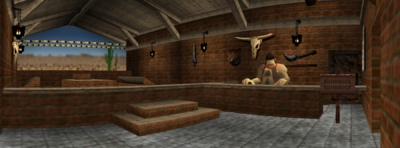
Because the very important quest thrust upon Link by the guardian spirit known as the Great Deku Tree can wait while our young hero partakes in some frivolous fun throughout Hyrule—this might be also how he finances the campaign—which is a tried and true tradition dating back to the original The Legend of Zelda in which these games were all about luck (skill based mini-games began in A Link to the Past). In the 3D Hyrule we get an assortment of carnival games and challenges that will test all kinds of skills, from shooting to diving to capturing chickens. They serve as a temporary gameplay change of pace and in the past they could have been video games on their own but here they are immersed within another story as optional side jobs—okay, maybe the Zora one is mandatory. They are a staple of RPG inspired games.
Once again, like in the shop theme, historicity does not matter as the pretensions of an European medieval village go away in favor of modern carnival and fair sensibilities. Gameplay considerations and communicating immediately to the player the environment they are in are the priority. Curiously, the shopkeepers have their games tailored to the weapons carried by the Hero of Time.
Here we have the shooting gallery mini-game cue which is for general mini-games, and the timed mini-game cue as representatives of the types of gameplay expected, each tailored to follow the environment and, in the case of the timed mini-games, the action and the passing of time; one is a location cue with likely diegetic music the other is a momentary cue whose music only exists for the player.
Other frivolous activities like fishing reuse tracks that fit such as the pleasant Kakariko Village for walking around the lake and, funnily, the battle cue whenever you capture and are struggling with a fish.
Musical Analysis: Shooting Gallery
Structure: Section 0 / Section 1 / Section 2
Time Signature: 4/4
Tempo: 200
Melodic and Harmonic Profiles: C Ionian/Major
Why would our modern carnival music play in the middle of a renassaince fair? Who cares, it’s more important to let players know that they can win prizes here and have fun. Carnival, circus, clowns, all used to travel together as entertainers, and circus music is unmistakable. The oom-pah rhythms and the characteristic timbre of the mechanical calliope or carousel organs. You can hear here the calliope in action:
Who thought about using this instrument for carnivals? As with many things, functional considerations supersede conceptual reasons. The calliope needs steam to properly work and carnival calliopes were usually installed in steam-drive carousels; they were also sufficiently loud to be heard above the sound of the attractions and the visitors.
With the calliope there is no way to vary tone or loudness. Musically, the only expression possible are pitch, rhythm, and duration of the notes. Kondo, not having access to the calliope in his sample libraries, does exactly that; using the more traditional instruments in a way that feels completely mechanical; all the instruments on this cue play each note at the same volume—same velocity in MIDI terms— and without any fancy articulations, creating that mechanized feel.
Section 0 is just a fade in, implying the music has been playing continuously and is diegetic, meaning that as Link gets close to the counter he hears the music more clearly. For Section 1 the piece only uses the I to V in the harmony, C and G. Section 2s usually go to the fourth chord so here it goes to F. This Section could also be called the winning prize section since it has that classic snare roll for suspense and the cymbal crash that plays when the winner is announced; since the shooting gallery is western themed there is a resemblance to the classic American track Oh! Susanna. The remaining chords are once again C and G. The melody is simple and plays a repetitive phrase transported to fit each underlying chord and then a coda. It truly makes you feel as if you are in a fairground and no matter where you find them, all shops of this kind are connected via music, letting you know what you got into right the moment when you opened the door.
Musical Analysis: Timed Mini-Game
Structure: Section 0 / Section 1 / Section 2
Time Signature: 4/4
Tempo: 185
Melodic and Harmonic Profiles: C Ionian/Major, C Chromatic (Section 0); C Mixolydian (Section 1); Eb Ionian/Major; Eb Mixolydian, C Ionian/Major (Section 2)
This one does have an intro that lets you know the game has started and time is running out. This is a track singled out by Koji Kondo himself as one of his favorites, the other being the funny trespassing the castle guards theme—instead of the epic or beautiful tracks, he seems to enjoy the most the ones that capture the action in the game and are plain fun. He even plays this live from time to time:
The piece was probably originally composed for the Cucco challenge inside Lon Lon Ranch because it tries to mimic the sounds of the chickens; It became the standard tune for timed mini games in the series, heard in other games rearranged.
There is a circense element to the cue as well—like a tightrope walker mid performance— but the catch this time is that Kondo does not try to emulate the calliope like on the Mini-Game Shop theme; here he uses the standard orchestral instruments, giving the piece a layer of quirkiness; it closely resembles that gallop dance style, where the key is having fast tempos:
Harmonically, the piece is more adventurous than the standard mini-game location, using a Mixolydian profile that is noticed right away by the change of the tonic C going to Bb. As time progresses the piece is transposed to higher chords and abruptly comes back to the original profile by returning to the dominant G. The progression would be:
Section 0
G
Section 1
C – Bb – G – Bb – G
Section 2
Eb – F – Ab – Bb
Ab – Bb – Db – Eb –
G
All major chords. Higher pitched instruments are added to the repetition pf phrases to create that sense of urgency.
The glockenspiel fulfills the role of a sound effect, sounding in a similar way to when Link grabs rupees, the currency of Hyrule.
The music manages to sound pressing but also light hearted thanks to the quirky harmony and soft instrumentation. It is after all not a matter of life or death wether you fail here, just pure fun. In contrast, our next cue is as serious as you can get.

Help to keep the rites going around here by supporting the shrine:

Media Files, requests and support for more interactive content

Thou shall donate since this is a cult and you are now a sheep

Help staying awake analyzing game tracks and writing posts or else everything will end up being written by A.I
- Inside The Score – The Legend of Zeda: A Link to the Past – End Credits / Staff Roll
 The land rests As the last few minutes of this extensive journey that has now come to an end fly by, the nostalgia and reflective mood kicks in. Because such a massive enterprise as a Zelda game or a Lord of the Rings movie require multiple endings to convey everything… Read More »Inside The Score – The Legend of Zeda: A Link to the Past – End Credits / Staff Roll
 - Inside The Score – The Legend of Zelda: A Link to the Past – Ending / Epilogue ~ Beautiful HyruleFinal of the fantasy The Triforce has been touched. A wish has been granted. For the occasion, the newly undeceased king of Hyrule has commissioned a march in honor of the legendary hero to the Hylian Sousa, who might as well be composer Nobuo Uematsu since this piece is very… Read More »Inside The Score – The Legend of Zelda: A Link to the Past – Ending / Epilogue ~ Beautiful Hyrule
- Inside The Score – The Legend of Zelda: A Link to the Past – Triforce Chamber / Power of the GodsTake your boots off your feet And thus the Triforce spoke to men. And it became present in history. And you better treasure and contemplate this moment seldom witnessed in the course of the series. The elusive opportunity to interact and touch the most important artifact. You are now in… Read More »Inside The Score – The Legend of Zelda: A Link to the Past – Triforce Chamber / Power of the Gods
- Inside The Score – The Legend of Zelda: A Link to the Past – Ganon Battle / Prince of DarknessProgressive evil En Garde! And you better be prepared since you are about to duel the iconic enemy of the series at perhaps his canonically most powerful incarnation. Right after having touched the sacred Triforce which allowed him to conquer all of the Golden Land and whose evil and darkness… Read More »Inside The Score – The Legend of Zelda: A Link to the Past – Ganon Battle / Prince of Darkness
- Inside The Score – The Legend of Zelda: A Link to the Past – Boss Battle / Anger of the GuardiansQuick mayhem Ah, the simpler times when boss battles where not a multi epic orchestral suite but just an ostinato more basic that even what became the music for standard battle encounters out there. We are a long way from each boss having his own personalized track. And this early… Read More »Inside The Score – The Legend of Zelda: A Link to the Past – Boss Battle / Anger of the Guardians
- Inside The Score – The Legend of Zelda: A Link to the Past – Dark World Dungeon / Dungeon of ShadowsMemento mori We are getting closer to Ganondorf (or at least the wizard Agahnim who ultimately fulfills the same human side of evil role in this game) and that means getting closer to the profiles and motifs of his own theme song (which naturally was the theme of Agahnim at… Read More »Inside The Score – The Legend of Zelda: A Link to the Past – Dark World Dungeon / Dungeon of Shadows