There ain’t no tunes inside the mountain
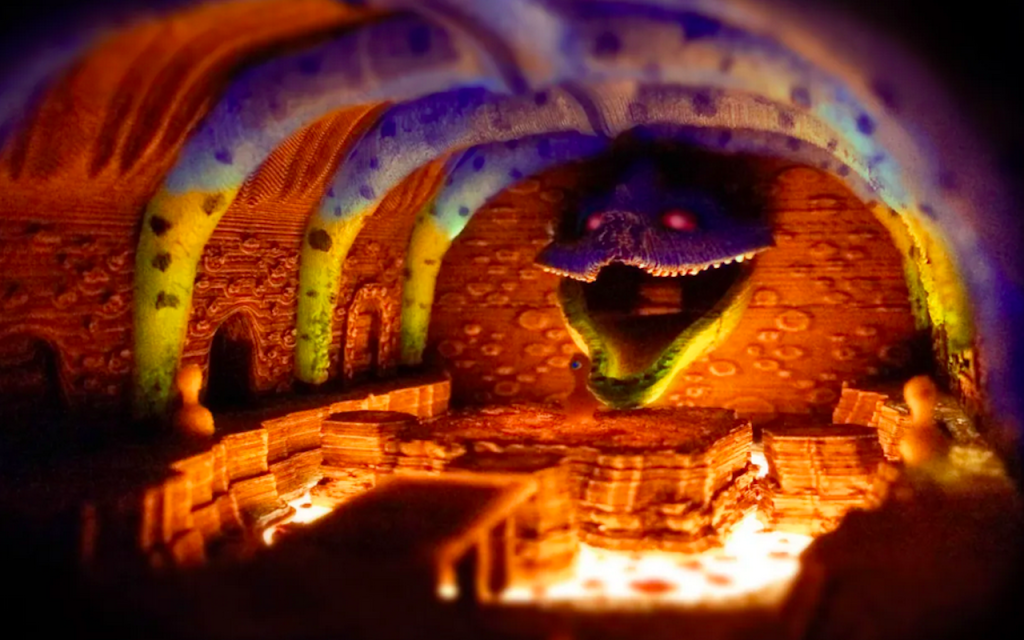
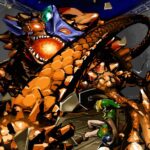
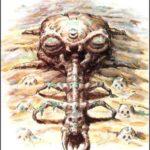
The second of the organic dungeons exclusive to the child era is right inside the mountain under what amounts to what apparently was once the primordial Dodongo, perhaps the mother of the boss encountered here that the Gorons used for decorating their mines. Because as blacksmiths and rock eating folks, the Goron delved too greedily and too deep, and disturbed that from which they fled, Darunia’s Bane. The mine concept will be expanded on Twilight Princess, the spiritual successor to Ocarina of Time.
Like the other dungeons, it relies more in ambient than in melodic music but this one takes things to the absolute extreme, being practically a literal ambient as opposed to just a hip genre for chill purposes. If the Deku Tree temple uses just one sound, this one takes the different approach by creating its soundscape via various sounds, certainly nothing that would be recognized as a musical instrument—except for one maybe. Are they diegetic? Likely. That would be the intention.
This theme alongside Inside Grea Deku Tree are the only dungeon cues reused for other environments (well, the well also uses the Shadow Temple cue but it is implied that they are the same), this one being used for the Death Mountain crater and also inside tombs, so you probably already encountered it before reaching this place.
Musical Analysis
Structure: Section 0 / Section 1
Time Signature: 4/4
Tempo: 64
Melodic and Harmonic Profiles: Atonal
Is Avant-Garde the hardest style of music or is it the easiest to pull off? Is it even music? At which point does sound becomes music? Questions that academics with too much time on their hands are still pondering to this day. But seriously, where does music start? Where does one draw that difficult line between, say, the sound of ordinary ambient and a beautiful symphony? Some would argue that music is in the “ear” of the beholder or that “the universe itself is music” These romantic notions may be fundamentally right, but it’s a lazy way out that evades the question.
The truth is that It all starts (and ends) with the brain; if a brain interprets it as music, then it’s music, simple enough—although, for some reason, people even dispute this, saying that music requires musical intention from the part of a creator, so those birds don’t count even though they are arguably more musical than many modern artists; the new paradigm of A.I also makes answering this question more pressing— But when does the brain starts interpreting audio input as music? Is a waterfall music? Probably not, it will not register as music for most human brains. We intuitively know that rhythm plays a part on it—this does not mean that a constant tempo is required, though— The frontier where sounds starts to morph into music is when the brain identifies a structural frame or pattern of question and answer. This would put, say, a clock at the very center of that transition; even though the sounds produced by a clock are practically the same, the brain interprets them as tick-tock, a question and and answer, the beginning of music. The more differentiated the question is from the answer, the more interesting the composition. You can vary the rhythm or the pitches or both. Balance between repetition and novelty is the key to good music. True perfection can only be achieved by finding the perfect balance between perfection and imperfection.
There is a cool audio experiment where you hear sound becoming music in real time in front of your own ears:
With this, here we could sit and discuss neat conclusions all day long, but enough with the philosophy. Koji Kondo would surely not have any of this in mind when working on the track; he was directed to make the ambient of Dodongo’s Cavern cavernous, creepy and unsettling and that’s what he did.
What is certain is that most normal folk wouldn’t identify Dodongos’s Cavern theme as music. This means the easiest drawer to discard the cue would be the catch-all tradition known as Avant-Garde. Taken from the French for “vanguard,” In the case of music, this style consists of all those individuals who presumably take music to the next frontier of development or at least take music on a divergent path; or saying it in another way, it’s all about creating a vibe; not for singing or dancing.
Textures, ambiences, atmosphere. These are the main considerations in creating a soundscape that shows that this is a dangerous place; you have to be careful here. And the main tools inside the bag of tricks of a sound designer are mangling everyday sounds: distortion, pitch shifting, speed changing and reverb are your allies here. Make the player feel they are inside a hot place underground accompanied with mining or disturbing sounds. Like on the Great Deku Tree cue, you probably will not realize where this short piece loops since it is disguised with reverberation during the transition, so it is as if it goes on forever without rhyme or reason.
The main textures of Dodongos’s Cavern are metal and air, vapor and fumes coming from the mountain. Kondo limits himself to these sounds perhaps to create the ambient of an underground mining facility; the sounds are implied to come from deep inside the cavern. There are only five of them, played at different speeds—the panning of the sounds is changing constantly— All the sounds were manipulated by reverb and other effects to enhance their otherworldliness.
Two of the samples used come from the library ‘Zero-G Ambient Vol.1’
Metal Rattle – LORE DRONE:
Ratchet – SPAEOSPHERE:
For the Wind Roar, you would think that a recording of wind ambience was used but in reality the sound is ……also a metal clang, pitched and slowed way down—that’s the power of pitch shifting— The same technique was also used to create one of the iconic sounds from the Nintendo 64, The “submarine sonar” sound from GoldenEye 007:
if any reader has extra information about Dodongo’s Cavern sample origins, please let me know.
Samples original names:
Ratchet = Spaceosphere
Metal Rattle = Lore Done
Metal Clang = Shine
Metal Grind = Metal Grind
Wind Roar = Wind Roar
The cue low key ended up being influential on the Zelda series. used for all kinds of underground facilities and creepy locations. In Ocarina of Time it’s the most used dungeon cue, appearing again inside tombs, Death Mountain, at the Gerudo fortress and also their training grounds. It finds its spiritual successors in the form of the Ganon’s castle track and in Majora’s Mask caverns; it eventually was reused in The Wind Waker again for a dungeon that could be what survived of Death Mountain. It is an unnerving cue that brings to life a soundscape full of dangerous objects of all sizes falling around close to you and at a distance within a vast space.
Help to keep the rites going around here by supporting the shrine:

Media Files, requests and support for more interactive content

Thou shall donate since this is a cult and you are now a sheep

Help staying awake analyzing game tracks and writing posts or else everything will end up being written by A.I
- Inside The Score – The Legend of Zeda: A Link to the Past – End Credits / Staff Roll
 The land rests As the last few minutes of this extensive journey that has now come to an end fly by, the nostalgia and reflective mood kicks in. Because such a massive enterprise as a Zelda game or a Lord of the Rings movie require multiple endings to convey everything… Read More »Inside The Score – The Legend of Zeda: A Link to the Past – End Credits / Staff Roll
 - Inside The Score – The Legend of Zelda: A Link to the Past – Ending / Epilogue ~ Beautiful HyruleFinal of the fantasy The Triforce has been touched. A wish has been granted. For the occasion, the newly undeceased king of Hyrule has commissioned a march in honor of the legendary hero to the Hylian Sousa, who might as well be composer Nobuo Uematsu since this piece is very… Read More »Inside The Score – The Legend of Zelda: A Link to the Past – Ending / Epilogue ~ Beautiful Hyrule
- Inside The Score – The Legend of Zelda: A Link to the Past – Triforce Chamber / Power of the GodsTake your boots off your feet And thus the Triforce spoke to men. And it became present in history. And you better treasure and contemplate this moment seldom witnessed in the course of the series. The elusive opportunity to interact and touch the most important artifact. You are now in… Read More »Inside The Score – The Legend of Zelda: A Link to the Past – Triforce Chamber / Power of the Gods
- Inside The Score – The Legend of Zelda: A Link to the Past – Ganon Battle / Prince of DarknessProgressive evil En Garde! And you better be prepared since you are about to duel the iconic enemy of the series at perhaps his canonically most powerful incarnation. Right after having touched the sacred Triforce which allowed him to conquer all of the Golden Land and whose evil and darkness… Read More »Inside The Score – The Legend of Zelda: A Link to the Past – Ganon Battle / Prince of Darkness
- Inside The Score – The Legend of Zelda: A Link to the Past – Boss Battle / Anger of the GuardiansQuick mayhem Ah, the simpler times when boss battles where not a multi epic orchestral suite but just an ostinato more basic that even what became the music for standard battle encounters out there. We are a long way from each boss having his own personalized track. And this early… Read More »Inside The Score – The Legend of Zelda: A Link to the Past – Boss Battle / Anger of the Guardians
- Inside The Score – The Legend of Zelda: A Link to the Past – Dark World Dungeon / Dungeon of ShadowsMemento mori We are getting closer to Ganondorf (or at least the wizard Agahnim who ultimately fulfills the same human side of evil role in this game) and that means getting closer to the profiles and motifs of his own theme song (which naturally was the theme of Agahnim at… Read More »Inside The Score – The Legend of Zelda: A Link to the Past – Dark World Dungeon / Dungeon of Shadows