Welcome to Hyrule’s spa
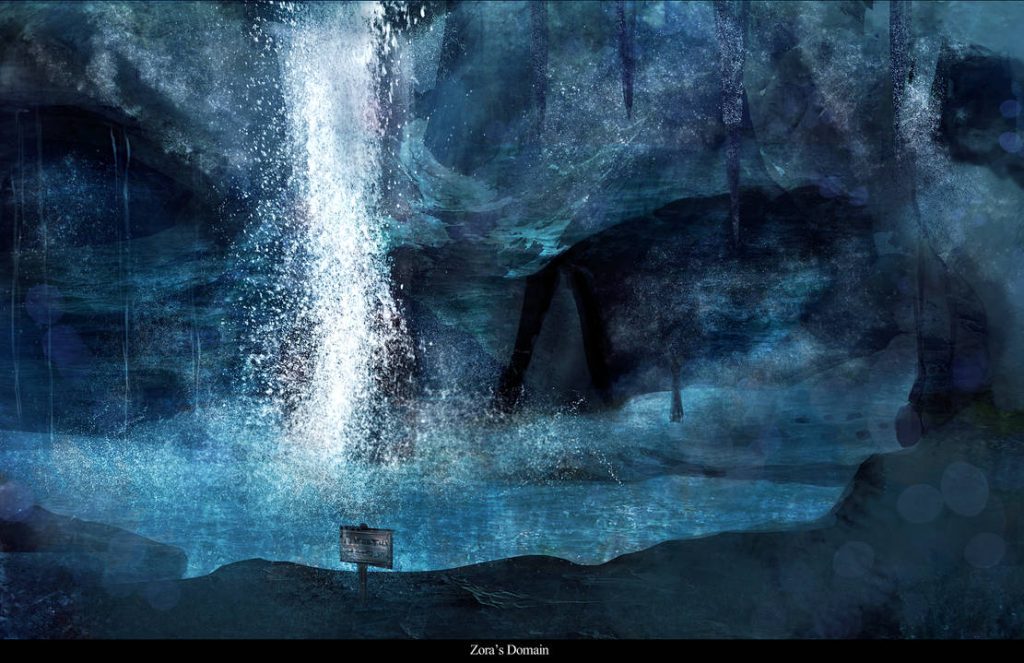
A sanctuary where the now benevolent merfolk from the Zelda series now live. We find ourselves among the water dwelling Zora race. Contrasting with the Goron in terms of culture, color palette, elemental object and body appearance, The Zora are the sophisticated fish people tasked with the protection of the water resources of the land. Appearing for the first time in the original The Legend of Zelda for the NES as monsters that the hero had to fight, the Zoras found in Ocarina of Time have received a makeover now closer to a human/hybrid appearance (they might literally be that, seeing the propensity of the Zora girls for falling for Hylian boys) and are now a fully integrated part of the culture of the game world, with their own monarchy and connections to the Hylians. Just like on A Link to the Past, which hinted at the Zora being an organized culture, their main residence is a paradisaical grotto at a waterfall; they are still river Zoras through and through unlike in other realms depicted in the series.
Zora’s Domain is located in a cave behind an impenetrable waterfall; closed to foreigners, only selected individuals are allowed to set foot inside their village. Link is one of them. They protect the flow of water throughout the kingdom so it is unsurprising that they become a target of the evil Ganondorf.
Even in Ocarina of Time we already can gather that Zoras comes in various shapes and forms, specially since royalty seems to be differentiated from the other villagers and are based on other aquatic creatures; this is amplified on later entries where all aquatic life is fair game for inspiration. Their sophistication, figures and long lifespans make them ironically the elf-like race in the series in contrast to the dwarf-like Gorons even if the whole lot of Hylians are the ones who have the elf ears. They are quite the original mermaid design that ditches the general tropes while still retaining some of the usual architecture. Time for Link to live his own Shape of Water type of adventure on the aquatic environments of Hyrule.
Although all kinds of girls flirt withe the hero as specifically requested by Miyamoto, it is only Princess Ruto who explicitly falls in love with Link, and the spiritual stone is actually his engagement ring. She is based around a hammerhead shark (even though the Zoras here are not sea creatures; but there is also a whale patron deity so everything goes with them). It seems evolutionary rules also play a rule in this universe since we are able to see the Zora at their early stages of development in the first game in the chronology.
Musical Analysis
Structure: Section 0 / Section 1 / Section 2
Time Signature: 4/4
Tempo: 160
Melodic and Harmonic Profiles: G Aeolian Dominant, G Ionian/Major (section 0); G Ionian/Major (Section 1,2)
For the peaceful nature found inside the caves, Koji Kondo decided to use a set of instruments that may be found on a spa setting or resort; relaxation is the order of the day. This is a safe haven where you can swim and marvel at what water can carve via natural processes. One of the main instruments featured is the steelpan, originating from the Caribbean islands of Trinidad And Tobago—in one of the rare cases where an instrument origin is not disputed— the steelpan, or steel drums, are brought out whenever characters are on a beach on vacation. It seems that in the mind of Kondo, they fundamentally conjure water, using them on a setting that is anything but tropical— there is a precedent though, because they are also heavily featured on the soundtrack for The Little Mermaid (1989) in an analogous mermaid kingdom. Steelpans are commonly used to play a style of music know as calypso, a style close to the heart of Koji Kondo since it forms the basis of his most famous composition, the Mario theme. For the Zora’s Domain cue there are traces of calypso rhythm influences, but the tempo is slower and the melodies are sparser; less bouncy and more laid-back. Still, the steel pans perform their characteristic tremolo effect alternating between sixths and fifths intervals. The nylon guitar is practically improvising some irregular arpeggios for the melody. It is an easy-listening track fundamentally.
The use of ethereal choirs, basically a synthesized sound instead of the standard ones, is meant to convey the siren song of the Zoras; they vocal chords must certainly sound different than ours.
It all sounds crystalline and captures the movements of water flowing non-violently. The amount of reverberation applied to al instruments befits the cavernous space of Zora’s Domain. The percussion part has patterns reminiscent of Brazilian music.
The cue opens up reminding us that this is a Zelda game and that the Zora have been here since the very beginning of the series by starting with the classic “Major Andalusian” cadence that is a staple of the Zelda series’ main theme; four descending major chords played by the steelpan combined with a voice pad that conveys the reverberation found inside the cave of these mystical creatures. They play G – F – Eb – D, The Zelda cadence.
After this intro, the cue settles on the relaxing vibe, with the guitar playing a pseudo-improvised melody on top of the lush chords. The combination of the steeped with the voice pad creates the undulating, fluid sensation characteristic of water. Like other magical and nostalgic game settings it has an emphasis on the I to IV chord change. The ethereal vibe is also aided by major seventh chords, smooth voice leading through chord inversions and long held harmony notes.
Section 1: Gmaj7 – C
The chromatic movement upwards signals the new section where some of the patterns change. This part is based around some more mysterious sixth chords and a chromatically descending accompaniment in which the guitar plays more stable arpeggio patterns. If we go by the choir pad the implied chords could be:
Section 2: D6 – C#m6 – C6 – F#dim11
Kondo is all about that jazz. Tracks such as this are precisely the kind of music he would be doing on his own as Latin-jazz is his favorite style of music. Even without the main percussion the part is still danceable thanks to the infecting rhythm of the guitar.
The mixture of the ethereal voice pad with the sensibilities of Bossa nova and calypso give the piece the distinctive feel that brings to mind the fusion of lounge jazz and electronic timbres with Latin styles that characterized much Japanese pop music of the 70s and 80s:
This particular synth pad used for Zora’s Domain as the ethereal choir can be found as: CD 2 – PAD:SYNTH-PADS 2 – PAD:Synth-Pads 5 : PAD:SYN-PAD 6 – From the library ‘Best Service Gigapack’
There is just one culture left. And it might be the most important one for the story the game is trying to tell.

Help to keep the rites going around here by supporting the shrine:

Media Files, requests and support for more interactive content

Thou shall donate since this is a cult and you are now a sheep

Help staying awake analyzing game tracks and writing posts or else everything will end up being written by A.I
- Inside The Score – The Legend of Zeda: A Link to the Past – End Credits / Staff Roll
 The land rests As the last few minutes of this extensive journey that has now come to an end fly by, the nostalgia and reflective mood kicks in. Because such a massive enterprise as a Zelda game or a Lord of the Rings movie require multiple endings to convey everything… Read More »Inside The Score – The Legend of Zeda: A Link to the Past – End Credits / Staff Roll
 - Inside The Score – The Legend of Zelda: A Link to the Past – Ending / Epilogue ~ Beautiful HyruleFinal of the fantasy The Triforce has been touched. A wish has been granted. For the occasion, the newly undeceased king of Hyrule has commissioned a march in honor of the legendary hero to the Hylian Sousa, who might as well be composer Nobuo Uematsu since this piece is very… Read More »Inside The Score – The Legend of Zelda: A Link to the Past – Ending / Epilogue ~ Beautiful Hyrule
- Inside The Score – The Legend of Zelda: A Link to the Past – Triforce Chamber / Power of the GodsTake your boots off your feet And thus the Triforce spoke to men. And it became present in history. And you better treasure and contemplate this moment seldom witnessed in the course of the series. The elusive opportunity to interact and touch the most important artifact. You are now in… Read More »Inside The Score – The Legend of Zelda: A Link to the Past – Triforce Chamber / Power of the Gods
- Inside The Score – The Legend of Zelda: A Link to the Past – Ganon Battle / Prince of DarknessProgressive evil En Garde! And you better be prepared since you are about to duel the iconic enemy of the series at perhaps his canonically most powerful incarnation. Right after having touched the sacred Triforce which allowed him to conquer all of the Golden Land and whose evil and darkness… Read More »Inside The Score – The Legend of Zelda: A Link to the Past – Ganon Battle / Prince of Darkness
- Inside The Score – The Legend of Zelda: A Link to the Past – Boss Battle / Anger of the GuardiansQuick mayhem Ah, the simpler times when boss battles where not a multi epic orchestral suite but just an ostinato more basic that even what became the music for standard battle encounters out there. We are a long way from each boss having his own personalized track. And this early… Read More »Inside The Score – The Legend of Zelda: A Link to the Past – Boss Battle / Anger of the Guardians
- Inside The Score – The Legend of Zelda: A Link to the Past – Dark World Dungeon / Dungeon of ShadowsMemento mori We are getting closer to Ganondorf (or at least the wizard Agahnim who ultimately fulfills the same human side of evil role in this game) and that means getting closer to the profiles and motifs of his own theme song (which naturally was the theme of Agahnim at… Read More »Inside The Score – The Legend of Zelda: A Link to the Past – Dark World Dungeon / Dungeon of Shadows