Enjoying the Eastern fumes and benefits of Oriental medicine
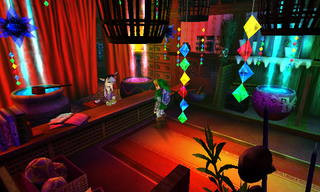
The weird side of Hyrule. Welcome to the back alley where the black market that does not pay taxes subsists via shady business. Starting with Link’s Awakening for the Game Boy, the development team behind the Zelda series made a conscious decision to start including characters that feel slightly off; the suspicious types. These are guys and gals whose intentions are not absolutely clear and might help or harm the hero. There are some locations on Hyrule where it is definitely better to not ask too many questions. These exotic locales offer items that are out of the ordinary; buy at your own risk.
This needs to feel esoteric all around because what is being brewed here are all kinds of medicines made by either old witches, crazy scientists or underground sellers. We all know in what kinds of establishments we would also hear this tune. It does not matter whether made by magic or science, the beverages found here certainly are not conventional. You often have to bring your own ingredients in order for the seller to craft what you are looking for, no questions asked.
If normal shops have the Latin inflected musak for you to have a satisfying shopping experience, then Koji decided that these eccentric characters would be accompanied by Eastern traditions associated with mysticism and new age in the collective imaginary; it’s almost tongue-in-cheek in the way it parodies the music you would presumably hear at your local tarot reader while she is on a spiritual journey or some kind of trance.
Musical Analysis
Structure: Section 0 / Section 1 / Section 2
Time Signature: 4/4
Tempo: 94
Melodic and Harmonic Profiles: G Double Harmonic Minor
Most likely composed first and foremost for the Potion Shop and then reused for all kinds of uncanny places, the cue does not shy away from using the trademarks that characterize music associated with all kinds of drugs and trips (of the spiritual kind, of course) — The wind chimes are used, no doubt with the intention of bringing to mind the cliched Hindu-style doors that always appear at the fortune teller venue or the esoteric chimes hanged all around for all kinds of superstitious purposes.
The conga glissando, coming back from Goron City cue, appears here in the low pitched register to emulate a different instrument: the Indian tabla or maybe a mridangam. What’s more, Koji Kondo probably uses the dulcimer in similar fashion to conjure up a sitar or maybe a veena. Being the closest timbre found in the instruments at his disposal, he uses the bass notes as a drone in similar fashion to how a sitar is performed. The djembe speaks for itself, being one of the go-tos instruments for an exotic world music sound. The drum patterns can be classified as a cyclic tala and the melody as a raga which are Indian musical frameworks for improvisation.
Though the instrumentation and rhythms suggest Indian classical music, for us the melody can also be more associated with a Middle Eastern, or Arab sensibility. When you learn the harmonic minor scale, you notice that its last bit sounds Middle-Eastern. This track doubles down on this sensation by using a scale that includes in it two of these harmonic tetrachords, the head and tail are the same as the tail of the harmonic minor scale. unsurprisingly Westerners simply call it the double harmonic scale. In this case, it is the double harmonic minor because it starts in the fourth mode of the double harmonic scale.
The melody part of the dulcimer seems to be playing a long form phrase around this scale with ornamental notes apt for the instrument in question and some irregular timing going on. The bass stays as a pedal G note.
Specifically, this genre of music would be the Hindustani classical music of north India—India has two different styles of art music— You can check a little of the style here:
The wacky mixture of influences continues thanks to the characteristic propensity that Japanese game developers have for disregarding a consistent tone in favor of communicating instantaneously what’s the deal with the place you are visiting.

Help to keep the rites going around here by supporting the shrine:

Media Files, requests and support for more interactive content

Thou shall donate since this is a cult and you are now a sheep

Help staying awake analyzing game tracks and writing posts or else everything will end up being written by A.I
- Inside The Score – The Legend of Zeda: A Link to the Past – End Credits / Staff Roll
 The land rests As the last few minutes of this extensive journey that has now come to an end fly by, the nostalgia and reflective mood kicks in. Because such a massive enterprise as a Zelda game or a Lord of the Rings movie require multiple endings to convey everything… Read More »Inside The Score – The Legend of Zeda: A Link to the Past – End Credits / Staff Roll
 - Inside The Score – The Legend of Zelda: A Link to the Past – Ending / Epilogue ~ Beautiful HyruleFinal of the fantasy The Triforce has been touched. A wish has been granted. For the occasion, the newly undeceased king of Hyrule has commissioned a march in honor of the legendary hero to the Hylian Sousa, who might as well be composer Nobuo Uematsu since this piece is very… Read More »Inside The Score – The Legend of Zelda: A Link to the Past – Ending / Epilogue ~ Beautiful Hyrule
- Inside The Score – The Legend of Zelda: A Link to the Past – Triforce Chamber / Power of the GodsTake your boots off your feet And thus the Triforce spoke to men. And it became present in history. And you better treasure and contemplate this moment seldom witnessed in the course of the series. The elusive opportunity to interact and touch the most important artifact. You are now in… Read More »Inside The Score – The Legend of Zelda: A Link to the Past – Triforce Chamber / Power of the Gods
- Inside The Score – The Legend of Zelda: A Link to the Past – Ganon Battle / Prince of DarknessProgressive evil En Garde! And you better be prepared since you are about to duel the iconic enemy of the series at perhaps his canonically most powerful incarnation. Right after having touched the sacred Triforce which allowed him to conquer all of the Golden Land and whose evil and darkness… Read More »Inside The Score – The Legend of Zelda: A Link to the Past – Ganon Battle / Prince of Darkness
- Inside The Score – The Legend of Zelda: A Link to the Past – Boss Battle / Anger of the GuardiansQuick mayhem Ah, the simpler times when boss battles where not a multi epic orchestral suite but just an ostinato more basic that even what became the music for standard battle encounters out there. We are a long way from each boss having his own personalized track. And this early… Read More »Inside The Score – The Legend of Zelda: A Link to the Past – Boss Battle / Anger of the Guardians
- Inside The Score – The Legend of Zelda: A Link to the Past – Dark World Dungeon / Dungeon of ShadowsMemento mori We are getting closer to Ganondorf (or at least the wizard Agahnim who ultimately fulfills the same human side of evil role in this game) and that means getting closer to the profiles and motifs of his own theme song (which naturally was the theme of Agahnim at… Read More »Inside The Score – The Legend of Zelda: A Link to the Past – Dark World Dungeon / Dungeon of Shadows