The cycle begins
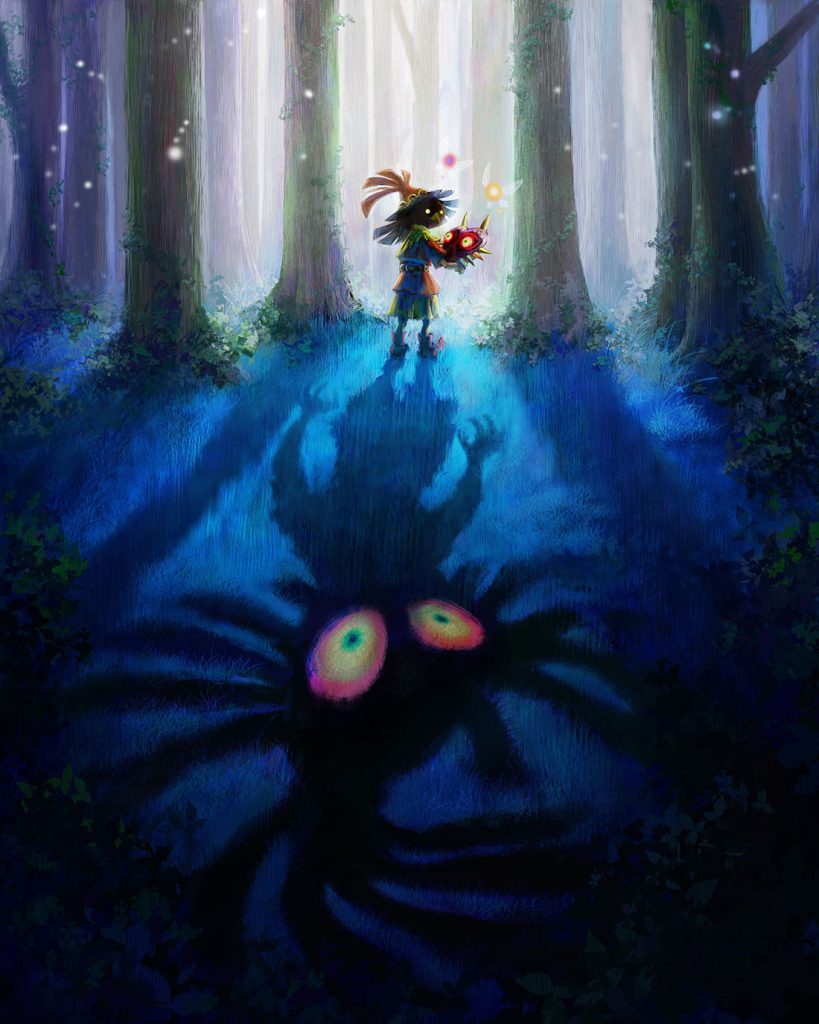
Aimless confusion is the name of the game here.
For a story about a cycle it is fitting that the piece that opens the curtain is also the one that closes it at the end. As if the hero never left this state of affairs.
At the end of Ocarina of Time, Link is sent to a place he does not belong anymore: his own time. After growing up through the five temples of Hyrule and defeating the King of Evil himself, he is back to a child body; a child who’s is no longer part of the Kokiri tribe. Left without most of the people he became friends with, and robbed of his identity as the hero of legend. The stories of his deeds being told never to reach his ears. Indeed, Link has met with a terrible fate and only a personal journey will heal him. He has no one to guide him
It is in this state of mind we find the hero at the very beginning; lost, with no direction, looking for the only creature that could provide navigation for him. Soon, he will cross paths with his mirror self. Another child who was robbed of his own identity by a dangerous artifact. Unlike Link, this imp has two guides of his own, who have quite the contrasting personalities, their names are a play on the word Tattletale and they actually talk like tinker bells since apparently the real dialogue of the previous companion was too annoying. These two are the first ones to spot Link and alert the skull kid, the fond of masks villain of this adventure, of his presence; when we first met him he wanted to get a mask that made hi look more imposing, it seems he got his wish. This is an encounter that will lead Link literally down the rabbit hole.
Musical Analysis
Structure: Section 1 / Section 2 / Section 3
Time Signature: 4/4, 3/4, 5/4, 7/4
Tempo: 67
Melodic and Harmonic Profiles: Bb Diminished; Gb Diminished; D Diminished; D Mixolydian; G Phrygian Major G Mixolydian; D Whole Tone; B Diminished
In yet another rare opportunity to hear Kondo’s film scoring prowess, the stunning intro also separates itself almost immediately from Ocarina of Time. The very first chord movement we hear being an E to Bb chord, two chords a tritone apart—a movement that is seldom found on the massive score of its predecessor— This chord transition being more associated with Danny Elfman and his darker scores for Batman and other Tim Burton films than with Koji Kondo. Whimsically dark would be the appropriate term for a [ I- Vb ] harmony movement; alien to most of the scales we are used to.
Full of mystery and suspense, just like the Lost Woods where fairies and skull kids inhabit, the score throws a whirlwind of angular chords that seem to be as lost from a tonal center as Link is himself—the time signature not being that far back in the elusive department!—All major chords played in inversion, supported by the upper strings maintaining a pedal note on B natural. The full progression of the intro being:
E – Bb – E – Bb – F# – A – F
D – Am – D – Am – D
phew! So yeah, in short, the level of complexity is already up a notch from Ocarina of Time. The D to Am vamp is the sacred Dorian spirit taking over.
The harp allows us to hear what is happening on the scene, Its delicate tones imitating the fluttering of the wings coming from this mysterious pair of fairies observing Link.
The confusion doesn’t stop there, with the cue seemingly repeating the progression but deviating and finding itself at other locations:
[ E – Bb – E – Bb – F# – A – F ] – Ab – Eb – G – Dm
Yep, we are practically doing circles here in these woods. These are the Lost Woods indeed, in a parallel world where they receive a more standard, less jolly cue. The Dorian vamp would be now in Dm to G.
After this, the music shifts to follow the action, descending to signal danger moments before the fairies attack and leave Link unconscious:
Dsus2 (b5) – D – Am are the three chords before the music shifts to mickey mousing the fairies’ attack and sounding the failure that represents Link getting knocked out. appropriately using a whole tone scale that represents dizziness.
The first part of the song ends and, as we see on screen the titular Majora and its skull kid puppet materialize, the Chinese gongs coming directly from the Peking opera accompany its introduction, just like in the real deal. This Chinese influence will accompany the character throughout the game, masks being a very important part of the Far East drama and opera scenes. The accelerando rhythm having an emotional significance and resonance for East Asians in the same way harmony progressions have codified certain emotions in the West. The instruments follow the increasing madness of the percussion, the ascending brass against the descending bass devolving into a deafening dissonance up to the climax of seeing the antagonist fully formed on the screen for the first time.
The piece ending on a unearthly Bm 9/#11 chord is the final touch that means this is no normal creature we are dealing with this time around; a totally unpredictable evil that just means havoc and destruction, not any particular objective in mind. Ganondorf was cunning and driven by power. Majora simply wants to harm for fun. Was this move premeditated? Is this just a game for the skull kid? The unpredictability of this character might make him an infinitely more dangerous foe.
Help to keep the rites going around here by supporting the shrine:

Media Files, requests and support for more interactive content

Thou shall donate since this is a cult and you are now a sheep

Help staying awake analyzing game tracks and writing posts or else everything will end up being written by A.I
- Inside The Score – The Legend of Zeda: A Link to the Past – End Credits / Staff Roll
 The land rests As the last few minutes of this extensive journey that has now come to an end fly by, the nostalgia and reflective mood kicks in. Because such a massive enterprise as a Zelda game or a Lord of the Rings movie require multiple endings to convey everything… Read More »Inside The Score – The Legend of Zeda: A Link to the Past – End Credits / Staff Roll
 - Inside The Score – The Legend of Zelda: A Link to the Past – Ending / Epilogue ~ Beautiful HyruleFinal of the fantasy The Triforce has been touched. A wish has been granted. For the occasion, the newly undeceased king of Hyrule has commissioned a march in honor of the legendary hero to the Hylian Sousa, who might as well be composer Nobuo Uematsu since this piece is very… Read More »Inside The Score – The Legend of Zelda: A Link to the Past – Ending / Epilogue ~ Beautiful Hyrule
- Inside The Score – The Legend of Zelda: A Link to the Past – Triforce Chamber / Power of the GodsTake your boots off your feet And thus the Triforce spoke to men. And it became present in history. And you better treasure and contemplate this moment seldom witnessed in the course of the series. The elusive opportunity to interact and touch the most important artifact. You are now in… Read More »Inside The Score – The Legend of Zelda: A Link to the Past – Triforce Chamber / Power of the Gods
- Inside The Score – The Legend of Zelda: A Link to the Past – Ganon Battle / Prince of DarknessProgressive evil En Garde! And you better be prepared since you are about to duel the iconic enemy of the series at perhaps his canonically most powerful incarnation. Right after having touched the sacred Triforce which allowed him to conquer all of the Golden Land and whose evil and darkness… Read More »Inside The Score – The Legend of Zelda: A Link to the Past – Ganon Battle / Prince of Darkness
- Inside The Score – The Legend of Zelda: A Link to the Past – Boss Battle / Anger of the GuardiansQuick mayhem Ah, the simpler times when boss battles where not a multi epic orchestral suite but just an ostinato more basic that even what became the music for standard battle encounters out there. We are a long way from each boss having his own personalized track. And this early… Read More »Inside The Score – The Legend of Zelda: A Link to the Past – Boss Battle / Anger of the Guardians
- Inside The Score – The Legend of Zelda: A Link to the Past – Dark World Dungeon / Dungeon of ShadowsMemento mori We are getting closer to Ganondorf (or at least the wizard Agahnim who ultimately fulfills the same human side of evil role in this game) and that means getting closer to the profiles and motifs of his own theme song (which naturally was the theme of Agahnim at… Read More »Inside The Score – The Legend of Zelda: A Link to the Past – Dark World Dungeon / Dungeon of Shadows