Down the rabbit hole
The spiritual successor to Dodongos’s Cavern ( and inside the tombs) but with the creepiness factor turned up a notch. The ambiguously metallic sounds from the Goron mines are replaced with true standards of horror film scoring to create the sense that something very bad could happen to you at any moment you expend on the underground.
First heard on the mysterious trippy trip through the rabbit hole Link falls just like Alice while seeing that his new land is based around time and masks. The cue is then used in all manner of caves and grottoes from Termina; the piece is a true noise fest of unsettling proportions.
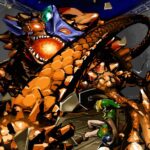
After being saved of his fall by a conveniently placed flower, the hero finds himself on a series of underground tunnels. The level of surrealism starts to rise as we see a now flying skull kid illuminated by two theater lamps straight from a circus; his level of power, confidence and evilness now seems totally different from the mischievous child from the surface. The Chinese opera has begun.
Musical Analysis
Structure: Section 0 / Section 1
Time Signature: 4/4
Tempo: 64
Melodic and Harmonic Profiles: Atonal
For this cavernous track it’s not surprising that it starts with the usual atmospheric wind that accompanied various dungeons throughout Ocarina of Time. For variety, a different sample from those of the previous game was used to create the random wind pattern; it even manages to sound a little bit like very deep voices, giving a more infernal and otherworldly sound to the cue.
The set of horror instruments are composed of ambiguous sounds meant to scare and unsettle, including some huge metal sounds like something has awakened below the earth or the floor is crumbling, some slashing sounds like guillotines are being operated and, the ultimate standard of horror, the screeching violins played in a very high register without any musical intention whatsoever. The Psycho” Strings, named after their famous use on the movie from Alfred Hitchcock in the iconic shower scene. From there, composers have taken this disturbing sound to signify danger or something unnatural lurking, just varying the speed depending of how close it is—the sound probably was not even made with an actual violin bow. It is also frequently performed by fast bow strokes below the bridge — the wooden piece that holds the strings up — of a cello. However, since nobody wants to damage a precious, expensive violin, In many horror movies they don’t use strings but a waterphone, an instrument that may even be more effective and versatile for these purposes; these beauties might be a sound designer’s dream acquisition.
By manipulating the speed and pitch of the sounds, Kondo manages to have a broader palette from just a few samples, sounding very different depending of what key is pressed on the keyboard controller.
As was said, the cue will be used for all kinds of scary places throughout Termina.
Link was without an identity at the beginning of the game. Majora is capable of seeing right through him, thus this lack of identity is about to turn literal for the hero of this adventure.
Sample used for the strings:
Danger Strings – Partition D – DANGER – DANGER [430] from the library Spectrasonics Distorted Reality:
Metal Rumble – PIT HIT_01 from the library Spectrasonics Distorted Reality:
Help to keep the rites going around here by supporting the shrine:

Media Files, requests and support for more interactive content

Thou shall donate since this is a cult and you are now a sheep

Help staying awake analyzing game tracks and writing posts or else everything will end up being written by A.I
- Inside The Score – The Legend of Zeda: A Link to the Past – End Credits / Staff Roll
 The land rests As the last few minutes of this extensive journey that has now come to an end fly by, the nostalgia and reflective mood kicks in. Because such a massive enterprise as a Zelda game or a Lord of the Rings movie require multiple endings to convey everything… Read More »Inside The Score – The Legend of Zeda: A Link to the Past – End Credits / Staff Roll
 - Inside The Score – The Legend of Zelda: A Link to the Past – Ending / Epilogue ~ Beautiful HyruleFinal of the fantasy The Triforce has been touched. A wish has been granted. For the occasion, the newly undeceased king of Hyrule has commissioned a march in honor of the legendary hero to the Hylian Sousa, who might as well be composer Nobuo Uematsu since this piece is very… Read More »Inside The Score – The Legend of Zelda: A Link to the Past – Ending / Epilogue ~ Beautiful Hyrule
- Inside The Score – The Legend of Zelda: A Link to the Past – Triforce Chamber / Power of the GodsTake your boots off your feet And thus the Triforce spoke to men. And it became present in history. And you better treasure and contemplate this moment seldom witnessed in the course of the series. The elusive opportunity to interact and touch the most important artifact. You are now in… Read More »Inside The Score – The Legend of Zelda: A Link to the Past – Triforce Chamber / Power of the Gods
- Inside The Score – The Legend of Zelda: A Link to the Past – Ganon Battle / Prince of DarknessProgressive evil En Garde! And you better be prepared since you are about to duel the iconic enemy of the series at perhaps his canonically most powerful incarnation. Right after having touched the sacred Triforce which allowed him to conquer all of the Golden Land and whose evil and darkness… Read More »Inside The Score – The Legend of Zelda: A Link to the Past – Ganon Battle / Prince of Darkness
- Inside The Score – The Legend of Zelda: A Link to the Past – Boss Battle / Anger of the GuardiansQuick mayhem Ah, the simpler times when boss battles where not a multi epic orchestral suite but just an ostinato more basic that even what became the music for standard battle encounters out there. We are a long way from each boss having his own personalized track. And this early… Read More »Inside The Score – The Legend of Zelda: A Link to the Past – Boss Battle / Anger of the Guardians
- Inside The Score – The Legend of Zelda: A Link to the Past – Dark World Dungeon / Dungeon of ShadowsMemento mori We are getting closer to Ganondorf (or at least the wizard Agahnim who ultimately fulfills the same human side of evil role in this game) and that means getting closer to the profiles and motifs of his own theme song (which naturally was the theme of Agahnim at… Read More »Inside The Score – The Legend of Zelda: A Link to the Past – Dark World Dungeon / Dungeon of Shadows