A Chinese tale
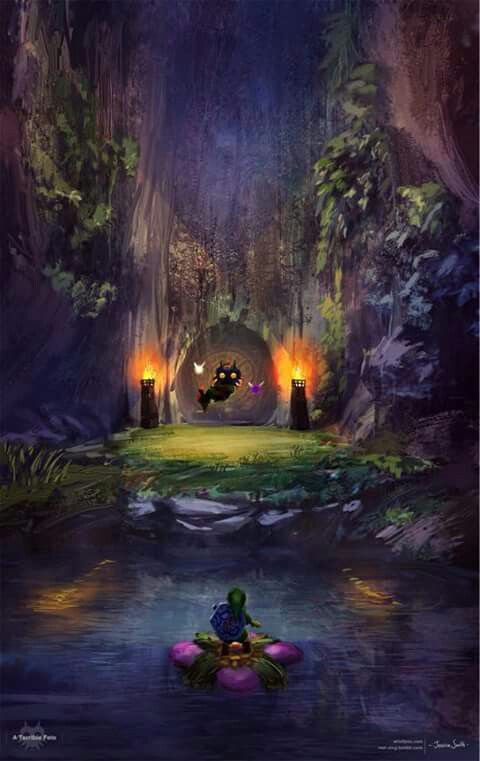
The curtain opens, lights on. The opera is about to begin.
The first character theme we hear from the game, the theme of Majora, is based around Chinese musical drama as related to the masks and the connotation these objects have on Eastern cultures. Nuo Opera, Peking Opera and Japanese Noh Theater being the main influences. From the very beginning the developers wanted to differentiate as much as possible this game from Ocarina of Time. As they said, anything from making strangely shaped trees to the town, which was inspired by medieval Europe in Ocarina of Time and now have that round Southeast Asian style to of course music. The tone is, quite simply, more surreal from now on.
Chinese opera has a specific language to it. Emotional strings are usually pulled based less on harmony and more on rhythm, something that may make the music more incomprehensible to people unfamiliar with it. Harmony and harmonic progression are aspects not emphasized neither in Chinese nor in other East Asian traditional music; the functions of harmony—such as underlining expression, providing sonic contrast, and creating a sense of forward motion—are handled with equal efficiency by rhythm in East Asia, although the methods and sounds are very different from their Western counterparts. In both traditions, the choices are not arbitrary, and with cultural exposure one will come to recognize the musical intention, even though it is not necessary to know precisely what chord or what rhythm pattern produces an appropriate musical effect.
For example, very few Western music listeners know that a doubly diminished chord (C–E♭–G♭–A) played tremolo means danger, although all would recognize the danger signal by ear. By the same token, a Peking opera audience hearing the large gong played alone in a certain rhythm pattern would know that the situation is meant to represent a moment of confusion; an accelerating rhythm has a different connotation to a slowing down one in the same way that a major chord gives us certain emotions vs minor chords.
Music in Chinese opera was not “composed” as we would recognize the practice or created by a composer in the conventional sense, that is, with new melodies invented specifically just for a given opera. The “composition” in Peking opera instead consists of setting standard, commonly used tunes into new contexts with words written to fit these traditional tunes.
With all this, we see that a Chinese opera ensemble—Peking opera which would be the most mainstream— is composed of a melodic section (wen chang) and a percussion section (wu chang). The percussion instruments can serve one moment as director, another moment as narrator, or as conductor, or as actor, or even as interpreter for the audiences, so as to push the development and flow of the performance on. Gongs appear simple-just hit them type of percussion but they can communicate quite a lot of information through rhythm, volume, where they are struck, and how they are muted; whether the pitch of the gong goes up, down or is indistinct also has particular associations, not to mention they also come in different sizes for different purposes.
Whether Kondo was really trying to speak this language in any meaningful way or merely just using the sound to create a vibe remains to be seen. In any case, the piece mostly takes the sonority as reference, with the melodic and harmonic accompaniment still rotted in standard film scoring. So the theme of Majora is indeed a villain song with the characteristic dissonances, chromaticism, and slow menacing flow, made with instruments emulating a Chinese opera sound and their characteristic percussion patterns which have an independent beat and meter.
Musical Analysis
Structure: Section 1 / Section 2
Time Signature: 4/4
Tempo: 80
Melodic and Harmonic Profiles: Bb Diminished; C Diminished; F Diminished
The presentation of instruments might seem wacky and random—what is a guitar doing here?—and not something that at first glance would be used for an antagonist, but it has to be remembered that most of them are meant to be emulating a respective counterpart from Chinese opera; Kondo is just using easily accessible samples and by changing their performance style, he is embedding them with the spirit of other instruments.
The main instrument for Majora is the Chinese suona, an instrument that, as many double reed type instruments, can sound very harsh or mellow depending on how it is played. In China there is an immense variety of suona, ranging from home made smaller ones, to traditional large suonas crafted by specialists, to orchestral ones that have keys on them; and classifications similar to that of clarinets and saxes (tenor, soprano, alto etc) The register Kondo is employing here may imply the sonority of a tenor suona. He is using here some of the same techniques from the Spirit Temple, like specific articulation and pitch bending to stay close to the instrument usual style and even introduce microtonal flourishes.
A real suona sounds like this:
This opera troupe also adds his own plucked instrument; surprisingly, the old trusted nylon guitar from Ocarina of Time. But buried in the mix and with the particular way it is played, is clearly meant to be one of the traditional Chinese plucked string instruments like the yueqin or the pipa—since the yueqin is very important in Chinese opera and is also called a moon lute, i would go with that for fitting reasons.
Next on the line of exotic associations is the accordion. What instrument may it be mimicking? The fact is, China may actually have had a big influence on the development of the accordion we know; the family of free-reed aerophones all have very distinct shapes and manner of playing but there is a characteristic sound to them that relates them. The Sheng, a Chinese free-reed mouth organ, is played by blowing through a mouthpiece at the side. It is one of the oldest Chinese instruments and one of the oldest known mouth organs—it is also one of the few Chinese ones that are expected to play more than one note at a time— The introduction of the Sheng into Europe in 1777 stimulated the use of the free reed principle in the construction of organs and other instruments, including the further development of the accordion. So we come full circle.
The accordion was the closest one because good luck finding a sheng sample back in those days.
Naturally, the gongs that we have been teased with since the opening of the game are a major part of the character of Majora. The instrument has been around since literally who-knows-when and originated in East Asia, go(i)ng around the world and now found in so many ensembles that it may be the most popular instrument from China, firmly ingrained in the collective imaginary of everyone and used by only the most over the top drummers; they are now even regularly employed on Western symphony orchestras and classical compositions. The two main categories of gongs are those that have a definite pitch information and those who sound like a crash without any discernible tuning.
Kondo brings us three gong samples to cement the opera flavor. An essential part of the orchestra for Chinese opera is a pair of gongs, the larger with a descending tone, the smaller with a rising tone; we got those here. The larger gong is used to announce the entrance of major players or men and to identify points of drama and consequence—of course, this is the one we hear here first— The smaller gong is used to announce the entry of lesser players or women and to identify points of humour. The third sample we hear on the piece seems to be a mix of the one most familiar to westerners, the Chau gong, its huge splash sound familiar to anyone who has watched a martial arts film, combined with the large opera gong on the same recording.
You can hear a sample of the various gongs here:
The low strings are the only instrument where it would be a stretch to call them anything but what they are. Even though, of course, the Chinese will have they own versions of bowed strings, like the famous high-pitched, two-string spike fiddle known as jinghu; they are used almost exclusively in a melodic role so they are not really being represented on this piece. Here we have just plain old brooding strings for malefic beings.
As said, hopefully someday we get to hear an arrangement made with the actual instruments intended or a real Chinese ensemble playing the Majora theme.
On the music side, the strings start by playing a combination of sixths and tritone intervals, alluding to the bleak and evil atmosphere; by the end of the piece, the sixths are being ditched as there are tritones all the way before finishing with a low menacing doubling down of the melody; just like real monophonic Chinese opera.
The suona plays the same main chromatic melody with the ornamental flourishes that add uniqueness to this theme. In fact, all the instruments play the same melody, confirming the influence of Chinese opera with its lack of harmony, the only remaining semblance of it being film scoring are the intervals on the strings. The guitar is played in fast tremolos true to the style of the yueqin too.
The gongs themselves are sometimes playing the accelerating rhythm that in the opera language mean confusion and surprise by the arrival of this major character, and sometimes playing an accelerating beginning with a slowing down at the end. Could some Chinese message be decoded from all these patterns? Perhaps. Koji is a person that really likes to study carefully each and every style. Still, it would be difficult to pinpoint exactly the subtle differences of the rhythmic language of Chinese opera.
The weirdness doesn’t stop, as Link is robbed of his last semblance of identity in a weird sequence: his physical one, taken by Majora by transforming him into an even more childish version of himself. In a cruel prank, Link is back to being a children of the forest. But not a Kokiri; this time he is but a defenseless Deku scrub mocked by guards as just a defenseless kid like he was at the beginning of Ocarina of Time.
His problems are just beginning before he truly crosses the threshold to the otherworldly land trapped in a permanent terminal state.
Help to keep the rites going around here by supporting the shrine:

Media Files, requests and support for more interactive content

Thou shall donate since this is a cult and you are now a sheep

Help staying awake analyzing game tracks and writing posts or else everything will end up being written by A.I
- Inside The Score – The Legend of Zeda: A Link to the Past – End Credits / Staff Roll
 The land rests As the last few minutes of this extensive journey that has now come to an end fly by, the nostalgia and reflective mood kicks in. Because such a massive enterprise as a Zelda game or a Lord of the Rings movie require multiple endings to convey everything… Read More »Inside The Score – The Legend of Zeda: A Link to the Past – End Credits / Staff Roll
 - Inside The Score – The Legend of Zelda: A Link to the Past – Ending / Epilogue ~ Beautiful HyruleFinal of the fantasy The Triforce has been touched. A wish has been granted. For the occasion, the newly undeceased king of Hyrule has commissioned a march in honor of the legendary hero to the Hylian Sousa, who might as well be composer Nobuo Uematsu since this piece is very… Read More »Inside The Score – The Legend of Zelda: A Link to the Past – Ending / Epilogue ~ Beautiful Hyrule
- Inside The Score – The Legend of Zelda: A Link to the Past – Triforce Chamber / Power of the GodsTake your boots off your feet And thus the Triforce spoke to men. And it became present in history. And you better treasure and contemplate this moment seldom witnessed in the course of the series. The elusive opportunity to interact and touch the most important artifact. You are now in… Read More »Inside The Score – The Legend of Zelda: A Link to the Past – Triforce Chamber / Power of the Gods
- Inside The Score – The Legend of Zelda: A Link to the Past – Ganon Battle / Prince of DarknessProgressive evil En Garde! And you better be prepared since you are about to duel the iconic enemy of the series at perhaps his canonically most powerful incarnation. Right after having touched the sacred Triforce which allowed him to conquer all of the Golden Land and whose evil and darkness… Read More »Inside The Score – The Legend of Zelda: A Link to the Past – Ganon Battle / Prince of Darkness
- Inside The Score – The Legend of Zelda: A Link to the Past – Boss Battle / Anger of the GuardiansQuick mayhem Ah, the simpler times when boss battles where not a multi epic orchestral suite but just an ostinato more basic that even what became the music for standard battle encounters out there. We are a long way from each boss having his own personalized track. And this early… Read More »Inside The Score – The Legend of Zelda: A Link to the Past – Boss Battle / Anger of the Guardians
- Inside The Score – The Legend of Zelda: A Link to the Past – Dark World Dungeon / Dungeon of ShadowsMemento mori We are getting closer to Ganondorf (or at least the wizard Agahnim who ultimately fulfills the same human side of evil role in this game) and that means getting closer to the profiles and motifs of his own theme song (which naturally was the theme of Agahnim at… Read More »Inside The Score – The Legend of Zelda: A Link to the Past – Dark World Dungeon / Dungeon of Shadows