The opera director
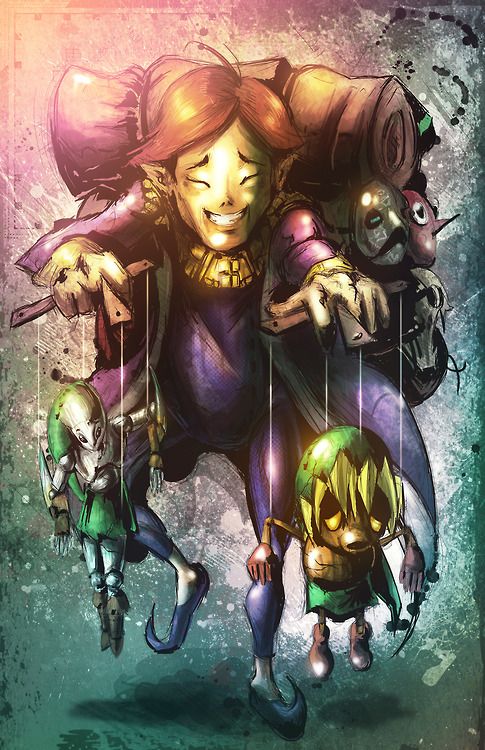
The Happy Mask Salesman, the puppet master, one of the most mysterious characters to appear in the Zelda series. If the developers, inspired in the TV series Twin Peaks, wanted to introduce suspicious characters ever since Link’s Awakening, it means that the mystic Happy Mask Salesman may be the culmination of this idea. He was already mysterious back in Ocarina of Time, where his shop was empty at the beginning and only opened just at the right time for Link to start his mask journey. It also turned out that he had a very different business model from the other shops in Hyrule, interested not only in profit but also in putting Link to work selling the masks because, as he claimed, what they were doing was giving happiness; he also promised Link that by doing so, he would find it himself.
Ultimately, it turned out to be true. Link ended up gaining more money and was rewarded with the mysterious Mask of Truth, a powerful mask that could see right through people’s hearts, something that the salesman warned him about. The character from Majora’s Mask was already there; his abrupt changing moods, strange religious dialogue speaking of faith, the true meaning of life, happiness and seeing the true colors of people. He was also one of the few characters that disappeared completely from most of the adult portion of the game.
This level of consistency between his portrayal in both games is not due to the developers foreshadowing the release of Majora’s Mask, it is because since the beginning there was a connection between the concept of masks and Chinese religious practices—he was one of the few blatantly Asian characters found in Ocarina of Time —his outfit and design also remains unchanged between games, the developers expecting to develop further the thread opened with Ocarina of Time.
He is nothing but a Chinese exorcist and his little mask quest from Ocarina of Time was a mini taste of what would come on The Legend of Zelda: Majora’s Mask, where the concept of ultimately seeing the truth by giving happiness to other sentient beings was expanded to make a full game out of it—the 3DS remake even went on to give the role of entrusting Link the bombers’ notebook to the Happy Mask Salesman for cohesiveness reasons— This concept will continue to permeate the series right to its modern installments, with Skyward Sword’s gratitude crystals replacing the role of masks. He was right all along; masks can potentially give you happiness. They are imbued with emotions and feelings, and collecting many of them is a symbol of a strong mind, a mind that is able to see truth. Just have faith… and keep trying a little longer. Link will have plenty of that in Majora’s Mask.
As has been stated, masks are extrinsically linked to Chinese exorcist religions and many truly believe that when they put a mask, their spirit is possessed and they become fully immersed on the character. Masks are an age-old cultural phenomenon shared by almost all ethnic groups of China. One of the most distinguishing characters of what is known as Nuo religion is its iconographic style, which represents the gods as wooden masks or heads, with people creating festivities around them and praying for a good harvest. The character of the Happy Mask Salesman is most likely based around that of a Chinese shaman or priest belonging to the ancient Nuo folk religion; a spiritual guide known as Wu. He represents a figure denominated the fangxiangshi, the Chinese exorcist that commanded rituals in order to put spirits to rest and scrutinizes evil spirits away; it’s usually depicted as carrying a lance and shield to expel malevolent spirits. The meaning of fangxlangshi is usually translated as “one who sees in all four directions” This figure, by close proximity and cultural interchange, also appears in Japanese rituals, where it is known as hōsōshi.
In learning the Song of Healing Link will basically become his disciple, essentially inheriting his role to service the land of Termina and purify this world.
Musical Analysis
Structure: Section 1 / Section 2 / Section 3 / Section 4
Time Signature: 3/4
Tempo: 126
Melodic and Harmonic Profiles: F Lydian; F Ionian/Major
Following on the footsteps of his precious mask stolen, the theme of the Happy Mask Salesman is also all about Chinese music. But this time it seems of a more folkloric, primal nature; a true rural Nuo opera or ceremonial procession. The piece is a reprise of the Song of Healing that the salesman will teach Link, played with that unmistakable Eastern flavor. Like on the theme for Majora, Kondo didn’t bother to introduce a lot of new samples as long as the sounds he already had served his purpose.
By the manner of performance and style, nobody would have probably though that the same Southern American banjo from the ranch would be a lead instrument for an Oriental character but here we are. Turns out the banjo can sound surprisingly Asiatic. It serves as the perfect folkloric fold for this Nuo priest. The banjo is most likely a stand in for either the Chinese sanxian or the Qinqin.
We also find the characteristic set of bells hear across many Eastern religious ceremonies and rituals, the most famous being perhaps the one known as Kagura Suzu used in Japan’s Shinto ceremonies. Nonetheless all East Asian cultures have their own variations of these sacred bells, the Nuo being among them. The goal of the jingle is to make the character sound more spiritual.
We are introduced as well to the bronze drum that is found in a great variety of configurations and levels of craftsmanship across East Asia, adding to the ancientness of the piece and its rite nature. In rural China there is not even need for a sophisticatedly made drum, just any metal pan or pot will do as long as it goes clang.
A sophisticated bronze drum would sound like this:
But this drum along with the timpani and the cymbals that are surely imitating one of the multiple drums from these communities (examples being cymbals like daba and bo, or drums like Tanggu Zhangu and dagga) is going for a more primitive sound, one before instruments were constructed by specialized artisans. Something more akin to the humbler earlier Nuo opera that has been around as far back as the 11th century….before Christ!. It might even be the oldest preserved form of drama in existence.
The only instrument playing a Western figure being the driving snare drum, added for reinforcement and propulsion.
Here you may hear the soloed folk percussion in action:
Not forgetting the suona which is again featured front and center, it being one of the main instruments from China. It intrinsically connects the Happy Mask Salesman with Majora. Both melodic instruments (suona and banjo) are subjected to a considerable amount of vibrato effect, adding to the exotic flavor.
The Happy Mask Salesman is certainly an interesting fella. One of the most enticing theories going around about this mysterious figure is that he is based around series’s creator Shigeru Miyamoto due to their likeness; it has been said that it could be a meta commentary from the developers seeing as how, for this game, Miyamoto also gave them a difficult task to complete in a very limited amount of time. So the theory is very plausible; this mask salesman seems to know a lot about the game world and the character of Link; he is a character that is more powerful than he initially appears. And although his public persona seems very friendly and happy go lucky, inside the company Miyamoto commands quite the amount of respect and even fear, being a very strict developer focusing in minute details and sometimes vague direction. “Miyamoto-san gets pretty scary when he’s angry, doesn’t he?” said by former Nintendo president Satoru Iwata. Could his temper also be anything like that of the Happy Mask Salesman? Likely.
Other possibilities are that he might be Link’s own consciousness or just simply a spirit guide for him, a sensei who watches over a person that is on their path to awakening. This is supported by the fact that he is actually the guide for the Japanese Official The Legend of Zelda twitter account, reinforcing that he is a meta figure for the company (he seems to be the only Nintendo character that acts as if he can communicate with the real world) and that he truly knows everything about this fantasy universe.
After crossing the doors of this clock tower Link will be exposed to the sight of the unrelenting clock; he will find himself in a cycle. A cycle of rebirth that he and only he through his efforts can escape, gifting a dawn of a new day to both Termina and himself. He just has to believe in his strengths and make the most of his time to get to know a little bit better the people around him. Who knows, the Happy Mask Salesman may end up fulfilling his promise:
“You’ve met with a terrible fate, haven’t you? Now don’t think me rude, but I have been following you… For I know of a way to return you to your former self”
And he is not talking about Link’s deku scrub predicament.

Help to keep the rites going around here by supporting the shrine:

Media Files, requests and support for more interactive content

Thou shall donate since this is a cult and you are now a sheep

Help staying awake analyzing game tracks and writing posts or else everything will end up being written by A.I
- Inside The Score – The Legend of Zeda: A Link to the Past – End Credits / Staff Roll
 The land rests As the last few minutes of this extensive journey that has now come to an end fly by, the nostalgia and reflective mood kicks in. Because such a massive enterprise as a Zelda game or a Lord of the Rings movie require multiple endings to convey everything… Read More »Inside The Score – The Legend of Zeda: A Link to the Past – End Credits / Staff Roll
 - Inside The Score – The Legend of Zelda: A Link to the Past – Ending / Epilogue ~ Beautiful HyruleFinal of the fantasy The Triforce has been touched. A wish has been granted. For the occasion, the newly undeceased king of Hyrule has commissioned a march in honor of the legendary hero to the Hylian Sousa, who might as well be composer Nobuo Uematsu since this piece is very… Read More »Inside The Score – The Legend of Zelda: A Link to the Past – Ending / Epilogue ~ Beautiful Hyrule
- Inside The Score – The Legend of Zelda: A Link to the Past – Triforce Chamber / Power of the GodsTake your boots off your feet And thus the Triforce spoke to men. And it became present in history. And you better treasure and contemplate this moment seldom witnessed in the course of the series. The elusive opportunity to interact and touch the most important artifact. You are now in… Read More »Inside The Score – The Legend of Zelda: A Link to the Past – Triforce Chamber / Power of the Gods
- Inside The Score – The Legend of Zelda: A Link to the Past – Ganon Battle / Prince of DarknessProgressive evil En Garde! And you better be prepared since you are about to duel the iconic enemy of the series at perhaps his canonically most powerful incarnation. Right after having touched the sacred Triforce which allowed him to conquer all of the Golden Land and whose evil and darkness… Read More »Inside The Score – The Legend of Zelda: A Link to the Past – Ganon Battle / Prince of Darkness
- Inside The Score – The Legend of Zelda: A Link to the Past – Boss Battle / Anger of the GuardiansQuick mayhem Ah, the simpler times when boss battles where not a multi epic orchestral suite but just an ostinato more basic that even what became the music for standard battle encounters out there. We are a long way from each boss having his own personalized track. And this early… Read More »Inside The Score – The Legend of Zelda: A Link to the Past – Boss Battle / Anger of the Guardians
- Inside The Score – The Legend of Zelda: A Link to the Past – Dark World Dungeon / Dungeon of ShadowsMemento mori We are getting closer to Ganondorf (or at least the wizard Agahnim who ultimately fulfills the same human side of evil role in this game) and that means getting closer to the profiles and motifs of his own theme song (which naturally was the theme of Agahnim at… Read More »Inside The Score – The Legend of Zelda: A Link to the Past – Dark World Dungeon / Dungeon of Shadows