Dynamic combat
The last track we will come across courtesy of new hired composer Toru Minegishi (still in his early twenties), the three themes he contributed to the game leaving proof that he was perfectly capable of adapting to the style of Zelda music and infuse his own with dynamism and excitement, all probably contributing to him becoming the lead composer for 2006 Twilight Princess.
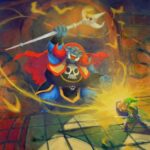
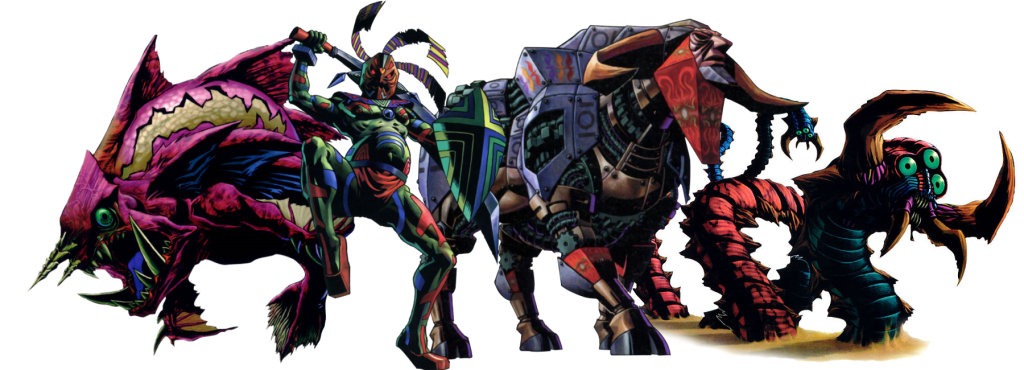
This is the music for the four main bosses of the temples, each containing a portion and essence of the being that is Majora, who have to be conquered by the Hero of Time before being able to fight the real enemy.
Ironically, the spiritual successor to the boss battle from Ocarina of Time woud actually be the Mini Boss Battle from Majora’s Mask, so that leaves open the stage for Minegishi to compose a true original; or is it? For this soundtrack it appears that Minegishi studied very closely the previous orchestral works possible on the Nintendo 64, Ocarina of Time being the main inspiration overall. But the boss battle from Majora’s Mask seems to have a strong influence from the space opera score from Star Fox 64, the guinea pig of orchestral arrangement on the N64.
Musical Analysis
Structure: Section 0 / Section 1 / Section 2 / Section 3 / Section 4 / Section 5 / Section 6 / Section 7
Time Signature: 4/4 (section 0); 7/4 (Section 1); 6/4 (Section 2); 8/4 (Section 3, Section 4); 11/8, 7/8 (Section 5); 7/4 (Section 6; Section 7)
Tempo: 158 (Section 0 190 and then ritardando to 129)
Melodic and Harmonic Profiles: D Diminished; D Chromatic; G Diminished; G Chromatic; A Diminished; A Chromatic
Unlike the boss battles from Ocarina of Time full of angular ostinatos and rhythmic displacements meant to have the player always uncomfortable and alert, Here we have a slightly more sweeping cinematic score full of sustained notes and telling a dynamic story that evolves, as if it’s trying to match the important beats of an imaginary playthrough battle—something that Minegishi would go on to perfect in the combat music from Twilight Princess thanks to the technology of the new systems—the influence from Star Fox 64 can be really felt at the very beginning of Section 6, where the strings descend first a tone and then chromatically, playing a series of fast parallel sus2 chords. In any case, this music would easily fit into the Hollywodesque soundtrack of the anthropomorphic animals blasting each other in space; Toru probably trained himself by studying closely the orchestration of previous Nintendo 64 games made within the company.
Besides that, this still maintains some of the standards of battle/action music; hence brass are prominent, orchestral percussion is prominent, and the piccolo plays at its highest, most alarming register, plus there still remains a lot of parallel transposition.
The intro, taking cues from the Dragon Boss Battle from Ocarina of Time, starts with rapid Phrygian tetrachords played by the piccolo above the rest of an orchestra that is playing dominant chords, the last one transposed a semitone.
After that, the suspense of slowing down the tempo and sustaining the only piano note from the entire track sets the tone for the start of the adrenaline, courtesy of the snare driving the rhythm with its militaristic feel and the Jaws-type accompaniment of the low strings (the two classic alternating minor seconds) always pumping up the action. The brass start simple, just limiting themselves to short twin phrases that pose questions and answers, where the question phrase ends moving down and the answers ends with an interval moving up; they are then transposed to different registers, first a perfect fourth and then a major second. The reason is obvious, to raise the tension, as if the battle is getting harder. The orchestration is also progressively enhanced by doubling notes and adding more instrumentation. The snare pattern also shifts in complexity throughout the track and the volume grows in portions that need accent.
Section 2 is pretty much an interlude with a focus on creating accents as if the hero on a movie just got in danger. The piccolo is back with its Phrygian tetrachords and all the rhythm section stops what is doing in order to accentuate. Odd time signatures galore as the theme briefly shifts from 7/4 to 6/4, losing a beat to create confusion.
Section 3 begins by altering the Jaws pattern living in the low end and also making the melody question phrase the same as the answer (both end moving down). The time signature changes once again to an 8/4 pattern (also can be normal 4/4) However, this time signature change memo is not received by the horns which play sustained notes at their own rhythm, playing mostly minor thirds and tritones; this part would be where the hero truly runs into trouble. It ends with a another short interlude preparing the stage for the strings to take over the melody.
The strings bring with them the strong Star Fox 64 vibes by sticking to parallel sus2 chords, harmony that is not as dissonant but still carries a sense of danger. Underneath it all, the ostinatos continue to be transposed to new diminished scales. Something really weird is happening, the hero cannot see where the monster went.
Then cacophony happens, everything is thrown out the window during Section 5. This section is the equivalent to the music that sounds in the modern Zelda games when the boss is vulnerable; a cue that indicates to the player that they should hurry up and stick their swords into the boss. Just like Koji Kondo, Toru employs only for this part the rhythmic dislocation by making the timpani rhythmically clash with the descending chromatic arpeggios in such an extreme way that is is practically a miracle the entire track doesn’t fall apart. The timpani can be interpreted as going in a 11/8 time signature while the arpeggios take out an eight note each time they are repeated, creating a rhythmically complex part where the track starts to lose synchronization—the ostinatos are going 12/8. then 11/8, 10/8— But before you know it, it goes back to the ostinato from the beginning while the music from Star Fox 64 plays on top just in time to connect with the loop point. Sections 5 and 6 are as if the boss just recovered and the cycle of finding its weak spot has begun anew.
As you can see, Toru Minegishi was trying to capture the feel of a dynamic boss battle before the technology allowed him to actually do that. Ideally, he expected that the music would synchronize with key moments of the battle; but ultimately it all depends on the player. it seems the track was composed by paying attention to how a boss battle from the game developed in time (perhaps the mechanical bull). The technique of trying to make dynamic music even if the music is not programmed to be interactive, was pioneered by Koji Kondo since his early Mario days, where he played and replayed the game trying to capture the rhythms that a normal player would get while traversing the world, from jumps to coins. Nowadays this technique is not required as much since technology allows the music to change depending of what is happening on screen—analog to what happened in the overworld from Ocarina of Time.
In short, the boss battle cue from Majora’s Mask tries to predict the rhythm of the battle that the average player would have.
What is certain is that the cinematic sensibilities of Minegishi would go on to enhance the Wagnerian score of Twilight Princess, a soundtrack full of leitmotifs and music adapting to the action. After Majora’s Mask, Koji Kondo could rest assured that the legacy of Zelda music still had a lot to offer with contributions of a growing number of composers all supervised by him; passing the torch from master to student, sometimes with outstanding results.
You can hear the rhythm section here and see if we coincide on the different time signatures and transpositions the track presents:
Help to keep the rites going around here by supporting the shrine:

Media Files, requests and support for more interactive content

Thou shall donate since this is a cult and you are now a sheep

Help staying awake analyzing game tracks and writing posts or else everything will end up being written by A.I
- Inside The Score – The Legend of Zeda: A Link to the Past – End Credits / Staff Roll
 The land rests As the last few minutes of this extensive journey that has now come to an end fly by, the nostalgia and reflective mood kicks in. Because such a massive enterprise as a Zelda game or a Lord of the Rings movie require multiple endings to convey everything… Read More »Inside The Score – The Legend of Zeda: A Link to the Past – End Credits / Staff Roll
 - Inside The Score – The Legend of Zelda: A Link to the Past – Ending / Epilogue ~ Beautiful HyruleFinal of the fantasy The Triforce has been touched. A wish has been granted. For the occasion, the newly undeceased king of Hyrule has commissioned a march in honor of the legendary hero to the Hylian Sousa, who might as well be composer Nobuo Uematsu since this piece is very… Read More »Inside The Score – The Legend of Zelda: A Link to the Past – Ending / Epilogue ~ Beautiful Hyrule
- Inside The Score – The Legend of Zelda: A Link to the Past – Triforce Chamber / Power of the GodsTake your boots off your feet And thus the Triforce spoke to men. And it became present in history. And you better treasure and contemplate this moment seldom witnessed in the course of the series. The elusive opportunity to interact and touch the most important artifact. You are now in… Read More »Inside The Score – The Legend of Zelda: A Link to the Past – Triforce Chamber / Power of the Gods
- Inside The Score – The Legend of Zelda: A Link to the Past – Ganon Battle / Prince of DarknessProgressive evil En Garde! And you better be prepared since you are about to duel the iconic enemy of the series at perhaps his canonically most powerful incarnation. Right after having touched the sacred Triforce which allowed him to conquer all of the Golden Land and whose evil and darkness… Read More »Inside The Score – The Legend of Zelda: A Link to the Past – Ganon Battle / Prince of Darkness
- Inside The Score – The Legend of Zelda: A Link to the Past – Boss Battle / Anger of the GuardiansQuick mayhem Ah, the simpler times when boss battles where not a multi epic orchestral suite but just an ostinato more basic that even what became the music for standard battle encounters out there. We are a long way from each boss having his own personalized track. And this early… Read More »Inside The Score – The Legend of Zelda: A Link to the Past – Boss Battle / Anger of the Guardians
- Inside The Score – The Legend of Zelda: A Link to the Past – Dark World Dungeon / Dungeon of ShadowsMemento mori We are getting closer to Ganondorf (or at least the wizard Agahnim who ultimately fulfills the same human side of evil role in this game) and that means getting closer to the profiles and motifs of his own theme song (which naturally was the theme of Agahnim at… Read More »Inside The Score – The Legend of Zelda: A Link to the Past – Dark World Dungeon / Dungeon of Shadows