Cartoon soul
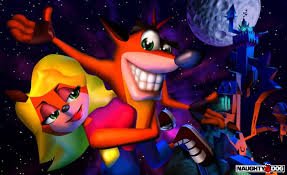
Buragata!
Or whatever is the sound that the tiki mask Aku Aku makes since pretty much every person has their own interpretation (in truth it is gibberish and was never intended to mean anything. However, various people on the Crash team say it sounds like ”Rutabaga).
Obviously we would not dare to leave behind (unlike the Super Smash Bros series) the other big 90s mascot with attitude, who alongside Sonic the Hedgehog was destined to fight against the plumber boy moustache man—as Crash himself refers to his nemesis—becoming in the process the unofficial mascot for the Sony’s Play Station who had just entered the ring in the heated console wars.
The idea was to explore the graphical capabilities of the console and the CD-ROM medium and bring them to their absolute limit and beyond, creating a truly playable cartoon that pays homage to the greatest hits of the Looney Tunes series with Indiana Jones thrown in for good measure.
From the facial animations, to the death animations, to the design philosophy and narrative concept, The all-possibe-angles platformer Crash Bandicoot came alive like no other game before, bringing various new literal perspectives to the oversaturated 2D platformes of the time. Conceived during a road trip, the developers set up to create a mascot for the brand new console from Sony, a classic mascot in the sense that it was meant to be a true animal with an alliterative name where the surname was the species (Felix, the Cat, Oswald, the Rabbit, Donald Duck, Sonic the Hedgehog, Mickey Mouse, Bugs Bunny) plus all the edge that 90s kids could muster. Willy the Wombat, as he was initially known, was meant to be cool, like the American market expects (Remember the rules: America is hardcore, Japan is cute, Europe is artsy). He took on an exotic species nobody had heard of, just like the crazy Tasmanian Devil from Warner that was popular at the time and who also destroys everything on his path with his vortex spin; was given a spiky punk haircut like Sonic and a sexy girlfriend like Roger Rabbit (…and Bugs Bunny? No judgement). At the end of the day the name Willy the Wombat was deemed too ridiculous so they ended up changing it to another exotic species from Oceania, the bandicoot— seems everyone picks oceania since the weirdest creatures apparently come from there (the people are mostly normal)—and just like Sonic was named after his capacity to travel at supersonic speeds, this bandicoot was named after his capacity to destroy crates—which were a late minute addition to the game when the developers felt their levels were too empty. Thus the final name also came pretty late.
Like many other cartoon characters his final design has little resemblance to what a bandicoot is supposed to look like, the color and clothes having more to do with what looked good on the screen produced by the 32-bit system and the TVs of the era. Crash himself was edgier and had more attitude in the marketing materials than in the game; inside the game he was more of a goofy, happy-go-lucky character most likely Nsane due to the experiments performed on him by the Frankenstein like doctors who are the big baddies of the series. The gameplay was mostly modeled on the Donkey Kong Country series with innovative camera angles that explored the new 3D medium.
The wombat, and later bandicoot, species dictated the islandic culture of the first game, with Polynesian imagery, Māori masks and totems, and inhabitants. The game is set on these Indiana Jones inspired temple ruins on the first half, and later, the laboratories with The Jetsons-like concentric circle designs and expressionistic castle from Dr Neo Cortex, who is also based on the Looney Tunes character The Brain. Everything here is Polynesian culture… well, naturally, except for the music which in typical media fashion is portrayed closer to ones from African tribesmen or the Caribbean as opposed to any attempt at Māori accuracy other than getting some samples and sounds for the didgeridoo instrument which in any case was developed by Aboriginal peoples of northern Australia.
The developers of Crash Bandicoot at Naughty Dog initially discussed populating the Crash universe with just ambient sounds and wacky, random sound effects just before coming to their senses and bringing at the last minute the services of the American music production company Mutato Muzika, founded by Mark Mothersbaugh of the band Devo. The LA company specialized in audio and music for media such as films and television; they were just dabbling in the medium of video games so they were looking for people who could do excellent MIDI mockup orchestration and knew enough about software programs. Enter composer Josh Mancell, who was fresh out of university and had all this computer savvy knowledge. He had just come to the competitive Los Angeles scene encouraged by his teachers in order to pursue a career in composing for media. Josh learned the piano at an early age but his main instrument are the drums. He pulled some strings and some contacts in order to meet up with the Devo musician and was just at the right time, right place since they were looking for experts on new technologies. He became the go to man for the first few video game gigs of the company. Universal Studios which were the publishers of the game, worried about the lack of music in the game, contracted the music production company unbeknown to developers Naughty Dog. Universal and the developers butted heads about the direction of the music; the former wanted it to be more traditional sounding while Naughty Dog wanted something bold and experimental. Composer had to find a way to please both. There was a two month deadline.
So the music for the original game was created very late into development. Even long after it was playable and most of the final concepts were entering their finishing touches. The levels were silent asides from the sound effects caused by Crash and the other characters that were taken straight from the psychologically addictive tried and true sounds from casinos, slot machines and pinball machines.
The final music ended up as a nice mix of the cartoon music popularized by Carl Stalling for Disney and Warner Bros, who alongside his musicians featured heavily the xylophone since The Skeleton Dance short animation and because the instrument was useful for the mickey mousing technique of following footsteps and runs. This was combined with heavy emphasis on African percussion and beats; all in tandem worked twofold with the tribal aesthetic since marimbas and wood mallets are one of the few melodic instruments that sound aboriginal and primitive. This was the case for the first half of the game. While the later part which were laboratories benefited from the composer’s popular music influences in industrial music and the use of new wave type synths alongside some surf guitars.
Following in the footsteps of the Hollywood tradition of making film music appropriate to scenes and not distracting from the dialogue or the visuals, it dismisses wall to wall melody opting instead for ambient drum beats, ostinatos and melodic licks—the contrast with Japanese games was deemed so wide that some of the music got overhauled alongside the character designs in order to make them more cute and melodic, the composer having to change all of the boss cues in a weekend and receiving strange comments such as the bonus music sounding too ‘nostalgic’ for Japanese audiences. Mancell’s initial tracks for the game were manic and hyperactive though, right before the producers directed him toward more ambient compositions.
Even though the Sony Play Station with its CD capabilities had room for pre-recorded music, which many games used, the memory bandwidth of Crash Bandicoot was exhausted with the graphical engine, so the music is composed of MIDI sequences as pictured here delivered by the composer alongside note samples that were later imported into the game. The composer has uploaded various Crash Bandicoot tracks in their pre-console mix which preserve the stereo and have the full quality of samples:
As said, Josh Mancell was initially directed to provide some demos for the main theme and other ambients. The message was for the music to be more atmospheric so the composer wrote some for the various environments that received a mixed reception; Yet they knew that they got the right man when he brought the ‘Hog Wild’ theme which had a higher sense of fun, allowing the composer to inject more melodic phrases to the score. Even so, he features heavily his main instrument, the drum kit, and African percussion, inspired by the combination of drumming with world instrumentation of groups like the African Head Charge:
Musical Analysis
As for the main theme, it is one of the most melodic tracks on the soundtrack but still using the combination of African percussion with drums. It is still sparse since there is not really a chordal instrument, just the bassline and the melodic instruments playing in unison. Since it is also the opening theme of the series, it pays homage to the Looney Tunes intro song, ‘The Merry-Go-Round Broke Down’ which also opens with a guitar slide and is based around mallets as per the cartoon hymn laws. Besides this, we can see also the blues/soul influence of the composer, using traditional chromatic based soul phrases and sax riffs commonly used on this blues influenced genre, from Ray Charles’s ‘Unchain my Heart’ to recent hits such as Jessie J’s ‘Bang Bang’.
The original demo for the main theme sent by the composer had a more complex melody and was later used for the second half of the first level:
The final theme uses licks taken from the C blues scale. It starts with the Looney Tunes intro which transitions into a blues progression. Then the bass walks. The melodies are in a call-response format during Section A while the Marimbist is allowed to improvise during Section B with the G minor pentatonic scale. The excitement of blues based music is the clash of major harmonic profiles with minor melodies. For the outro the theme goes to the Bb and introduces the high blues note E before connecting the loop with the chromatic restart.
Josh Mancell would go on to compose the soundtrack for the classic trilogy alongside the obligatory mascot kart racer. For some reason, even though apparently he was willing, Mancell was not called back to compose for the fourth entry—the game itself makes a point of not acknowledging the rest of the games—which was meant as a revamp and a call back to the original trilogy. As a fun fact, Among those who auditioned for the position of composer for Crash Bandicoot 4 was Grant Kirkhope from the Banjo Kazooie series who later shared his audition tracks after also being rejected for the gig:
Crash became one of the last classic cartoon mascots, right before games took a turn for more realistic characters allowed by graphical advancements.
The music and spirit of the game is captured in the Dash Dingo games from The Simpsons, which parody Crash.
Help to keep the rites going around here by supporting the shrine:

Media Files, requests and support for more interactive content

Thou shall donate since this is a cult and you are now a sheep

Help staying awake analyzing game tracks and writing posts or else everything will end up being written by A.I
- Inside The Score – The Legend of Zeda: A Link to the Past – End Credits / Staff Roll
 The land rests As the last few minutes of this extensive journey that has now come to an end fly by, the nostalgia and reflective mood kicks in. Because such a massive enterprise as a Zelda game or a Lord of the Rings movie require multiple endings to convey everything… Read More »Inside The Score – The Legend of Zeda: A Link to the Past – End Credits / Staff Roll
 - Inside The Score – The Legend of Zelda: A Link to the Past – Ending / Epilogue ~ Beautiful HyruleFinal of the fantasy The Triforce has been touched. A wish has been granted. For the occasion, the newly undeceased king of Hyrule has commissioned a march in honor of the legendary hero to the Hylian Sousa, who might as well be composer Nobuo Uematsu since this piece is very… Read More »Inside The Score – The Legend of Zelda: A Link to the Past – Ending / Epilogue ~ Beautiful Hyrule
- Inside The Score – The Legend of Zelda: A Link to the Past – Triforce Chamber / Power of the GodsTake your boots off your feet And thus the Triforce spoke to men. And it became present in history. And you better treasure and contemplate this moment seldom witnessed in the course of the series. The elusive opportunity to interact and touch the most important artifact. You are now in… Read More »Inside The Score – The Legend of Zelda: A Link to the Past – Triforce Chamber / Power of the Gods
- Inside The Score – The Legend of Zelda: A Link to the Past – Ganon Battle / Prince of DarknessProgressive evil En Garde! And you better be prepared since you are about to duel the iconic enemy of the series at perhaps his canonically most powerful incarnation. Right after having touched the sacred Triforce which allowed him to conquer all of the Golden Land and whose evil and darkness… Read More »Inside The Score – The Legend of Zelda: A Link to the Past – Ganon Battle / Prince of Darkness
- Inside The Score – The Legend of Zelda: A Link to the Past – Boss Battle / Anger of the GuardiansQuick mayhem Ah, the simpler times when boss battles where not a multi epic orchestral suite but just an ostinato more basic that even what became the music for standard battle encounters out there. We are a long way from each boss having his own personalized track. And this early… Read More »Inside The Score – The Legend of Zelda: A Link to the Past – Boss Battle / Anger of the Guardians
- Inside The Score – The Legend of Zelda: A Link to the Past – Dark World Dungeon / Dungeon of ShadowsMemento mori We are getting closer to Ganondorf (or at least the wizard Agahnim who ultimately fulfills the same human side of evil role in this game) and that means getting closer to the profiles and motifs of his own theme song (which naturally was the theme of Agahnim at… Read More »Inside The Score – The Legend of Zelda: A Link to the Past – Dark World Dungeon / Dungeon of Shadows