N’sanity beach
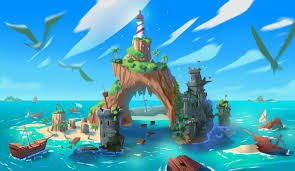
Ahoy! Being based around a pirate adventure finally paid off in this vacation that comes early for the bear and the bird when they visit this tropical island that serves as the second world. But not everything is a walk in the park since the usual perils await; sharks, pirates, annoying sea critters and of course animated inanimate objects like treasure chests and naval mines, all checked for stay at the resort.
The beach level is of course one of the staples in gaming. These worlds brimming with palm trees, water, sun and sand are not necessarily combined with the under water level (of which Banjo-Kazooie has its own twist) or the pirate level. But everything we associate with the surface of environments close to the sea are fair game. Their music is also as standardized, featuring steel pans, pedal steel guitars, or ukuleles. Instrumentation stereotypical to tropical islands and the Caribbean. Occasionally, it may invoke sailing with accordions if the pirates are part of the picture (like on here with an actual sea hippo pirate, where the music changes to an accordion rendition of the theme—which is in reality and harmonica sample pitched down). The beach world is usually one of the earlier levels, just as we see on this 3D platformer.
This level takes place on a tropical island in the middle of the ocean, with several pillars and elevated pathways made of stone that make up the geography of the land. The centerpiece is a large mountain forming an archway underneath, complete with a stone pillar holding a lighthouse. It serves as the main landmark for the players to find their way relative to it—just like the ant tower in the previous level; this is all part of the 3D level design language. The layout was perhaps a follow up to the second level of Super Mario 64, Whomp’s Fortress, which also features a central tower around which the level was constructed; Banjo-Kazooie levels are just less abstract and platformy and more exploratory and closer to real life environments. Treasure Trove Cove is massive as opposed to the more compact Mumbo’s Mountain.
Yet, when Grant Kirkhope was testing the waters, literally, for the music of this island, he originally zeroed in into just the tropical aspects of any island, creating a more peaceful track with a laidback feel. According to Grant, the music in this world originally had “a sort of Beach Boys ‘Wipe out’ middle section to it”. Chris Stamper, one of the two higher ups at Rare didn’t like it, so he had him change it. So, like the other earlier worlds, it was replaced due to its original lack of zaniness, which was a musical direction that came later into the time.
Like other beta version tracks, the original had more repetitive melodies and sections, with straightforward major tonality feel. It has some Caribbean percussion elements thrown in but it seems that Grant had in mind what Koji Kondo had in mind when he made the music for Yoshi’s Island, obviously based around and island too. Both had similar instrumentation and aboriginal feel but in Yoshi’s Island it fitted more since besides the island, the Yoshies also added a primitive, prehistoric layer thanks to the dinosaur themes.
Musical Analysis
Structure: {I – ABA’ CC’ B’A’ DB}
Tempo: 125
Melodic and Harmonic Profiles: C Ionian/Major; F# Ionian/Major
Since Treasure Trove Cove ended up being a fully fledged beach themed level, there simply wasn’t other option than to bring the calypso style into the picture; that means less oom-pah and more Caribbean rhythms. Calypso is a style of Caribbean music that originated in Trinidad and Tobago during the early to the mid-19th century and spread to the rest of the Caribbean Antilles by the mid-20th century. It is characterized by highly rhythmic and harmonic vocals alongside lots of syncopation. Its signature sound if of course the steel pan, more commonly known as steel drums. You cannot go wrong by deploying these on any beach level or even underwater settings, alongside other common used instruments like tuned wooden percussion, and Latin percussion. A well known example is the song ‘Under the Sea’ which uses similar instrumentation to Treasure Trove Cove:
Except that in the world of Grant Kirkhope everything becomes more epileptic and unpredictable; this tradition means that he has to shoehorn in as many different chords as possible and somehow end up with a cohesive track that is catchy, fun and complex at the same time. Let’s see if there is any logic that can be extracted from it.
Like on Mumbo’s Mountain the song follows a structure based around four different sections combined and recombined throughout the duration, creating even more variety by rearranging or altering the orchestration each time their return. Plus the intro, the structure can be seen as:
{I – ABA’ CC’ B’A’’DB}
There are some differences with the structure from Mumbo’s Mountain, like the placement of the A’ section or the fact that it does not end with D but instead adds one last reprise of the B section. Unlike, Mumbo’s level, There are no traces of the beta version of the theme here, with a brand new motif based around a particular rhythm that brings to mind certain Caribbean patterns from Soca music and the like. The main rhythmic motif that opens the melody (Dun dudunDu) is present as the basis for the melody in different forms on all sections except for the D section.
The intro is of the category of the accompaniment-setting types, like Mumbo’s Mountain. The melody immediately starts with section A, which is the section based around short and clear cut question-answer blocks. Grant removes himself quickly from the standard major tonality by using major profiles for the question and switching right away to minor profiles for the answer; so even this early the music begins getting Banjo-Kazooized. After four question-answer blocks— which together form a macro question-answer— we move to the B section which fulfills the same role as in Mumbo’s Mountain, we can call it the frantic or hopping section.
The harmony for the A section would be something like:
{ [ (C – Ab7 – C) – (C – Ab7 – C) ] – [ (C – Ab7 – C) – (C – Db – G7 – C) ] }
Minor chords beware, Grant does not need you. We see some of the Kirkhope favored patterns; we are safe for now from his tritone movement—at least on far inspection— but his I – bVI is the close second in his toolbox. The other technique favored by Grant, specially to end phrases of the sections is the bII – V – I. Why is this Kirkphonian? Well, instead of coming up with exotic scales and harmonic theory in order to come to terms with this cadence, it is better to just realize that the bII of the C Tonality is none other than the tritone chord of G, that is Db. So Grant can’t help it but to throw it in.
The B section, or frantic section, is not as frantic as it wants you to think it is. In fact, like on the Mumbo tune, it follows a predetermined harmonic pattern that serves to give that feeling of jumping in zigzag apt for any platformer game; it creates a feeling of rapid cascading key changes, demolishing any sense of tonality but still directed towards reaching a certain chord. The main rhythmic motif of the tune is transposed to different starting points following the chords played. Now we see Grant using the tritone of C, the F# to kickstart his mad journey through the following pairs:
(F# – B) – (F – Bb) – (Eb – Ab) – G
Grant Kirkhope went to town, visiting any chord. The pattern has some semblance of sanity in the fact that each pair can be conceptualized as a new key where it can be generalized as the chord movement I – IV; or, alternatively, after the first pair, from the F chord it moves counterclockwise throughout the circle of fifths: F – Bb – Eb – Ab. Then it is just a matter of moving a semitone down to go back to the C tonality and ending on its dominant chord, G.
After this, all the band enters and performs with more panache a new rendition of section A, the melody now harmonized on the steelpans. The drum set plays a Caribbean pattern that syncopates every other bar; there is no hi hat since that role is sufficiently covered by the Latin percussion. The “bass” of the cue is none other than the palm muted guitar sample played at lower registers; perhaps it was felt that its attack served the stye better than the more jazzy bass guitar sample.
C section ensues and it goes back to a question-answer format, just that now the melodic phrases are in long form. The beginnings of phrases still retain the main rhythmic motif slightly altered. The more woody sounding xylophone is called upon to help the tropical feeling. For this part the piece shifts the tonality to the tritone chord of C, that means we are now gravitating around F#. Nevertheless, the composer still keeps using the borrowed chords from the relative minor in order to get his precious I – bVI movement, among others. On this part, the two big question-answer blocks are not symmetric since the second goes to a different harmonic direction. The harmony for the C section is:
[F# – D7 – F# – B – F# – Ab – Db7]
[F# – C – Db – G – C]
We can see the moment the piece returns to a C based tonality when the F# changes abruptly to the C chord and the tune goes for the Kirkhopian bII – V – I again at the end of the phrase. The melody adapts naturally to its bed chords.
Apparently, C section is repeated after this with just a different instrument taking the lead and the marimba now fulfilling harmonic roles through its use of trills. However, the second block delves into another territory; finally, we get to hear, for the first and only time, a minor chord on the cue, the vi hopelessly trying to bring a sense of normalcy to a mix where Grant also tacked in the III of the scale too. So the progression for this new C section can be thought of as:
[F# – D7 – F# – B – F# – Ab – Db7]
[F# – Bb – Ebm – Ab – Db ]
After surviving an even more exciting B section the track puts on the brakes to make space for the audience to clap along to a more sparse A section, where the xylophone responds to the call of the melody with short snippets of the endings of phrases. The rhythm section begins to slowly enter one by one in preparation for bringing down the house on section D, where Grant brings new sonorities to a very unusual selection of chords, playing fast arpeggios and a new melody not based around the rhythmic motif; it is played by the xylophone and muted guitar in unison. The marimba plays the arpeggios adding sixths to the chords so they sound more beachy. The harmony is heard as:
C6 – F#6 – C6 – Bb (b6)
C6 – F#6 – C6 – Db6 – C6
few composers can work as smoothly with the disparate harmonic relationship between C, F# and Bb. Nevertheless, as you can see, Kirkhope still favors essentially the same movements like the one to sharp fourth and one to the flat major second. The song ends with one last frantic B section.
Here you can hear the “Instrumental” version of the track, which is just a stripped down version where the harmony is easier to hear:
Grant Kirkhope shows that nobody should fear going to any chord as long as the melody can keep up with the changes in a coherent and satisfying way, where order comes from chaos. He likes to paint himself into a corner by choosing difficult chords and then trying to get out by melodic inventiveness. In any case, it seems you can go a long way with just major chords. And after creating a complex theme for a level, it is now a matter of fiddling around by playing with the orchestration for different situations that present themselves on the environment.

Help to keep the rites going around here by supporting the shrine:

Media Files, requests and support for more interactive content

Thou shall donate since this is a cult and you are now a sheep

Help staying awake analyzing game tracks and writing posts or else everything will end up being written by A.I
- Inside The Score – The Legend of Zeda: A Link to the Past – End Credits / Staff Roll
 The land rests As the last few minutes of this extensive journey that has now come to an end fly by, the nostalgia and reflective mood kicks in. Because such a massive enterprise as a Zelda game or a Lord of the Rings movie require multiple endings to convey everything… Read More »Inside The Score – The Legend of Zeda: A Link to the Past – End Credits / Staff Roll
 - Inside The Score – The Legend of Zelda: A Link to the Past – Ending / Epilogue ~ Beautiful HyruleFinal of the fantasy The Triforce has been touched. A wish has been granted. For the occasion, the newly undeceased king of Hyrule has commissioned a march in honor of the legendary hero to the Hylian Sousa, who might as well be composer Nobuo Uematsu since this piece is very… Read More »Inside The Score – The Legend of Zelda: A Link to the Past – Ending / Epilogue ~ Beautiful Hyrule
- Inside The Score – The Legend of Zelda: A Link to the Past – Triforce Chamber / Power of the GodsTake your boots off your feet And thus the Triforce spoke to men. And it became present in history. And you better treasure and contemplate this moment seldom witnessed in the course of the series. The elusive opportunity to interact and touch the most important artifact. You are now in… Read More »Inside The Score – The Legend of Zelda: A Link to the Past – Triforce Chamber / Power of the Gods
- Inside The Score – The Legend of Zelda: A Link to the Past – Ganon Battle / Prince of DarknessProgressive evil En Garde! And you better be prepared since you are about to duel the iconic enemy of the series at perhaps his canonically most powerful incarnation. Right after having touched the sacred Triforce which allowed him to conquer all of the Golden Land and whose evil and darkness… Read More »Inside The Score – The Legend of Zelda: A Link to the Past – Ganon Battle / Prince of Darkness
- Inside The Score – The Legend of Zelda: A Link to the Past – Boss Battle / Anger of the GuardiansQuick mayhem Ah, the simpler times when boss battles where not a multi epic orchestral suite but just an ostinato more basic that even what became the music for standard battle encounters out there. We are a long way from each boss having his own personalized track. And this early… Read More »Inside The Score – The Legend of Zelda: A Link to the Past – Boss Battle / Anger of the Guardians
- Inside The Score – The Legend of Zelda: A Link to the Past – Dark World Dungeon / Dungeon of ShadowsMemento mori We are getting closer to Ganondorf (or at least the wizard Agahnim who ultimately fulfills the same human side of evil role in this game) and that means getting closer to the profiles and motifs of his own theme song (which naturally was the theme of Agahnim at… Read More »Inside The Score – The Legend of Zelda: A Link to the Past – Dark World Dungeon / Dungeon of Shadows