Slavic frantic fun
Taking the maxim you are what you eat to the extreme, the Sanrio-like puffy, cute, pink…thing known as Kirby is the pampered child of the Super Smash Bros. series, being also created by the fighting series director Masahiro Sakurai for the Game Boy and developed by HAL Laboratory—there is a reason why he is the only one that survives the world of light massacre. Throughout most of his adventures Kirby journeys across Dream Land, a fictional country on the distant Planet Popstar, to protect it from alien invaders and other threats to his home, often with eldritch abominations as final bosses.
In development, Kirby’s design was originally intended to be a mere placeholder for the Player Character. However, Sakurai grew attached to the Waddling Head, and decided to stray from the plan and keep him as the protagonist. He was initially known as Popopo, the star of Twinkle Popo, but this was wisely rechristened from a list of name candidates. It helped that the lawyer who defended Nintendo in an important lawsuit from Universal involving Donkey Kong was named John Kirby.
Hirokazu Ando, the composer of the first Super Smash Bros. game is also very familiar with Kirby seeing that he personally composed many of the games from the franchise; however, curiously one of his own compositions was not selected to represent the Kirby series in this fighting title. Instead, we get what was at the time a rather obscure track from original series’ composer Jun Ishikawa, an inhouse composer from HAL. The frantic pace of the music that accompanied a mini-game included in the SNES game Kirby Super Star, Gourmet Race, fit perfectly the tone of the Super Smash Series and went on to become one of the staples of both series, becoming the most recognizable piece to come off the Kirby franchise without being remotely close to being the main theme, unlike the other characters represented in the game which have their series’ iconic theme as their stage background music.
Dream Land
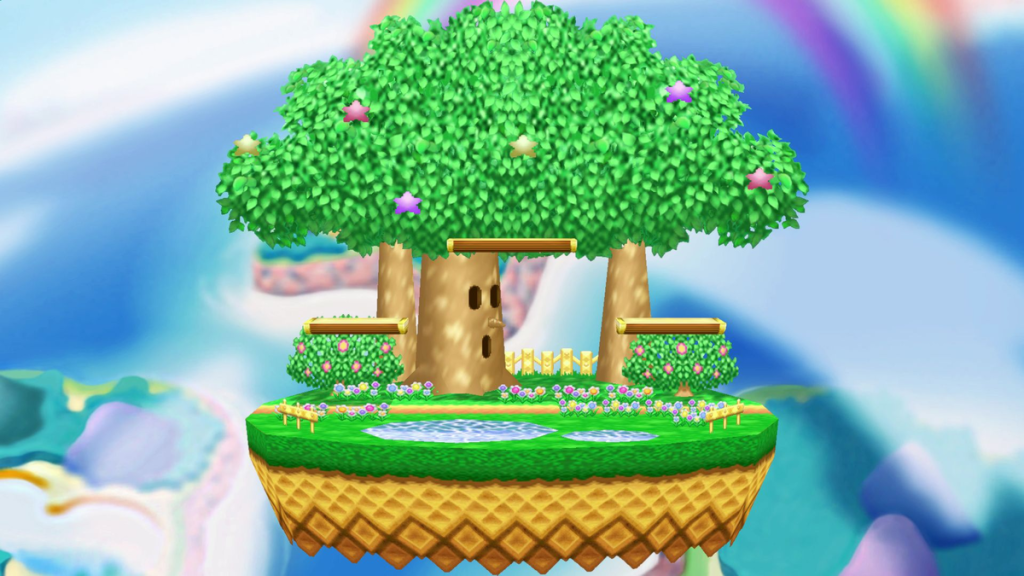
This stage is loosely based on Green Greens, which is located in Dream Land, from Kirby’s Dream Land and Kirby Super Star‘s Spring Breeze. Whispy Woods, a sentient apple tree, first appeared in Kirby’s Dream Land as the first boss and has appeared in numerous Kirby games since. In most games, he attacks by dropping apples over Kirby and shooting gusts of air at him. In this stage, Whispy Woods still blows out air, but this only pushes fighters without damaging them.
The theme uses the infectious fast oom-pah rhythms reminiscent of Russian folk music to set the chaotic tone alongside a simple harmony in the C minor tonality, which then goes on to the relative Eb major tonality. It sticks close to the original arrangement from the SNES game, not adding the characteristic extended harmony that plagues other Smash 64 tunes. It mainly focuses on a i to iv progression after a descending intro of Fm – Gm – Ab – G. It uses sparingly the VII chord to finish the phrases.
The composition is all about the melody, instrumentation and jumping rhythms. When it goes to the relative major it focuses on the famous Pachelbel’s Canon chord progression, ending with a sus chord in order to loop, just like the Lost Woods theme from Ocarina of Time.
Here you can hear the “instrumental”version followed by the melodic one.
Kirby Victory Theme
Like the other combatants, Kirby’s victory theme is the short recurring theme that plays when Kirby completes a stage or defeats a boss, debuting in Kirby’s Dream Land (though the shortened version that this track is based on debuted in Kirby’s Adventure composed by the same guy in charge of this Super Smash Bros. entry). It is a fun celebratory flourish in the key of A major which also ends with the characteristic extended harmony prevalent in the music arrangements from Super Smash Bros. 64. Here you can see the track deconstructed.
Help to keep the rites going around here by supporting the shrine:

Media Files, requests and support for more interactive content

Thou shall donate since this is a cult and you are now a sheep

Help staying awake analyzing game tracks and writing posts or else everything will end up being written by A.I
- Inside The Score – The Legend of Zeda: A Link to the Past – End Credits / Staff Roll
 The land rests As the last few minutes of this extensive journey that has now come to an end fly by, the nostalgia and reflective mood kicks in. Because such a massive enterprise as a Zelda game or a Lord of the Rings movie require multiple endings to convey everything… Read More »Inside The Score – The Legend of Zeda: A Link to the Past – End Credits / Staff Roll
 - Inside The Score – The Legend of Zelda: A Link to the Past – Ending / Epilogue ~ Beautiful HyruleFinal of the fantasy The Triforce has been touched. A wish has been granted. For the occasion, the newly undeceased king of Hyrule has commissioned a march in honor of the legendary hero to the Hylian Sousa, who might as well be composer Nobuo Uematsu since this piece is very… Read More »Inside The Score – The Legend of Zelda: A Link to the Past – Ending / Epilogue ~ Beautiful Hyrule
- Inside The Score – The Legend of Zelda: A Link to the Past – Triforce Chamber / Power of the GodsTake your boots off your feet And thus the Triforce spoke to men. And it became present in history. And you better treasure and contemplate this moment seldom witnessed in the course of the series. The elusive opportunity to interact and touch the most important artifact. You are now in… Read More »Inside The Score – The Legend of Zelda: A Link to the Past – Triforce Chamber / Power of the Gods
- Inside The Score – The Legend of Zelda: A Link to the Past – Ganon Battle / Prince of DarknessProgressive evil En Garde! And you better be prepared since you are about to duel the iconic enemy of the series at perhaps his canonically most powerful incarnation. Right after having touched the sacred Triforce which allowed him to conquer all of the Golden Land and whose evil and darkness… Read More »Inside The Score – The Legend of Zelda: A Link to the Past – Ganon Battle / Prince of Darkness
- Inside The Score – The Legend of Zelda: A Link to the Past – Boss Battle / Anger of the GuardiansQuick mayhem Ah, the simpler times when boss battles where not a multi epic orchestral suite but just an ostinato more basic that even what became the music for standard battle encounters out there. We are a long way from each boss having his own personalized track. And this early… Read More »Inside The Score – The Legend of Zelda: A Link to the Past – Boss Battle / Anger of the Guardians
- Inside The Score – The Legend of Zelda: A Link to the Past – Dark World Dungeon / Dungeon of ShadowsMemento mori We are getting closer to Ganondorf (or at least the wizard Agahnim who ultimately fulfills the same human side of evil role in this game) and that means getting closer to the profiles and motifs of his own theme song (which naturally was the theme of Agahnim at… Read More »Inside The Score – The Legend of Zelda: A Link to the Past – Dark World Dungeon / Dungeon of Shadows