Space opera
Stepped in the shoulders of giants, the music from the epic space opera…for some reason featuring anthropomorphic animals…called Star Fox—because of course every good space war drama needs to have the word “star” on its name—displays proudly its influences on its sleeve, synthesizing its sound from a mixture of the influential Planets suite from Gustav Hoist (especially Mars), which itself influenced the score for Star Wars (it was actually used as a tempt track), combined with the romantic pomposity of adventure films from the 30s and the patriotic military music featuring snare drum for marching. However, the two main influences for the presentation of these games were the British puppet show Thunderbirds and the recently released film Independence Day. More about Star Fox music can also be found over here
Originally, the idea of the Star Fox series was to showcase the newly developed Super FX chip for the SNES, which allowed to create 3D graphics with polygons; the perfect game to demonstrate this was a space shooter on rails. The animals were only added later thanks to the quirky sensibilities of game developer Shigeru MIyamoto, who was inspired by the similarity between the long lines of Shinto gates in Kyoto and the gates the Arwings had to cross in the game; Miyamoto finally settled on having a fox as the main character after visiting Fushimi Inari-taisha in Kyoto, the head shrine of Inari, a Japanese kami associated with foxes. Inari is portrayed as being able to fly, and its shrines, particularly the one in Kyoto, are surrounded by red arches, giving Miyamoto the idea of a fox that could fly through arches.
You can see the arches and the fox here:
https://en.wikipedia.org/wiki/Fushimi_Inari-taisha
Another game designer, Inamura, used Japanese folklore as an inspiration to add a bird named Falco—but he is actually a pheasant—and a hare as two other protagonists. He also added a toad; the inspiration came from a staff member of Nintendo EAD who used a toad as his personal mascot. Imamura populated the Cornerian army with dogs and the enemy army with monkeys, and made General Pepper a dog and Andross a monkey, since there is a Japanese expression about fighting like dogs and monkeys.
The main theme of the Star Fox series written by composer Koji Kondo replaces the original main theme of the series written for the original game, since Star Fox 64 is a reimagining of that first game combined with elements from the cancelled sequel. Th score for the N64 game mixes the romantic grandeur of film scoring with martial music. Koji Kondo wrote the main leitmotifs for the Star Fox team and ending of the game while composer Hajime Wakai wrote the music for the stages. The triumphant score from Kondo contrasts with the war infused scores from Wakai. The two main influences on the music, just like the games themselves, were the award winning score of the recently released movie Independence Day and the TV show Thunderbirds, which also combined The Planets suite with Hollywood adventure music and military bugle calls, fanfares and marching snares.
Sector Z
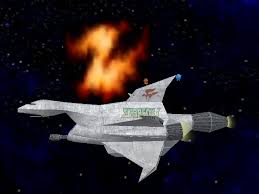
One of the two stages that never returned to the Smash Bros. series (alongside planet Zebes) since it was coopted by other pars of the universe, namely planet Corneria, also featuring the Great Fox, the huge ship that carries the team across space. It was the largest stage on the original game. This stage is based on the Sector Z level from Star Fox 64, named lile this because of its Z shaped nebula in the background. On this level, Invader III ships attempted to ambush the Great Fox, Star Fox’s mobile headquarters, by firing six Copperhead Missiles at it; hence the reason why it is the best stage to put the Great Fox on. Also in this stage are the Arwings themselves, Star Fox’s signature aircraft, that occasionally fly above the stage and are based on their appearance in Star Fox 64; they also appear to have one Laser Upgrade as they fire two lasers at once as opposed to the standard one. Probably Falco, the best pilot because he is a bird, is the one flying it.
The version of the main theme heard in Smash Bros is the one normally heard whenever the team is beginning a mission; sadly, it does not feature the same parts that are used on the intro, which has an extra section where the timpani become more intense playing in eights and there is a string ostinato propelling the action and making the theme feel darker (although this one contains the extended outro at least). It is also sparser since it does not have a horn section. Like many adventure focused pieces, it its a modal composition that mostly uses the Mixolydian and Phrygian major profiles. The trumpets play a harmonized melodies creating various kinds of suspended chords and other non major/minor ones which make the piece feel less light and more menacing. Curiously, the the second loop of the piece interchanges the real trumpets with the synthetic ones for Section 1.
Fox Victory Theme
Mission Accomplished. The galaxy is saved or, rather, Fox just managed to score a victory against Pikachu in a one on one battle from Super Smash Bros.
Like most of the other victory themes, this one is based in one of the celebratory cues from the parent series, in this case the mission completed successfully from Star Fox 64 composed by Koji Kondo. This is just a snippet of the full track from the game and goes quickly to the coda. The theme itself is based on rhythmic and harmonic motifs taken from the main theme of the series. As Koji Kondo often does in his celebratory cues, it uses the so called Mario cadence with the bass pointing towards a bVI-bVII-I resolution using the G scale.
Help to keep the rites going around here by supporting the shrine:

Media Files, requests and support for more interactive content

Thou shall donate since this is a cult and you are now a sheep

Help staying awake analyzing game tracks and writing posts or else everything will end up being written by A.I
- Inside The Score – The Legend of Zeda: A Link to the Past – End Credits / Staff Roll
 The land rests As the last few minutes of this extensive journey that has now come to an end fly by, the nostalgia and reflective mood kicks in. Because such a massive enterprise as a Zelda game or a Lord of the Rings movie require multiple endings to convey everything… Read More »Inside The Score – The Legend of Zeda: A Link to the Past – End Credits / Staff Roll
 - Inside The Score – The Legend of Zelda: A Link to the Past – Ending / Epilogue ~ Beautiful HyruleFinal of the fantasy The Triforce has been touched. A wish has been granted. For the occasion, the newly undeceased king of Hyrule has commissioned a march in honor of the legendary hero to the Hylian Sousa, who might as well be composer Nobuo Uematsu since this piece is very… Read More »Inside The Score – The Legend of Zelda: A Link to the Past – Ending / Epilogue ~ Beautiful Hyrule
- Inside The Score – The Legend of Zelda: A Link to the Past – Triforce Chamber / Power of the GodsTake your boots off your feet And thus the Triforce spoke to men. And it became present in history. And you better treasure and contemplate this moment seldom witnessed in the course of the series. The elusive opportunity to interact and touch the most important artifact. You are now in… Read More »Inside The Score – The Legend of Zelda: A Link to the Past – Triforce Chamber / Power of the Gods
- Inside The Score – The Legend of Zelda: A Link to the Past – Ganon Battle / Prince of DarknessProgressive evil En Garde! And you better be prepared since you are about to duel the iconic enemy of the series at perhaps his canonically most powerful incarnation. Right after having touched the sacred Triforce which allowed him to conquer all of the Golden Land and whose evil and darkness… Read More »Inside The Score – The Legend of Zelda: A Link to the Past – Ganon Battle / Prince of Darkness
- Inside The Score – The Legend of Zelda: A Link to the Past – Boss Battle / Anger of the GuardiansQuick mayhem Ah, the simpler times when boss battles where not a multi epic orchestral suite but just an ostinato more basic that even what became the music for standard battle encounters out there. We are a long way from each boss having his own personalized track. And this early… Read More »Inside The Score – The Legend of Zelda: A Link to the Past – Boss Battle / Anger of the Guardians
- Inside The Score – The Legend of Zelda: A Link to the Past – Dark World Dungeon / Dungeon of ShadowsMemento mori We are getting closer to Ganondorf (or at least the wizard Agahnim who ultimately fulfills the same human side of evil role in this game) and that means getting closer to the profiles and motifs of his own theme song (which naturally was the theme of Agahnim at… Read More »Inside The Score – The Legend of Zelda: A Link to the Past – Dark World Dungeon / Dungeon of Shadows