Gotta Throw ‘Em Out
It all started with a game concept about capturing bugs and here we are, the highest grossing multi-billion dollar media franchise and pretty much the culmination of the transmedia concept, each avenue pursued feeding the other one in a perfect feedback loop. And it is not even an old one, having appeared in the 90s and overtaking all the American IPs. That is how quickly the pocket monsters took over the entire world which has not been able to let go of its grasp.
Released in Japan in February of 1996 for the Game Boy, Pokémon was meant as an artificial form of insect collecting for kids that lived in cities and thus couldn’t participate in such a hobby other than in digital form (as the original creator was a bug collector when he was a kid), with the paired versions providing incentive for players to get together and trade creatures with their friends.
While a handful of composers contribute to the music of more recent titles (including outsider Toby Fox from Undertale fame), director and composer Junichi Masuda was exclusively responsible for the soundtrack of 1996’s Pokémon Red and Blue (originally released as Red and Green in Japan). They crafted the unmistakable core musical identity of Pokémon that’s heard across each and every game that followed, sprung from 8-bit counterpoint due to the composer maximizing the mere four channels of sound allowed by the Game Boy and creating the illusion of richer harmony.
Saffron City
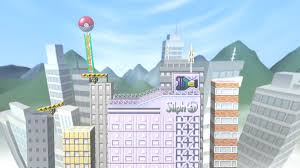
This stage is based on the city from Pokémon Red and Green. Saffron City is the second largest city in the Kanto region, and one of the largest cities in the entire series. The main building, Silph Co., is a major producer of items that benefit Pokémon trainers, such as Potions, Repels, Technical Machines, and various Poké Balls. In Pokémon Red and Blue, Team Rocket orchestrates an invasion of Silph Co. to steal their top-secret project, the Master Ball. Upon their defeat, the Saffron Gym becomes accessible. This stage takes place on top of the roof of Silph Co.; however, its design is different than how it originally appears in the Pokémon games. The other buildings, including the ones in the background, do not bear resemblance to any building in Pokémon Red and Blue’s Saffron City; it seems they just recreated a Pokemon city since there was not a 3D reference. However, they do in fact resemble the taller skyscrapers that are shown to make up the city in the Pokémon anime and in the Pokémon Adventures manga, meaning that the overall design of Saffron City in Smash was most likely inspired more by the anime and manga than the games.
There’s one musical element that screams Pokémon adventure like no other tough, the [I – bVII – I] chord progression; some of Pokémon‘s most important themes are centered around it. They are a staple chord movement from the Mixolydian profile and, just like on The Legend of Zelda series, it is combined with other modes to keep things interesting. It is a profile that screams adventures full of wonders and difficult tasks.
The melody also has what is known as the Mitsuda Lick, the little descending chromatic phrase that is heard in many RPGs, including those by composer Yasunori Mitsuda for the Chrono series, Undertale, and ultimately originating in The Legend of Zelda as the short whistle theme.
The main theme of the series or “Title Screen” composed by Game Freak’s sound programmer and also game designer Junichi Masuda has technically two songs stitched together, making it feel as if it has two intros. The first one is a call to battle with marching music pumping the pokemon trainers, then the theme itself starts with the adventurous Mixolydian feel. It goes back and forth between the [I -bVII] (the Smash bros version actually replaces the bVII by the v which also belongs to the Mixolydian profile of G). When the strings take the lead in a contrasting section the piece goes to borrowed chords from the G major and minor tonalities, including the bIII, the IV and the V.
As was pointed out, the Smash Bros arrangement uses the more melancholic I – v progression as its basis. It uses deep drums in order to accentuate the sense of battle. The counterpoint is exemplified by the sole trombone responding to the main melody whenever it leaves a vacuum and then playing its own thing.
Pokemon Victory Theme
The victory theme for both mascot Pikachu and puffy Jigglypuff is a small excerpt of the title theme, and thus the Smash stage, for the first generation of Pokémon, a track which would go on to become the Pokémon main theme for the entire series. The theme is naturally abridged.
It is unorthodox in the context of the Smash 64 ost since normally it would take a victory or triumph cue from the series and apply it to the characters’ victory here; instead of using, say, the Pokemon battle win cue or winning against a gym leader, it just rearranges the same main theme of the series unlike for the other characters in the rooster. Thus we end with the same Mixolydian feeling and the quick cadence. The melody is directly taken from the cadence of the A section of the main theme.
The arranger does not bother to bring a trombone or the synth tuba; it just uses the trumpet samples for the low brass.
Here you can watch and hear that theme deconstructed.

Help to keep the rites going around here by supporting the shrine:

Media Files, requests and support for more interactive content

Thou shall donate since this is a cult and you are now a sheep

Help staying awake analyzing game tracks and writing posts or else everything will end up being written by A.I
- Inside The Score – The Legend of Zeda: A Link to the Past – End Credits / Staff Roll
 The land rests As the last few minutes of this extensive journey that has now come to an end fly by, the nostalgia and reflective mood kicks in. Because such a massive enterprise as a Zelda game or a Lord of the Rings movie require multiple endings to convey everything… Read More »Inside The Score – The Legend of Zeda: A Link to the Past – End Credits / Staff Roll
 - Inside The Score – The Legend of Zelda: A Link to the Past – Ending / Epilogue ~ Beautiful HyruleFinal of the fantasy The Triforce has been touched. A wish has been granted. For the occasion, the newly undeceased king of Hyrule has commissioned a march in honor of the legendary hero to the Hylian Sousa, who might as well be composer Nobuo Uematsu since this piece is very… Read More »Inside The Score – The Legend of Zelda: A Link to the Past – Ending / Epilogue ~ Beautiful Hyrule
- Inside The Score – The Legend of Zelda: A Link to the Past – Triforce Chamber / Power of the GodsTake your boots off your feet And thus the Triforce spoke to men. And it became present in history. And you better treasure and contemplate this moment seldom witnessed in the course of the series. The elusive opportunity to interact and touch the most important artifact. You are now in… Read More »Inside The Score – The Legend of Zelda: A Link to the Past – Triforce Chamber / Power of the Gods
- Inside The Score – The Legend of Zelda: A Link to the Past – Ganon Battle / Prince of DarknessProgressive evil En Garde! And you better be prepared since you are about to duel the iconic enemy of the series at perhaps his canonically most powerful incarnation. Right after having touched the sacred Triforce which allowed him to conquer all of the Golden Land and whose evil and darkness… Read More »Inside The Score – The Legend of Zelda: A Link to the Past – Ganon Battle / Prince of Darkness
- Inside The Score – The Legend of Zelda: A Link to the Past – Boss Battle / Anger of the GuardiansQuick mayhem Ah, the simpler times when boss battles where not a multi epic orchestral suite but just an ostinato more basic that even what became the music for standard battle encounters out there. We are a long way from each boss having his own personalized track. And this early… Read More »Inside The Score – The Legend of Zelda: A Link to the Past – Boss Battle / Anger of the Guardians
- Inside The Score – The Legend of Zelda: A Link to the Past – Dark World Dungeon / Dungeon of ShadowsMemento mori We are getting closer to Ganondorf (or at least the wizard Agahnim who ultimately fulfills the same human side of evil role in this game) and that means getting closer to the profiles and motifs of his own theme song (which naturally was the theme of Agahnim at… Read More »Inside The Score – The Legend of Zelda: A Link to the Past – Dark World Dungeon / Dungeon of Shadows