The original side of smash
Here is where we get to the extra content and tracks found in the first game. We get a sample of some original compositions by the Smash Bros. arragenr Hitokazu Ando, including the bonus mini games and one for Metal Mario who curiously does not use the one he already got in Super Mario 64.
Bonus Game
We could not leave the series behind before at least taking a look at a couple of original contributions by composer Hirokazu Ando to the soundtrack of the game he so expertly arranged, being entrusted with updating some of the most iconic pieces of video game music for the N64 era.
In this case we are visualizing the Bonus stage music, heard on any Break the Targets or Board the Platforms challenges, and in Race to the Finish. Sadly, these are modes that have not returned in the modern entries of the series since they were personalized for each of the characters and their abilities; perhaps it ia almost impossible to make an stage now that there are many more characters. The piece also serves as the basis for other cues in the game like the VS Results.
The music is a simple and catchy bluesy song which Ando is able to jazzify with his characteristic extended harmony that pervaded a lot of his arrangements. Like any good blues it has a swing feel and the melody is based mostly in call and response between the organ and Rhodes piano on the one hand and the synthesized choirs on the other. It has a very elaborate drum beat composed of not one but two drum kits, one of them with more electronic samples. It is based around a bass line that is then transposed a step and a half up. There is a tension in the ostinato since it uses a tritone interval as opposed to the expected perfect fourth. There are three short sections that compose the piece, an intro and A and B. The A section is the boogie-woogie one while the B sections introduces a more futuristic, lounge like vibe which fits the ambiguous dimension where these bonus games take place.
Meta Crystal
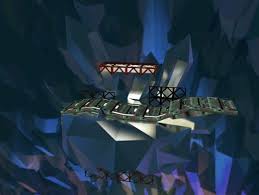
Time to bring on the heavy metal….alongside actual metal sounds and electricity, or at least percussion that is clearly intended to mimic the ferrum footsteps of our opponent. These sounds receive star billing and are immersed in a thunderstorm of electric guitar sounds, whose fundamental notes are obscured, leaving behind only the high frequency hiss of the instrument which contributes to the electrifying ambient of the stage, which is based around the original home of metal Mario in Super Mario 64, the Hazy Maze level full of iron platforms and diamonds. This stage is loosely based on Cavern of the Metal Cap, a secret area; its setting takes place in an underground area decorated with glimmering crystals.
The tune itself, or tuneless track more accurately since the melody is just an extended solo, is a showcase of progressive rock skills from the mandolin instrument playing a complex flurry of notes as a background for the track. The bass follows a i – bVI – bVII – i epic progression in the minor scale of G. The cue was composed by Hirokazu Ando without taking elements from the original metal Mario theme, which is based around the invincibility Mario music, neither the Hazy Maze Cave level. It is an original meant to engulf the Metal Mario fight in metallic and electric sounds. The snare is used in unnatural ways by taking three samples on different registers, making it sound like heavy hits in the underground. Meanwhile the cymbals are just following the menacing steps of Metal Mario against the factory floor. Hey, even the attack of the electric guitar sounds like metal steps. A frantic track for a frantic battle. A true metal composition.
Ans there are also a couple of bonus characters from other series that do not have their own stage but indeed they have their own victory themes. Here they are.
Ness Victory Theme
The wild card of the original Super Smash Brothers. Psychic but otherwise normal kid known as Ness comes representing the wacky, off-the-wall fun that is the unconventional RPG Mother series, a story about an alien invasion full of strange characters and settings. One thing becomes very apparent when you start playing Earthbound, as it is known in the west: this is not your average, ordinary role-playing game. There are no swords or magical flames to be found, no medieval kings to converse with, no princesses to rescue, nothing that is even remotely thought of when it comes to your typical RPG. Instead, Earthbound focuses on a rather modern setting. The hook is that everything takes place on pretty much modern America and you have to interact with people who are quirky characters and parodies of Eagleland. Oddly enough, this is the reason the game can feel so strange and bizarre, creating a rabid fanbase and naturally becoming a cult classic in the process. Neither its creator nor the main composer belong to the game industry; Shigesato Itoi is a Japanese celebrity essayist and advertiser who just wanted to experiment in a new medium and thanks to his friendship with Shigeru Miyamoto managed to convince the company to fund his game. He brought in Japanese rock musician Keiichi Suzuki to write music for the series in collaboration with Hip Tanaka since, as someone from the record industry, he didn’t know anything about implementing music for video games.
This is the reason why the music is eclectic and varied; The soundtrack ranges from retro styled science fiction soundscapes to uplifting and bubbly pop, rock, dub and Latin music, alongside some jazzy elements. Pretty much everything under the sun is fair game. The main influences of the composers were 60s popular music like The Beatles, The Beach Boys and Frank Zappa.
Since there is no stage for Mother in the original Smash for the N64—Ness is relegated to appear in the Dream Land stage because he is a brother of Kirby, seeing as both were developed by the same company—the only representative piece of music from the series comes from the victory cue, which is an arrangement of the epic lullaby known as “Eight Melodies”. In EarthBound the songs is inherited through Ness’s childhood memories and is the key to unlock his own pure land, his inner consciousness in order to fight the evil within him. To truly understand himself and enter his mind, Ness must collect all eight of these melodies to gain access to his own Dream Land. Unlike the original eight melodies from the NES Mother 1, this composition is different and is in G major. It focuses mostly on the major pentatonic scale, sounding sweet and yearning as a typical lullaby and the pop music of the 60s.
This arrangement shifts the key to Db and sprinkles in the extended harmony favored by the original Super Smash Bros. cues. It uses a funky bass line to anchor the piece. Here you can see the track deconstructed.
Captain Falcon Victory Theme
Speaking of electrifying music…if you are able to read this it means you are not playing F-Zero and a new game has not been announced and will never be announced. This is because of its category as the “other” racing franchise from Nintendo, focusing on high octane speed achieved by frictionless anti-gravity vehicles and futuristic settings; naturally its music is also high octane and full of power. The series is known for pushing technological limits to be one of the fastest racing games around. It has remained in popular culture mostly thanks to the recurrent call to action of its protagonist Captain Falcon into the ring of Super Smash Bros.
The power of the engines of these formula zero vehicles can only be matched by those growling, razor like sounds of distorted guitars and ear splitting drum hits that are the bread and butter of hard rock, a genre that with only three instruments can match the punch of a 70 piece orchestra.
Or at least that is the vibe these sampled sounds are trying to emulate in both the original game and this Smash arrangement: the distortion of hard rock and power metal scores that characterize the series. Taken from the Nintendo 64 entry, the victory theme of Captain Falcon is obviously the same as the cue heard whenever you cross the final goal in one of those dangerous, high speed races. The score was originally composed by Taro Bando, a Nintendo employee normally not heard of in relationship with music since he is actually a sound designer and audio director, he just happened to score this game maybe because he is the rocker of the company or really wanted to tackle this project.
The electric guitar infused score imitates the audio signal processing sound of distorted guitars common in rock alongside its corresponding limitations in what intervals of notes commonly sound pleasant in those conditions; we are talking about what are known as power chords, a colloquial term for a perfect fifth interval when played on an overdriven guitar as well as possibly octaves of those notes. When a typical chord containing such intervals (for example, a major or minor chord) is played through distortion, the number of different frequencies generated, and the complex ratios between them, can make the resulting sound messy and indistinct, so rock musicians are pretty much stuck with perfect fifths and less dynamic range—palm muting is often the only means of generating dynamics, otherwise it is pure rage—However, in a power chord or the other perfect intervals, the ratio between the frequencies of the root and the perfect are very close to the just interval. When played through distortion, what is known as intermodulation leads to the production of partials closely related in frequency to the harmonics of the original two notes, producing a more coherent sound. That is the technical explanation, the correct explanation is that it sounds badass. The sustain allowed by distortion also permits players to create howling sounds when pitch bending a string of the guitar, this is being tried to emulate here with samples.
The arrangement uses perfect intervals on the guitars (one playing chords, the other just the root to create layering of distortion, a common technique in loud, aggressive rock music), a new electric bass sample with a fuzzier tone and powerful psychotic drums unlike any of the other tracks from the game. The guitars and bass use bends to be faithful to the genre but even then the arranger felt it was not enough to convey the sound of a true guitar bend, so he added a triangle wave sound on top to make the effect as realistic as possible on the hardware. There are also some cymbals and a single snare sound reinforcing the percussion of the track.
The harmony comes down mostly to a minor pentatonic scale in power chords with some blues notes, a staple of hard rock too. Just a cool lick with a cadence in E minor tonality, which any guitarist is familiar with. The drums follow the strong beats of the melody close and the bass is used to reinforce the root exclusively.
Help to keep the rites going around here by supporting the shrine:

Media Files, requests and support for more interactive content

Thou shall donate since this is a cult and you are now a sheep

Help staying awake analyzing game tracks and writing posts or else everything will end up being written by A.I
- Inside The Score – The Legend of Zeda: A Link to the Past – End Credits / Staff Roll
 The land rests As the last few minutes of this extensive journey that has now come to an end fly by, the nostalgia and reflective mood kicks in. Because such a massive enterprise as a Zelda game or a Lord of the Rings movie require multiple endings to convey everything… Read More »Inside The Score – The Legend of Zeda: A Link to the Past – End Credits / Staff Roll
 - Inside The Score – The Legend of Zelda: A Link to the Past – Ending / Epilogue ~ Beautiful HyruleFinal of the fantasy The Triforce has been touched. A wish has been granted. For the occasion, the newly undeceased king of Hyrule has commissioned a march in honor of the legendary hero to the Hylian Sousa, who might as well be composer Nobuo Uematsu since this piece is very… Read More »Inside The Score – The Legend of Zelda: A Link to the Past – Ending / Epilogue ~ Beautiful Hyrule
- Inside The Score – The Legend of Zelda: A Link to the Past – Triforce Chamber / Power of the GodsTake your boots off your feet And thus the Triforce spoke to men. And it became present in history. And you better treasure and contemplate this moment seldom witnessed in the course of the series. The elusive opportunity to interact and touch the most important artifact. You are now in… Read More »Inside The Score – The Legend of Zelda: A Link to the Past – Triforce Chamber / Power of the Gods
- Inside The Score – The Legend of Zelda: A Link to the Past – Ganon Battle / Prince of DarknessProgressive evil En Garde! And you better be prepared since you are about to duel the iconic enemy of the series at perhaps his canonically most powerful incarnation. Right after having touched the sacred Triforce which allowed him to conquer all of the Golden Land and whose evil and darkness… Read More »Inside The Score – The Legend of Zelda: A Link to the Past – Ganon Battle / Prince of Darkness
- Inside The Score – The Legend of Zelda: A Link to the Past – Boss Battle / Anger of the GuardiansQuick mayhem Ah, the simpler times when boss battles where not a multi epic orchestral suite but just an ostinato more basic that even what became the music for standard battle encounters out there. We are a long way from each boss having his own personalized track. And this early… Read More »Inside The Score – The Legend of Zelda: A Link to the Past – Boss Battle / Anger of the Guardians
- Inside The Score – The Legend of Zelda: A Link to the Past – Dark World Dungeon / Dungeon of ShadowsMemento mori We are getting closer to Ganondorf (or at least the wizard Agahnim who ultimately fulfills the same human side of evil role in this game) and that means getting closer to the profiles and motifs of his own theme song (which naturally was the theme of Agahnim at… Read More »Inside The Score – The Legend of Zelda: A Link to the Past – Dark World Dungeon / Dungeon of Shadows