Doom-Pah
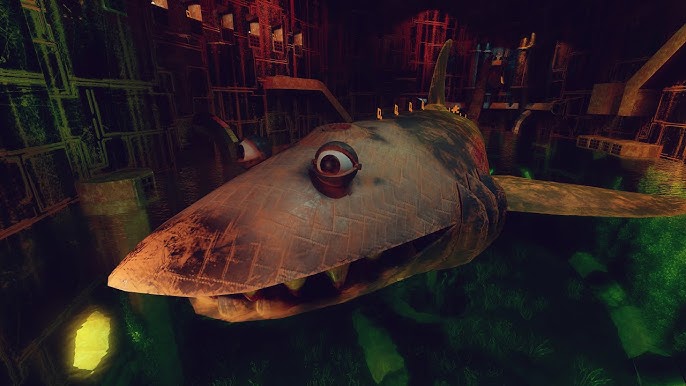
Nobody does nastiness quite like Rareware. This is how not even Mario, who ironically is an actual plumber, dares to put up with the level of filthiness that the poor bear and bird have to deal with in their adventures. What even happened to the underwater level? We were supposed to look forward to spend some quality time with amicable fishes, mermaids, sea stars and only deal with sharks and other non-mutant critters. Instead, we are presented with a Banjo-Kazooie specialty, the decayed industrial complex; serving as the first in the trilogy of bleak and dirty sites that the protagonists visit alongside Rusty Bucket Bay and Grunty Industries. The absurdly spacious sewer known as Clanker’s Cavern is a tonal shift that thoroughly cements Banjo-Kazooie as not your standard cute mascot platformer.
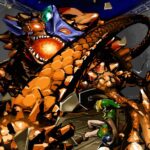
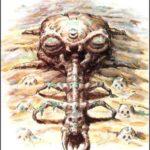
It almost was not so since it appears that the concept for the world came later in development even though in-game it serves as the third level. It seems that, originally, Rare was planning for this to be a kind of forest themed level with big water bodies named Fungus forest. In fact, it is in this forest were we are able to get a glimpse of how the eponymous Clanker looked like before Gruntilda got ahold of him in order to serve as her disposal grinder, slowly adding mechanical parts to what was originally a fully organic creature..Yikes! The level was canned perhaps due to being perceived as too straightforward and similar to Mumbo’s Mountain. It resurfaced years later on a different game, Donkey Kong 64, where the theme music that Grant Kirkhope had originally composed was reworked into it (named Temple in the beta archives). Since there also exists an early version of the music for what ended up being Atlantis in Banjo-Tooie, it is likely that Fungus Forest was meant to have that underwater section incorporated.
But only Clanker, the whale-shark (or possibly what was known as a megalodon), made it to the final product. Only that he, alongside the rest of the concept, was completely overhauled and what was meant as a peaceful stroll through the woods ended up being nightmare fuel and grim.
The level takes place in the underworld, in a large unkempt sewage system covered with rusted metal and pipes. It is accessed via a hole above the drainage pipe on the third floor of Grunty’s Lair. This time around the central landmark is Clanker himself serving as the main landmark, the mechanized cyborg whale-shark hybrid that is trapped inside the compound and used as a water disposal against his will; disturbingly, he has open wounds that reveal the organic nature of his original body. The closest parallel in Super Mario 64 and possible inspiration would be Hazy Maze Cave, which is a more abstract toxic industrial complex where there is also a large, lonely sea creature trapped deep within (Fungus Forest alongside Atlantis was more akin to Mario 64 third level).
Bleak levels have a strong pedigree in gaming. They usually mark a turning point in the adventure and serve to change the pace by making things get a little drearier. The color scheme turns drab, the music plays in a minor key, the creatures seem fearful—If there are any at all. Going underground is the usual way to make them ever since World 1-2 from Super Mario Bros. And just like the real underground from our cities, that means going down the drain into the sewers; Common mechanics of these levels include maze-like layouts, navigation skills, narrow passages obstructed by rotating propeller blades of death, running water causing platforms to act like conveyor belts, and requiring the player to swim through sections of the level (sometimes the whole thing). Hitting switches to somehow divert the flow of water to flood or drain certain areas is also fairly common. Sometimes they end up being infamously hard and confusing levels, specially since not many players (or developers) are adept at swimming in 3D spaces.
Clanker’s Cavern falls into the category of impossibly large sewer tunnels which are almost absent in real life but populate the action of many popular media. As fun facts, the sounds of Clanker speaking are different than any other character in the Banjo-Kazooie series, as he will make very long groans while speaking, whereas any other character makes constant short-timed mumbles. Besides, the actual sounds that Clanker makes are Banjo’s slowed down, as said by Grant Kirkhope who was also the sound designer for the project.
All this claustrophobic bleakness and ugliness requires an appropriate musical accompaniment. And, as any Disney villain is fully aware, if you want menace but would still like to retain melody, lest this become an avant-garde horror fest, you need to go to the actual “underground” of the real life; because what you want is the coolness and lure of the seedy life, the places were the eternal street musicians share space with traditions of prostitution, opium dens and other unsavory fellows of dubious reputation. It means spending time at your nearest nightclub or cabaret.
This is specially so in the old school cartoon tradition Banjo and company belong to. Since the golden era of animation is basically a vaudeville offspring—a comedy act in drawn form— it is no wonder that simply taking the cartoon orchestra and playing songs based around minor profiles with swinging jazz rhythms will bring to mind the seedy connotations associated with places where this music is found; notable acts include histrionic performers such as Cab Calloway, whose sly jazz and flamboyant stage manner served him well when playing himself in various deranged animated shorts. In modern times, jazz is typically known for being fun and catchy or artsy and highbrow. But like other old-school styles jazz music used to be rebellious in nature; dissonant, tribal, dangerous, exciting. One of the many genres that adopted the title of “Devil’s Music”, Jazz was considered counter-culture at its height. Parents and the critical establishment disparaged it as “evil” and “vulgar”, perhaps due to its initial popularity among African-Americans and its association with gangsters and drug use. Non-traditional musical elements such as syncopation, dissonance clashed against the ears of those accustomed to traditional pop. Black-and-white cartoons from the early days made extensive use of the dichotomy between jazz and classical music.
But pure jazz is a broad term and it is only part of the equation. What Clanker’s Cavern—a perfect name indeed for one of those unwholesome places— is stepping into is the realm of dark cabaret, a term that has come to define a particular musical genre that draws on the aesthetics of burlesque, vaudeville and Weimar-era cabaret, with live performances that borrow from the stylings of goth. Artists (and villains) who want to keep the old-school bawdy spirit alive often end up falling within this style.
Since this level was one of the later additions to the game it is safe to assume that it also found itself borrowing from the musical direction Grant Kirkhope took after his epiphany writing for Mad Monster Mansion. Cabaret proper had long associations with counter and decadent culture, dealing with disturbing themes. However, the groundwork that synthesized and codified the style would be The Threepenny Opera (1928), a German play with influences from swing jazz and German dance music; it was exemplary of the perceived decadence of the German cabaret that flourished alongside German expressionism when the Weimar Republic was in power in Germany in the ’20s and very early ’30s. So it is no wonder that a young Tim Burton, a big fan of German Expressionism would find himself compelled to work with the frontman of the band Oingo Boingo as the main composer for his films after hearing the huge influence from the dark jazz of the cabarets present in the music coming from Danny Elfman. Here is him covering the haunting jazz-vaudeville standard “Minnie the Moocher” as none other than the devil himself, the lowest of the low characters:
With Tim Burton he then went on to use these stylistic devices to great success in movies like The Nightmare Before Christmas (1994). In turn, it ended up permeating the gloomier aspects of Banjo-Kazooie when inspiring Grant Kirkhope. Nevertheless, the style goes back further since, as has been said, it was always called upon in the golden era of animation whenever characters found themselves in creepy or depraved situations, particularly in the Betty Bop cartoons and others who used famous jazz musicians of the era.
In short, the flamboyant vaudeville stage manner, jazz swing, cabaret culture and unsavory situations go hand in hand. And Clanker’s Cavern alongside its sequel ‘Inside Clanker’ co-opt this tradition in order to enhance the sense of decay. Or, more simply, just take the cartoon orchestra, play it in a minor key—empathizing the harmonic minor—and call it a day. Notwithstanding, the third level still displays the usual shenanigans in the harmonic department that define the Banjo-Kazooie sound.
Musical Analysis
Structure: {I -ABA – I’ – A’CC’B’}
Tempo: 100
Melodic and Harmonic Profiles: C Aeolian/Minor; C Harmonic minor; C Ionian/Major; D Mixolydian; D Ionian/Major
Compared to the two previous worlds, the melodies here are more sophisticated; and by sophisticated it is meant that the phrases are longer and more elaborate, while the question-answer blocks in the previous tunes were more immediate and the rhythmic motifs were repeated more often (the answer usually started with the same rhythmic pattern as the question, just transposed to a different starting point); in Clanker’s domains both the question and the answer phrases are endowed with more melodic resources like extended interval leaps and less repetitive rhythmic patterns. The structure {I -ABA – I’ – A’CC’B’} also differs considerably from the other two themes by ditching an entire D section in favor of a key transposition for the main A section that is aided by a mini fugue, a contrapuntal compositional technique where the same melody played by one or more distinct voices begins at different times, the result being a tune that harmonizes with its own beginning (it insists upon itself).
The intro is also slightly more elaborate, with a walking bass line that sets the main vaudeville progression before the whole rhythm section enters, making the intro longer than on the previous two worlds. It is a standard for the style descending chord progressions that makes use of the sassy V of the scale courtesy of combining the power of the natural minor and harmonic minor. It goes:
Cm – Bb – Ab – G
The verse, or A section, plays over this progression, the answer phrases extending the duration of the chords. By this point we know how Grant likes to end his phrases, with the clashing bII to V to tonic movement that draws mileage of the fact that bII is the tritone chord of the dominant degree of the scale, the progression being:
Cm – Bb – Ab – G
Cm – Bb – Ab – G
Cm – Bb – Ab – G – Db – G7
The second question-answer block alters the ending by sustaining the Ab chord—in bawdy dominant seventh form—and then to the Kirkhope cadence:
Cm – Bb – Ab – G
Cm – Bb – Ab7
Cm – Db – G – Cm – G7
After this we find ourselves hearing the most Banjo-Kazooie sounding harmony possible, with Grant using his favorite chords one after the other as the basis of section B. These wacky chords together only barely hint at being based around a C major tonality, the F# being its tritone chord and the Ab borrowed from the parallel minor being its bVI; both chord movements are heavily featured throughout the score of the game. The transition from A to B section is able to be smooth due to the G7 from the previous section having leading notes to the F#. The answer phrase from this section reverts to the minor profile and once again to the Kirkhope cadence. So everything is here: tritone chords, I-bVI and the KIrkhope cadence, giving us the sequence:
F# – C – Ab – C
Fm – Eb – Db – G7
(Cm also functions for the Eb)
It doesn’t get any more Banjo-Kazooie than this.
Just like on Mumbo’s Mountain we then go back to a reprise of the last part of the A section before the key transposition a semitone up catapults itself after a return of the intro.
In section C is where the instruments change roles in the orchestration; the marimba is now used as accompaniment playing trills and the trombone is the melody maker. The piece is now making use of a mixolydian profile based around D, this is thanks to the emphasis on going between the I and the bVII chord. This means the pattern is slowly climbing a half step for each key change, first around C, then Db and now D. And obviously what cannot be absent is the movement towards the tritone chord, the bV; in this case Ab. Plus none other than the Kirkhope cadence once again but this time based around D, the bII – V – I.
[C] section harmony
D – C – D
D – Ab
D – C – D
D – Eb – A7 – D
As in the previous two world tunes, Section C is repeated immediately with a different orchestration. There is usually a more sparse C section and a more busy C section. The marimba is aided by the timbre of the xylophone in order to create a new hybrid instruments apt for the echoey ambient of this large cavern. There is not a D section. But, like on the previous two themes, we do return to a revamped B section; so back to being based around C. It connects smoothly with the intro and it is ready for the loop. The drum kit obviously needs to make that hi hat swing in order to keep the cabaret audience entertained.
Here is the instrumental version courtesy of this swing band:
It is getting late but the venue still has more music on the bill. And deep into the night the music gets sleazier and nastier, just like on the insides of poor Clanker.

Help to keep the rites going around here by supporting the shrine:

Media Files, requests and support for more interactive content

Thou shall donate since this is a cult and you are now a sheep

Help staying awake analyzing game tracks and writing posts or else everything will end up being written by A.I
- Inside The Score – The Legend of Zeda: A Link to the Past – End Credits / Staff Roll
 The land rests As the last few minutes of this extensive journey that has now come to an end fly by, the nostalgia and reflective mood kicks in. Because such a massive enterprise as a Zelda game or a Lord of the Rings movie require multiple endings to convey everything… Read More »Inside The Score – The Legend of Zeda: A Link to the Past – End Credits / Staff Roll
 - Inside The Score – The Legend of Zelda: A Link to the Past – Ending / Epilogue ~ Beautiful HyruleFinal of the fantasy The Triforce has been touched. A wish has been granted. For the occasion, the newly undeceased king of Hyrule has commissioned a march in honor of the legendary hero to the Hylian Sousa, who might as well be composer Nobuo Uematsu since this piece is very… Read More »Inside The Score – The Legend of Zelda: A Link to the Past – Ending / Epilogue ~ Beautiful Hyrule
- Inside The Score – The Legend of Zelda: A Link to the Past – Triforce Chamber / Power of the GodsTake your boots off your feet And thus the Triforce spoke to men. And it became present in history. And you better treasure and contemplate this moment seldom witnessed in the course of the series. The elusive opportunity to interact and touch the most important artifact. You are now in… Read More »Inside The Score – The Legend of Zelda: A Link to the Past – Triforce Chamber / Power of the Gods
- Inside The Score – The Legend of Zelda: A Link to the Past – Ganon Battle / Prince of DarknessProgressive evil En Garde! And you better be prepared since you are about to duel the iconic enemy of the series at perhaps his canonically most powerful incarnation. Right after having touched the sacred Triforce which allowed him to conquer all of the Golden Land and whose evil and darkness… Read More »Inside The Score – The Legend of Zelda: A Link to the Past – Ganon Battle / Prince of Darkness
- Inside The Score – The Legend of Zelda: A Link to the Past – Boss Battle / Anger of the GuardiansQuick mayhem Ah, the simpler times when boss battles where not a multi epic orchestral suite but just an ostinato more basic that even what became the music for standard battle encounters out there. We are a long way from each boss having his own personalized track. And this early… Read More »Inside The Score – The Legend of Zelda: A Link to the Past – Boss Battle / Anger of the Guardians
- Inside The Score – The Legend of Zelda: A Link to the Past – Dark World Dungeon / Dungeon of ShadowsMemento mori We are getting closer to Ganondorf (or at least the wizard Agahnim who ultimately fulfills the same human side of evil role in this game) and that means getting closer to the profiles and motifs of his own theme song (which naturally was the theme of Agahnim at… Read More »Inside The Score – The Legend of Zelda: A Link to the Past – Dark World Dungeon / Dungeon of Shadows