Nasty Club
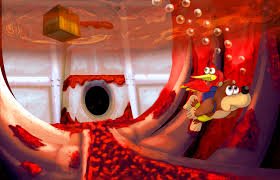
Time to get to the seedy underbelly of society. Or at least the underbelly of a literal whale accompanied with the continued emphasis of the cabaret aspects; but this time with the sultriness turned up to 11. The song gets sparser, the rhythms more intimidating and the orchestration nastier courtesy of the muddy timbre of the baritone sax, whose family of instruments are a staple in the nightclub circuit.
Just like in The Legend of Zelda: Ocarina of Time, the Banjo series presents us with a similar take on the womb inside a whale level—with Grant taking a more humorous route when it comes to the body sound effects one might find in these situations— It is only when we get inside Clanker that we realize the extent of the biological nature of this environment, with lots of organic compounds, parasites and the characteristic red color scheme of the muscles and what squishy stuff is made of. Mysteriously, in these levels things tend to be relatively spacious, well-lit, and full of breathable air. Naturally, when the outside of the creature involved is shown, expect it to be bigger on the inside. However, the cybernetic essence of Clanker adds a different twist to how these types of levels usually pan out. You can enter the body of through his teeth, his gills, or his blowhole.
The music, which in this case is not the usual rearrangement of the level tune since this is pretty much the other half of the world, continues with the Weimar-cabaret influence and shady minor jazz vibe from loud and proud Broadway villains. The main rhythmic motif of the melody is a usual staple found in other songs that assimilate these styles like Be Prepared from Lion King or the song Boris The Bat.
From spooky situations up to film noir. This all thanks to the Weimar German expressionists that migrated to America during war times and ended up in the film industry circuit.
Musical Analysis
Structure: I – {AA’ BA’ C A’’ O}
Tempo: 110
Melodic and Harmonic Profiles: C Harmonic minor; F# Ionian/Major; G Harmonic minor
The sassy percussion comprises the intro of the track, special mention going to the finger snaps associated with gang culture, burlesque and obnoxious patrons; Finger snapping at someone has long been used as a sign of brassy attitude or diva gesture, done to express a taunting satisfaction following what one has considered to be an impressive insult or diss; you can also use them to advance on someone in unison with your ruffian friends as an intimidation tactic or to creep out someone as was done to great effect. It has been used in slow, cool jazz and works such as the musical West Side Story, Spider-Man 3, Twin Peaks and The Adams’ Family.
The main motif is used throughout the question-answer blocks from the A section, altering the pitches but maintaining the ubiquitous rhythmic pattern. The featured instrument could be none other than the low timbre of the sax, favored by Grant Kirkhope to musicalize heavy characters and murky locations thanks to its raspy color in the lower register. The harmony focuses on the interplay between the C minor chord and the more seductive G major from the harmonic minor scale when compared to the more hopeless G minor. The full section can be thought of as going:
Cm – G – G7 – Cm
Fm – Cm – G7 – Cm – G
zThe full band enters accompanied by the countermelody of the otherworldly and classic monster movie sound of the theremin doing huge leaps through pitch bending as is characteristic of the sound coming from the instrument. During the final chord of this new A section there is a dissonance present between the walking bass line coming from the baritone sax, now playing an accompaniment tole, and the bassoon; the walking line ascends through the notes of the G major tetrachord while the bassoon stays on C minor (the B natural combined with C and Eb).
Compared to other theremin uses and in part thanks to the digital sample medium, Grant is also able to use the theremin as a chordal instrument, creating a synth pad bed that haunts the B section of the tune. The melody during this section also plays with the main rhythmic motif from section A, altering it just slightly by strategically removing and adding notes to the question-answer blocks. The harmony for this section is one not previously heard on the soundtrack; it has a more sinister aura. There are three chords that belong to the Db major scale plus its tritone chord G major. Nevertheless, the context and the Kirkhope cadence [ bII – V – i ] of the piece make it still gravitate towards a C minor tonality.
Db – G – Bbm – G
Fm – G – Fm – Db – G
Similar chords are used in other decadent places like Cauldron’s Keep from Banjo-Toole.
Back to the main A section. The only difference with the previous iterations is the way the walking bass line raises the tension by going towards higher pitches at the end of the phrase and the band ending with a diminished F chord.
C Section gives back the melody to the baritone sax in call in response fashion with the theremin. The piece continues with the same rhythmic motif, making it the first one on the soundtrack entirely based around a single motif. Like on other contrasting section, Grant chooses to go to the tritone chord of C and then use voice leading in the marimba arpeggios to create a descending by a semitone chord progression during the theremin solo that borrows from multiple profiles.
The harmony during the section is:
F# – C – Ebm – C
B – Gm – A – D – G7
It is only with that last strong dominant G7 chord that we realize we are hastily moving towards returning to the main A section and C tonality. The last A section is the subdued moment from this track. The swinging drum kit drops out and the skinny xylophone plays the tune.
The last section is closer to a proper outro than a full blown main section, with a call and response between the main motif and the theremin playing chords beyond the grave. The focal interplay is between the creepy tritone movement among F# and Cm and the more sad and pensive one between Fm and G. The chords are playing in inversions and voice leading that focus on descending movements and then ascending to connect smoothly the loop—which excludes the intro. The full sequence being:
Cm Cm – F# – Cm – F# – Cm
Cm Fm – G – Fm – G – Cm
As has been noted, the baritone sax and the marimba are the timbres more closely associated with the Banjo-Kazooie trademark sound, the marimba as part of the cartoon heritage and the raspy sax as the one giving that heavy, muddy twang. Here we saw the interplay between them that will only fully blossom on the next swampy world, auspicious for more of these two.

Help to keep the rites going around here by supporting the shrine:

Media Files, requests and support for more interactive content

Thou shall donate since this is a cult and you are now a sheep

Help staying awake analyzing game tracks and writing posts or else everything will end up being written by A.I
- Inside The Score – The Legend of Zeda: A Link to the Past – End Credits / Staff Roll
 The land rests As the last few minutes of this extensive journey that has now come to an end fly by, the nostalgia and reflective mood kicks in. Because such a massive enterprise as a Zelda game or a Lord of the Rings movie require multiple endings to convey everything… Read More »Inside The Score – The Legend of Zeda: A Link to the Past – End Credits / Staff Roll
 - Inside The Score – The Legend of Zelda: A Link to the Past – Ending / Epilogue ~ Beautiful HyruleFinal of the fantasy The Triforce has been touched. A wish has been granted. For the occasion, the newly undeceased king of Hyrule has commissioned a march in honor of the legendary hero to the Hylian Sousa, who might as well be composer Nobuo Uematsu since this piece is very… Read More »Inside The Score – The Legend of Zelda: A Link to the Past – Ending / Epilogue ~ Beautiful Hyrule
- Inside The Score – The Legend of Zelda: A Link to the Past – Triforce Chamber / Power of the GodsTake your boots off your feet And thus the Triforce spoke to men. And it became present in history. And you better treasure and contemplate this moment seldom witnessed in the course of the series. The elusive opportunity to interact and touch the most important artifact. You are now in… Read More »Inside The Score – The Legend of Zelda: A Link to the Past – Triforce Chamber / Power of the Gods
- Inside The Score – The Legend of Zelda: A Link to the Past – Ganon Battle / Prince of DarknessProgressive evil En Garde! And you better be prepared since you are about to duel the iconic enemy of the series at perhaps his canonically most powerful incarnation. Right after having touched the sacred Triforce which allowed him to conquer all of the Golden Land and whose evil and darkness… Read More »Inside The Score – The Legend of Zelda: A Link to the Past – Ganon Battle / Prince of Darkness
- Inside The Score – The Legend of Zelda: A Link to the Past – Boss Battle / Anger of the GuardiansQuick mayhem Ah, the simpler times when boss battles where not a multi epic orchestral suite but just an ostinato more basic that even what became the music for standard battle encounters out there. We are a long way from each boss having his own personalized track. And this early… Read More »Inside The Score – The Legend of Zelda: A Link to the Past – Boss Battle / Anger of the Guardians
- Inside The Score – The Legend of Zelda: A Link to the Past – Dark World Dungeon / Dungeon of ShadowsMemento mori We are getting closer to Ganondorf (or at least the wizard Agahnim who ultimately fulfills the same human side of evil role in this game) and that means getting closer to the profiles and motifs of his own theme song (which naturally was the theme of Agahnim at… Read More »Inside The Score – The Legend of Zelda: A Link to the Past – Dark World Dungeon / Dungeon of Shadows