Bubblegloom Sounds
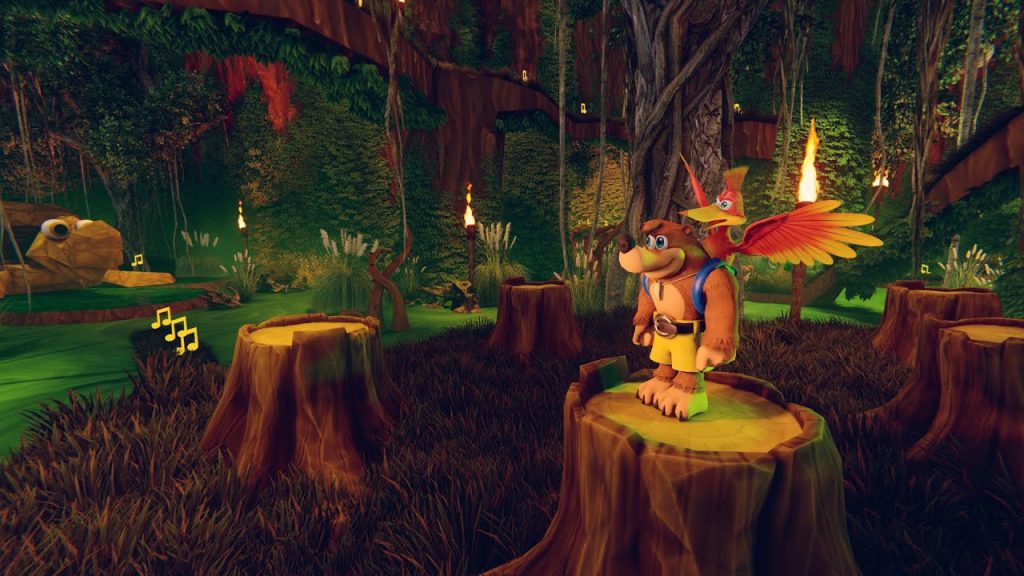
Back to the deepest, now darkest wilds; this time thicker than ever. And that also means back to the very beginning since the enemies found here are the first character presented to us by the game, accompanied with that same iconic sound of the baritone sax that is synonymous with the series. Like on that intro, the raspy and heavily murky timbre of the instrument will serve as the centerpiece of the track, playing alongside the rest of the cartoon orchestra and making Biubblegloop Swamp one of the locations closest to the game vision tone wise; it feels heavy, dense and humid, a more realistic environment than the more abstract levels from other platformers of the time; it is a quintessential Banjo-Kazooie world.
From the music it can be easily inferred that this was also one of the later additions to the rooster of levels since there seems to be no early version and the track features the manic, tritone based sound that was the musical direction decided at a later stage in development. It is likely that Bubblegloop Swamp replaced the more generic lava level that was originally conceived during development, with the pools of lava being replaced with their equivalent piranha infested swamp that serves as the boundary defining feature that separates the different “islands” that compose the layout of the world. This makes the swamp the level that probably followed the template and design philosophy of Lethal Lava Land from Super Mario 64. Changing the concept but maintaining the same types of hazards helps the bear and the bird to differentiate themselves more from the standard elemental-like—forest, fire, water, ice, ghostly—nature of the mascot platforming formula.
Notwithstanding, the swamp environment is still a staple of places where dangers and adventure might be found. It is a close cousin of the jungle and the woods, but more waterlogged. Swamp levels in games tend to be filled with mosquitoes, alligators and crocodiles, giant and ferocious dragonflies and other hostile wildlife. Expect some hopping frogs and toads to show up as the swamp generic one-hit monster. Sticky mud, which makes movement difficult, is also a common feature, what quicksand is to desert, which can be just annoying or deadly like on the Banjo iteration. Just remember that if water is not blue or crystalline, then it is probably not a good idea to dive in—might apply for real life too.
Musical Analysis
Structure: Pre-Intro – {I – ABA’CA’’B’D}
Tempo: 135
Melodic and Harmonic Profiles: C Ionian/Major; C Aeolian Dominant; Eb Ionian/Major
We could say that the music relies heavily on marimba and woodwinds for jungle effect, but we already know that the entire soundtrack does use this cartoon orchestra. So it all comes down to writing a memorable tune with more staccato phrases and give more prominence to the muddy timbre of the baritone sax. Like the level itself, the melodic phrases are separated by big silences, creating the aural island equivalent to the ones in which the frogs and Banjo hop throughout their time here. And speaking of frogs, here they are promoted from sound effect to musical instrument thanks to the harmonic role Grant throws them into in order to enhance the ambient and cleverly incorporate it into the music; Bubblegloop Swamp is the first song where we can say the sound effect plays a truly musical role.
Comparing with the previous themes, the intros are getting more elaborate, with a more extensive sense of anticipation. The main inspiration of the track are the frogs themselves jumping around throughout the level and their choir begins the piece in what we will deem as the “pre-intro” due to it not returning after the track loops. They begin as if truly belonging to the ambient soundscape. But then we quickly realize that they are in sync with the track and part of the overall ensemble when the first notes of the swampy sax play the same sparse notes. The way the drums and the main melody are introduced gives this intro a sense of asymmetry, as if the marimba player entered two bars earlier than he should (you were supposed to wait 8 bars after the sax began!); this asymmetry is caused due to the aforementioned frogs not initially feeling as part of the music. The listener perceives the piece as beginning with the saxophone—and it is technically the beginning since it is the first thing after the loop.
Grant’s odd chords and note philosophy are in full force here, making use of major and minor profiles within the same song and trying to fit the melodies with the chords selected; the Kirkhope cadence [bII – V – I] is also prominent during the intro and the first section.
The harmony during the first parts could be thought as this:
C – Bb – G
C – Db7 – G7
The island-like question-answer melodies are entirely composed around a motif already familiar to players of the game since it is none other than the same one used during the B section from the track for Spiral Mountain (Dun dudun Dun Duun), adding an extra layer of familiarity to the piece. However, while this motif in Spiral Mountain remains happy and carefree within the major profile, Grant Kirkhope quickly gets weird with the very first answer phrase, ignoring the easier, and more expected note Bb and choosing the dissonant Db instead, already giving this swamp the Banjo-Kazooie treatment by relying on tritone based sonorities—the Db is the tritone note of G, which is the one that ends the question phrase:
[ (CDEC – G) – (CDEC – Db) ]
Section B is more jovial since it is contained within a major profile for the most part and uses the same motif with extra notes in the answering phrases. The catchiness in music is usually derived by how a composer manipulates the balance between repetition and new information; on this specific tune, Grant retains the exact same motif and uses it with different starting positions and with different profiles, giving us repetition in new ways, a balance between balance and unbalance. The piece can be thought of as being now in an Eb tonality and focusing on the standard [IV – V – I] chords, the happiest harmony around.
Progression during the first part of B section:
Ab – Eb – Bb7 – Eb
The G chord then takes us back to C tonality territory and to the A section—with, you guessed it, the Kirkhope cadence.
Ab – Eb – G7 – Db – G7
This time around, the turn to become the frantic section goes to the C section. And due to the frogs hopping around lacking any logical direction, it becomes one of the most frantic sections found in the Banjo catalogue because of the lack of a conventional melody, opting instead for a flurry of notes similar to the one in the cue ‘World Door Open’ (The honor of being the most frantic goes to Cloud Cuckooland, where the entire piece is the frantic section). Musically, what makes the frantic sections of the Banjo themes is the hopping from chord to chord and the feeling of quickly changing tonalities through cascading cadences. In the case of Bubblegloop Swamp we found ourselves leaping between the tritone movement from C to F# in different inversions and in upward/downward movements, then to the second most used chord movement characteristic of the series, the I to bVI; after that, another two tritone movements from E to Bb and from Db to G, all together creating the variegated progression:
[C – F# – C – F#]
[C – Ab] – [E – Bb] – [Db – G – Db – G]
We could say the Kirkhope cadence is still enforced here.
After another repetition of the whirlwind doubled with the flute we return again to A section as if nothing had happened, making this piece a little bit like a rondo form, where a main section is alternated with new material—although the unmelodic nature of C section would make it closer to an interlude or break than a proper section.
A revamped Section B follows with now the baritone sax player being able to play faster melodies in a higher register than usual. Then the last section, Section D, uses rhythmic displacement to modify the motif, beginning it at the second beat from the measure and further changing the answer phrases to create a more contemplative section. In the absence of the dominant degree of the scale [G], it sounds more modal thanks to the back and forth between C and Bb; it is the turn for D section to be the sparser one due to the drums being removed at the end.
D section harmony
C – Db – C – Bb
Throughout the track the drums are at their most dynamic in the score, changing considerably between sections to reinforce specific moments as opposed to maintaining a single beat. The piece uses two flutes panned to side to side.
Does Grant Kirkhope ever use sane harmonic progressions? As it happens, yes. Ironically, one of the most difficult mini games featuring a character so vile that literally earns its moniker is accompanied by the most pedestrian and earnest of the chord progressions. Go figure.

Help to keep the rites going around here by supporting the shrine:

Media Files, requests and support for more interactive content

Thou shall donate since this is a cult and you are now a sheep

Help staying awake analyzing game tracks and writing posts or else everything will end up being written by A.I
- Inside The Score – The Legend of Zeda: A Link to the Past – End Credits / Staff Roll
 The land rests As the last few minutes of this extensive journey that has now come to an end fly by, the nostalgia and reflective mood kicks in. Because such a massive enterprise as a Zelda game or a Lord of the Rings movie require multiple endings to convey everything… Read More »Inside The Score – The Legend of Zeda: A Link to the Past – End Credits / Staff Roll
 - Inside The Score – The Legend of Zelda: A Link to the Past – Ending / Epilogue ~ Beautiful HyruleFinal of the fantasy The Triforce has been touched. A wish has been granted. For the occasion, the newly undeceased king of Hyrule has commissioned a march in honor of the legendary hero to the Hylian Sousa, who might as well be composer Nobuo Uematsu since this piece is very… Read More »Inside The Score – The Legend of Zelda: A Link to the Past – Ending / Epilogue ~ Beautiful Hyrule
- Inside The Score – The Legend of Zelda: A Link to the Past – Triforce Chamber / Power of the GodsTake your boots off your feet And thus the Triforce spoke to men. And it became present in history. And you better treasure and contemplate this moment seldom witnessed in the course of the series. The elusive opportunity to interact and touch the most important artifact. You are now in… Read More »Inside The Score – The Legend of Zelda: A Link to the Past – Triforce Chamber / Power of the Gods
- Inside The Score – The Legend of Zelda: A Link to the Past – Ganon Battle / Prince of DarknessProgressive evil En Garde! And you better be prepared since you are about to duel the iconic enemy of the series at perhaps his canonically most powerful incarnation. Right after having touched the sacred Triforce which allowed him to conquer all of the Golden Land and whose evil and darkness… Read More »Inside The Score – The Legend of Zelda: A Link to the Past – Ganon Battle / Prince of Darkness
- Inside The Score – The Legend of Zelda: A Link to the Past – Boss Battle / Anger of the GuardiansQuick mayhem Ah, the simpler times when boss battles where not a multi epic orchestral suite but just an ostinato more basic that even what became the music for standard battle encounters out there. We are a long way from each boss having his own personalized track. And this early… Read More »Inside The Score – The Legend of Zelda: A Link to the Past – Boss Battle / Anger of the Guardians
- Inside The Score – The Legend of Zelda: A Link to the Past – Dark World Dungeon / Dungeon of ShadowsMemento mori We are getting closer to Ganondorf (or at least the wizard Agahnim who ultimately fulfills the same human side of evil role in this game) and that means getting closer to the profiles and motifs of his own theme song (which naturally was the theme of Agahnim at… Read More »Inside The Score – The Legend of Zelda: A Link to the Past – Dark World Dungeon / Dungeon of Shadows