Vile Building Pop
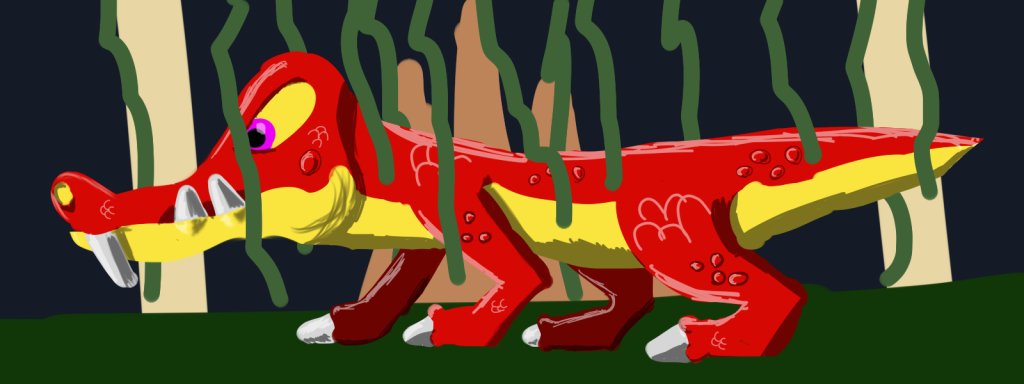
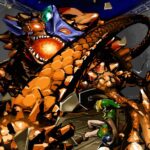
Mixing manic circus energy, show tune standard stock snippets and endearing 50s harmonies, Grant Kirkhope brings another mini-game to life. In this case it is none other than the one presented by the master of ceremonies known as Mr Vile, the greediest croc of all and the red counterpart to the more sweet looking transformation Banjo encounters in this world. The game is a new spin on the classic ‘Whack-a-mole’ trope found in fairs, amusement arcades and cartoons where characters hide inside holes connected by underground tunnels and unpredictably exchange the hole where they will appear; the player has to hit—or eat in this case— the right ones and avoid the detrimental ones. The game is found inside another alive giant creature just like Clanker—there don’t seem to be any organs inside but the giant crocodile is presumably sentient due to its eyes.
The music captures that carnival/circus performance ambience with the fast oom-pah rhythms and, alongside the dynamic tempo, sets the mood for this infamously difficult challenge.
Musical Analysis
Structure: PI – I – AB – O
Tempo: 170. Accelerando to 175, 180 and then 185
Melodic and Harmonic Profiles: C Ionian/Major
There are various influences at play. The first that catches the ear is meant to do exactly that, so much that is by now a customary beginning for multiple show tunes; it is known as the Minsky Pickup. What ’Shave and a Haircut’ is to endings, the Minsky Pickup is to beginnings, specially in cartoony and humorous situations. It automatically signals that wackiness is gonna ensue. The pickup is a six note Intro fanfare to a song and dance number (actually, it’s a somewhat shortened version of an older 16-note intro, the shorter version being the more common these days). Three notes of the same pitch, then up a full, up a half, up a half. “Dadum dadum dum dum” It’s rather ubiquitous, and originates from American vaudeville or perhaps even earlier. In vaudeville it became known as the “Minsky Pickup” (named after Minsky’s Burlesque and perhaps originating there), but it has also been called the “Cockney Intro” (possibly due to the similarities between vaudeville and British Pantomime and the inevitable bleedover of routines and musical numbers). The Minsky Pickup is what people hear in their heads when they think of “old-timey song from the age of steam, silent films, and top hats.” It can also be used as an ending, with the final two notes sharpened. During the Minsky burlesque variety shows it was also used like the drummer would use today the ‘Ba-dum-tssshhh’ sting after a joke or pun has just been made.
For this tune the pickup is somewhat obscured by the main, upper melody played by the trumpets, which technically don’t do the pickup since the melodic movement is not the classic ascending chromatic line; nonetheless, it can be clearly heard on the bass line played by the baritone sax, which the trumpets are harmonizing.
After this non-harmony-setting unique pre-intro, the circus music begins with the oom-pah rhythms in full force setting the harmonic landscape. The main motif begins shortly after where the question phrases use the pitch bending characteristic of the trombone, also sometimes associated with comedic situations, and the minor second-based answer phrases that this time will be the ones the composer is gonna play around with, transposing them to different starting points and varying their pitch relationships throughout the track. While the trombone is used like a trombone here, the baritone sax is used like a tuba.
The melody is then shared with the flute, which also makes use of the pitch bending technique, transforming itself into another instrument endemic to the comedy and cartoon vocabulary, the slide whistle; the instrument is what its name says it is, a whistle made out of a long tube with a slide at one end. An ascending and descending glissando is produced by moving the slide back and forth while blowing into the mouthpiece.
Grant Kirkhope is well behaved in the harmony department this time; in fact, Mr Vile gets the most wholesome chords due to Grant employing the commonly used Doo-Wop progression amidst the agitated rhythms. This progression was mainly used in the popular music of the 50s, consisting of the following: I-vi-IV-V. The first song to popularize the progression and its association with sincere sugary romanticism was Blue Moon, written in 1934.
There are only two main sections and the B section is closely related to the first one in terms of energy and melody, continuing to use the answer motif and various transpositions. It flips the question-answer block (the trombone glissando is now part of the end of the phrase). There are similarities between this track and the melody of the B section from Rusty Bucket Bay; both feature the trombone pitch bend motif and the exact same cadence to end their melodies. So Grant either consciously or unconsciously ended up using the same melodic template for both tunes (Rusty Bucket Bay also uses the same motif Bubblegloop Swamp took from Spiral Mountain during its final section, all contributing to the music having a glue that makes it subliminally sound as belonging to the same series and universe).
The harmony for this part is the also standard IV – I – V – I which unequivocally defines the key of a piece, contrary to other Banjo-Kazooie cues. Still, Grant cannot help it but end the phrase with a quick Kirkhope cadence by introducing the Db chord combined with its tritone chord, G major.
It creates the progression:
F – C – G – C
F – C – G – Db – G
The flute responds once again with the same B section melody and then, due to this being a timed mini-game, the song has to go to a coda that enhances the tension level with the usual tools of increasing the tempo and repeating the same motif each time with the entire track transposed one semitone up for every iteration; the tune ends up coming up to the F tonality. The motif subsequently takes out the answer phrase, further signaling that time is running out and things are about to end. Which the piece does with a similar show tune snippet equivalent to the Minsky intro and closing the track in descending motion just like an ascending motion opened it. The vaudeville contest performance has ended. Mr Vile won, by the way. The universal loser cue await those who fail and a triumphant fanfare to the ones who manage to finish on top.

Help to keep the rites going around here by supporting the shrine:

Media Files, requests and support for more interactive content

Thou shall donate since this is a cult and you are now a sheep

Help staying awake analyzing game tracks and writing posts or else everything will end up being written by A.I
- Inside The Score – The Legend of Zeda: A Link to the Past – End Credits / Staff Roll
 The land rests As the last few minutes of this extensive journey that has now come to an end fly by, the nostalgia and reflective mood kicks in. Because such a massive enterprise as a Zelda game or a Lord of the Rings movie require multiple endings to convey everything… Read More »Inside The Score – The Legend of Zeda: A Link to the Past – End Credits / Staff Roll
 - Inside The Score – The Legend of Zelda: A Link to the Past – Ending / Epilogue ~ Beautiful HyruleFinal of the fantasy The Triforce has been touched. A wish has been granted. For the occasion, the newly undeceased king of Hyrule has commissioned a march in honor of the legendary hero to the Hylian Sousa, who might as well be composer Nobuo Uematsu since this piece is very… Read More »Inside The Score – The Legend of Zelda: A Link to the Past – Ending / Epilogue ~ Beautiful Hyrule
- Inside The Score – The Legend of Zelda: A Link to the Past – Triforce Chamber / Power of the GodsTake your boots off your feet And thus the Triforce spoke to men. And it became present in history. And you better treasure and contemplate this moment seldom witnessed in the course of the series. The elusive opportunity to interact and touch the most important artifact. You are now in… Read More »Inside The Score – The Legend of Zelda: A Link to the Past – Triforce Chamber / Power of the Gods
- Inside The Score – The Legend of Zelda: A Link to the Past – Ganon Battle / Prince of DarknessProgressive evil En Garde! And you better be prepared since you are about to duel the iconic enemy of the series at perhaps his canonically most powerful incarnation. Right after having touched the sacred Triforce which allowed him to conquer all of the Golden Land and whose evil and darkness… Read More »Inside The Score – The Legend of Zelda: A Link to the Past – Ganon Battle / Prince of Darkness
- Inside The Score – The Legend of Zelda: A Link to the Past – Boss Battle / Anger of the GuardiansQuick mayhem Ah, the simpler times when boss battles where not a multi epic orchestral suite but just an ostinato more basic that even what became the music for standard battle encounters out there. We are a long way from each boss having his own personalized track. And this early… Read More »Inside The Score – The Legend of Zelda: A Link to the Past – Boss Battle / Anger of the Guardians
- Inside The Score – The Legend of Zelda: A Link to the Past – Dark World Dungeon / Dungeon of ShadowsMemento mori We are getting closer to Ganondorf (or at least the wizard Agahnim who ultimately fulfills the same human side of evil role in this game) and that means getting closer to the profiles and motifs of his own theme song (which naturally was the theme of Agahnim at… Read More »Inside The Score – The Legend of Zelda: A Link to the Past – Dark World Dungeon / Dungeon of Shadows