Eekum Bokum
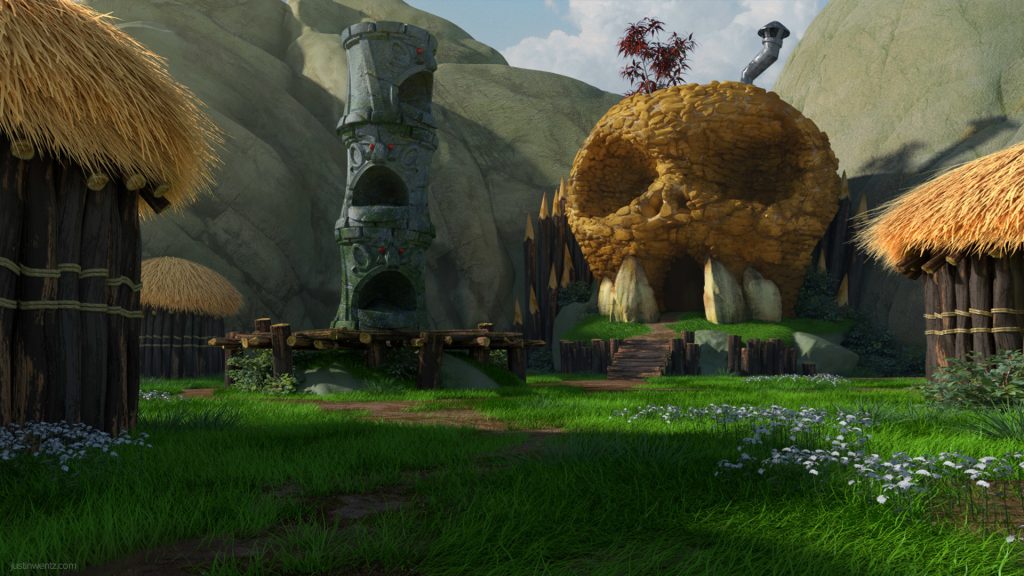
As the very first gameplay level, Mumbo’s Mountain brings the zany tritone and cartoon influences at the forefront. This world serves as a simple introduction level in the game, being fairly small and compact compared to the others. The level features a simple grassland theme, with elements of tribal villages influenced by different African and American natives being included; it is also also the homeland of the eponymous character Mumbo, the shaman of the village. A large hill separates the village from the lowlands area, which features a small pond and jungle trees; a giant termite nest can be seen from almost any place on the level, helping with guidance. In true video game tradition, as the first level it has the responsibility of being the pleasant green hill setting, a great place to start your journey, full of rolling hills, fleecy clouds, and bushy trees.
A video game trope popularized by Mario games, the landscape the characters travel along gets steadily esoteric as they get to the end of the quest. So there is not much difference from Spiral Mountain other than the added tribal theme. The Banjo-Kazooie levels are more grounded in reality than the more abstract platforming worlds of Super Mario 64; yet, though it lacks a lava world—Unless we count the trivia game show—it still has some of the characteristic environments expected from the plumber’s platformers next to more than a couple curveball ideas thrown around.
Based on this job description, Grant Kirkhope initially zeroed in on the cartoonish vibe, tribal themes, and pleasantries of the level and came up with a fun track to musicalize this level:
It has the big drums, tribal chants and jungle sounds expected from these settings alongside a bluesy melody straight from classic Hollywood fare; this shows the original direction for the music of Banjo-Kazooie, purely fun tracks with catchy melodies. In fact this original melody most likely comes straight from the 1962 American film about an African safari adventure, named Hatari!, where composer Henry Mancini created the quintessential kookiness anthem ‘Baby Elephant Walk’ a boogie-woogie song that has been used in multiple cartoons.
However, although the original melody can still be found on a different area for the game, the track was dropped in favor of the new musical direction Grant found while composing the theme for Mad Monster Mansion later in the game. The bosses at Rare felt that some of the earlier music did not fit anymore the amusingly sinister tone of Danny Elfman—another Carl Stalling disciple from his cartoon school—which is a codeword that means that the tunes are lacking the wacky tritones. And does Grant Kirkhope go to town with the tritone on the revamped track; the tritone chord movement is the centerpiece of the track, heavily featured in each and every section of Mumbo’s Mountain (except for the intro). Safe to say that the Rare developers where pleased with this new level of wackiness gained.
Musical Analysis
Structure: { I – AA’ B A” CC’ B’ A”‘D }
Tempo: 95
Melodic and Harmonic Profiles: C Ionian/Major; F Ionian/Major
The new track starts safe enough, with the characteristic oom-pah rhythms and normal chord changes; it seems that the tribal elements were ditched and left for later in the level when the actual tribal influence becomes clear. There are just two chords back and forth, with the bassoon used closer to how an accordion is performed, the basso continuo plus the chords.
Intro
C – G – C – G
Then the main motif starts, a somewhat faster version of the previous discharded theme contour; the new melody maintains the bluesy accidental notes of its ancestor but then the tritone chord takes us to other places. The melody also echoes the intro, using some of its intervals and rhythms. It has a selection of some of the standard instruments of a cartoon orchestra like the woodwinds. But like any good cartoon, the main instrument is the marimba. Marimbas and xylophones are prevalent in cartoon music since the very early days; It is the main instrument of the Looney Tunes and Merry Melodies after all; and started its path on the very first cartoons made by Walt Disney. The origin of why someone thinks of cartoons and chase scenes hearing these timbres is that George Hamilton Green, a xylophone player, wrote most of the music for the early Disney cartoons. And then Carl Stalling made them one of his principal instruments to mickey mouse character footsteps and other quick movement thanks to their fast, percussive timbre; it also helps that the xylophone is the instrument of choice for music initiation classes all over the United States. So, just like animation, it carries some stigma of being exclusive for children. (By the way, only obsessive classical music purists have stricter distinctions between the marimba and the xylophone—toy manufacturers can’t even distinguish between glockenspiels and xylophones—both instruments are usually made of wood so the differences amount to range, mode of tuning and timbre. Marimbas can go lower and resonate more, xylophones have a sharper tone and usually limit to high pitches, more toylike). The instrument is also appropriate for the tribal setting, although its presence surely comes more from cartoon canon than any attempt at cultural accuracy. The marimba is also the main instrument associated with the character Mumbo Jumbo. Kirkhope also selected it for pragmatic purposes,claimid that its quick timbre results in shorter files and thus saves memory space.
It does not take long for Grant Kirkhope to insert his favorite chord movement, immediately after the pedestrian oom-pah intro, he betrays expectations—of non-Banjo-Kazooie music, that is—and goes to the bV (same as the augmented fourth in practice), corrupting the initial chord progression of the intro. The full harmony of section A ends up being:
C – F# – C – F# – C – G – D7 – G7
C – F# – C – F# – G – G – C – G – C – G7
The chords change each beat, except for the rapid coda, like a heavy elephant walking through the level. You can see that all the tension is on the question motifs and the answers release it. The other odd chord here is the D, which was not chosen based around any modal music theory but just because it is the fifth of G and gives another flavor to the C tonality, which either in its major or minor version is pretty much the main tonality used throughout the entire game (the D would be a secondary dominant). Perhaps by using the C key, meaning all the white keys of a keyboard, going to weird chords in the Nintendo 64 system was conceptually easier for the composer, it is the easiest tonality to keep track of strange harmonies or it just feels the best for cartoonish games—The first Super Mario Bros game also has all of its tunes based around C— In a nutshell, Grant Kirkhope is not thinking about any particular harmonic traditions, he just sticks with a C based tonality and then finds chords that stick out in whimsical ways, using the melody as connective tissue to somehow ending back on the tonic.
The tune creates variation by rotating the instruments; section A’ replaces the clarinet with the marimba. The song then continues on with section B and a new set of chords appear. This harmony is based around a specific pattern that jumps between the Kirkhopian tritone chord movement and then to the fourth note, creating a cascade of of multiple tritone cadences; they can be analyzed in the following tritone pairs: (Db – G), Db selected for being the tritone chord of the dominant G; then a perfect fourth to C and rinse and repeat the pattern until reaching the F chord: (C – F#) (B – F). If the developers wanted more tritone, Grant had them covered in spades. It then goes, without a second thought, for the authentic cadence giving back a tiny bit of C tonality by ending the phrase on a G7 chord: D – G7.
To enhance the contrasting qualities between section A and B, the chords now change each two beats; this creates more differentiation between parts. The melody now shifts to the sound of palm muted strings (the original recording comes from an electric guitar but the sound as heard in the game sounds closer to the characteristic banjo of the main character).
A renovated A section comes back this time differentiated and at the same time familiar because now the two previous instruments play the melody unison.
Section C changes the pace by modifying the rhythm of the accompaniment and interchanging the melodic instruments with the accompaniment instruments; the trombone now takes the melody while the marimba and the clarinet take the harmony. The basso continuo disappears for the first few measures before the bassoonist slowly resumes his job, first reintroducing the bass and then adding the polka pah just in time to support the marimba that decided it was boring playing accompaniment and now plays a countermelody to offer variation between the two repetitions of the C section. Meanwhile, the clarinet also relieves the melody from the trombone. Here we hear both orchestral and counterpoint variation in the arrangement.
The harmony during this part is based around F major; Kirkhope likes to go to the fourth in contrasting sections, Still, the presence of the G minor and C dominant chords clues us into the new tonality. The progression goes:
F – Gm – C7 – F – C7
F – B – G – C7 – F
Nonetheless, the tritone chord movement still gives the abrupt whimsical feel thanks to the change from F to B.
Following the lead of the Super Mario Bros main theme, which presents the same sections on new light thanks to changing and mixing the sequences that come before and after, Grant Kirkhope has to find some way of returning to the main motif. But going from section C to section A would sound too abrupt and would not work out. Going back to the intro would make the piece too short for a place that the player is expected to remain a long time (unlike Mario 64, collecting the mcguffins will not each time take Banjo outside the level). Thankfully, Grant has section B, which serves as the bridge that will allow the music to return home via longer routes. The trip is not smooth though but both Banjo-Kazooie and cartoon music never likes it smooth. So the whirlwind chords of section B return with the same instruments playing different roles again. This revamped B section continues to make use of clever orchestration, placement and arrangement to feel like new music instead of the same section repeated. The muted banjo is the only one in charge of the accompaniment here.
Finally, the music safely reaches Section A once again, albeit with a new subdued orchestration. Grant could perfectly have ended the piece there or continue playing with the three building blocks like on the main theme from Super Mario 64. However, one last piece of new musical material is added to create a more complex cue. It has the same progression of section A but, owing to the power of melody and orchestration, it sounds nothing like section A. The coda playfully repeats itself three times reinforced by a new instrument each time and then connects it all smoothly with the intro, repeating the long cycle once again.
Here included are the extra sounds added when close to the termite base of operations; a military snare surely fitting for soldier termites alongside their marching chants meant to encourage the troops are added to the relenting drum beat of the track.
The Mumbo’s Mountain cue is the prototypical level music for Banjo-Kazooie: cartoonish, with oom-pah rhythms, based around the tritone chord movement and with different sections repeating themselves in new disguises and contexts. It will also become one of the most familiar tunes for the player thanks to its placement as the title theme when powering up the game cartridge. Good luck getting its intro out of your head, it will be the most listened snippet of the entire experience. Unlike the standard theme of the level, the variations will be more closely adapted to the environments and the characters appearing on screen. The primitive chants and drums rumble closer, some new faces are about to come up.
The muted guitar sample comes from the E-MU Proteus/1 – Stereo Mutes

Help to keep the rites going around here by supporting the shrine:

Media Files, requests and support for more interactive content

Thou shall donate since this is a cult and you are now a sheep

Help staying awake analyzing game tracks and writing posts or else everything will end up being written by A.I
- Inside The Score – The Legend of Zeda: A Link to the Past – End Credits / Staff Roll
 The land rests As the last few minutes of this extensive journey that has now come to an end fly by, the nostalgia and reflective mood kicks in. Because such a massive enterprise as a Zelda game or a Lord of the Rings movie require multiple endings to convey everything… Read More »Inside The Score – The Legend of Zeda: A Link to the Past – End Credits / Staff Roll
 - Inside The Score – The Legend of Zelda: A Link to the Past – Ending / Epilogue ~ Beautiful HyruleFinal of the fantasy The Triforce has been touched. A wish has been granted. For the occasion, the newly undeceased king of Hyrule has commissioned a march in honor of the legendary hero to the Hylian Sousa, who might as well be composer Nobuo Uematsu since this piece is very… Read More »Inside The Score – The Legend of Zelda: A Link to the Past – Ending / Epilogue ~ Beautiful Hyrule
- Inside The Score – The Legend of Zelda: A Link to the Past – Triforce Chamber / Power of the GodsTake your boots off your feet And thus the Triforce spoke to men. And it became present in history. And you better treasure and contemplate this moment seldom witnessed in the course of the series. The elusive opportunity to interact and touch the most important artifact. You are now in… Read More »Inside The Score – The Legend of Zelda: A Link to the Past – Triforce Chamber / Power of the Gods
- Inside The Score – The Legend of Zelda: A Link to the Past – Ganon Battle / Prince of DarknessProgressive evil En Garde! And you better be prepared since you are about to duel the iconic enemy of the series at perhaps his canonically most powerful incarnation. Right after having touched the sacred Triforce which allowed him to conquer all of the Golden Land and whose evil and darkness… Read More »Inside The Score – The Legend of Zelda: A Link to the Past – Ganon Battle / Prince of Darkness
- Inside The Score – The Legend of Zelda: A Link to the Past – Boss Battle / Anger of the GuardiansQuick mayhem Ah, the simpler times when boss battles where not a multi epic orchestral suite but just an ostinato more basic that even what became the music for standard battle encounters out there. We are a long way from each boss having his own personalized track. And this early… Read More »Inside The Score – The Legend of Zelda: A Link to the Past – Boss Battle / Anger of the Guardians
- Inside The Score – The Legend of Zelda: A Link to the Past – Dark World Dungeon / Dungeon of ShadowsMemento mori We are getting closer to Ganondorf (or at least the wizard Agahnim who ultimately fulfills the same human side of evil role in this game) and that means getting closer to the profiles and motifs of his own theme song (which naturally was the theme of Agahnim at… Read More »Inside The Score – The Legend of Zelda: A Link to the Past – Dark World Dungeon / Dungeon of Shadows