Bonus post
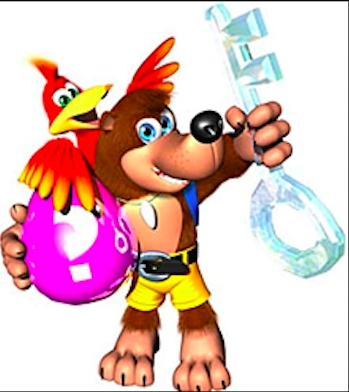
The fabled and equally infamous feature known as Stop ’n’ Swop, for many years shrouded in mystery and fueled by cryptic developer responses and wild fan speculation. Of all the secrets and mysteries in the Banjo-Kazooie series none are more tantalizing or more talked about than Stop ‘n’ Swop, and although most of them – both the silly and the sensible – are false, there are some truths out there thanks to the passing of time and more developers coming forward. The mystery involves six brightly colored eggs and a large key made of ice, which was visible to Banjo-Kazooie players, and their alleged use in its sequel Banjo-Tooie and other games made by Rare. The music ends up being not only in line with the mystery and wonder inside the game but, coincidentally, it also foreshadows the enigmatic meta-narrative surrounding the purpose of these objects; why are they here and where do they come from? It is something that could only be clarified somewhat recently thanks to the advent of the widespread use of the internet and more direct communication channels with the developers themselves, plus exhaustive search carried by tech-savvy fans of the game. It was also partly fulfilled with rereleases of the games in consoles that allowed this ahead-of-its-time connectivity that was ambitious and unpractical during the N64 era. It has been continually teased by Rare in many subsequent games as ongoing jokes where characters promise to unveil its secrets when players are asked to perform impossible tasks.
The gist of it was that to use Stop ‘n’ Swop items, one would have needed to own both Banjo-Kazooie and its sequel Banjo-Tooie. One had to collect the eggs in Kazooie, then switch the game off and quickly insert Tooie while the data, which developers discovered was retained by the Nintendo 64 for a few seconds, was still there. Basically an ambitious proposal that exceeded what the N64 was intended to do. Nintendo was not OK with this, arguing that such quick cartridge changes could potentially damage the consoles and that future cohorts of the N64 would likely even have shorter data retention spans of time, making the swap impossible to accomplish. The feature had to be removed but the items remained there as object for players to collect, apparently without rhyme or reason.
Musical Analysis
Structure: Section 1 / {I – AA’} / Section 3
Tempo: 100; 140 (Section 3)
Melodic and Harmonic Profiles: C Ionian/Major; F# Ionian/Major
Grant Kirkhope designed a short cue that is meant to play in the locations where these items are found; these are locations in selected levels of the game so the cue itself is adapted to the musical style of each world, using appropriate instrumentation and sometimes slightly altering the rhythm of the melody and tempo. The only things that remain pretty much the same are the brand new fanfare exclusive to the Stop ’n’ Swop project, making Banjo-Kazooie a game with quite a few different fanfares. Most games would probably be content with just a single triumphant fanfare for every situation but it seems that Grant, being a professional trumpet player himself, was quite fond and had no problem whatsoever coming up with new fanfares for many different situations.
The fanfare itself is similar to the others previously heard, with chordal melodies ascending by way of chord inversion reaching a climax. It is based around the same progression that will become the centerpiece of the Stop ’n’ Swop cue, the orphan C – F#, which does not quite fit to any parent scale since it uses the two profiles which are diametrically opposite to each other, just like Banjo and Kazooie themselves. Its effect is one of wonder and amazement at the discovery of something big and mystifying. The fanfare was reused in Donkey Kong 64 for when the door to a boss battle is opened.
While in the context of the fanfare the music still retains a triumphant connotation, in the proper cues the mystery of the I – bV tritone progression shines more. This progressions, which is a motif Grant Kirkhope took for the entire score of the game, provides the same similar instability of whole-tone scales or the quirkiness of the Lydian profile, due to the C and F# profiles not sharing any notes between them, which is what is meant when saying they are the most opposite scales, creating a pattern that puts the listener inside a floating dream, not quite settled in any home key.
The melody follows closely the profiles of each underlying chord. There was a single melody written, which is differentiated only with orchestration when repeated. In order to not complicate things too much and muddy even more the harmony, the notes conform themselves with pentatonic scales of the underlying chord. They give these items the mystical quality they gained both inside and outside the game.
And for when the player acquires the item, why not yet another fanfare? No problem, Grant has it covered too, this time with the unambiguously triumphant Mario cadence amidst a small variation that uses two passing chords to reach the tonic C. The progression being C – Ab – Bb – C – Db – B – C
And speaking of exclusive fanfares everywhere, the end is here and to celebrate it of course we have one last brand new fanfare; however, this time the brass are not the protagonists since this fairy tale has to end in the only way possible, featuring the duo that accompanied the player on this adventure. The heroes that opened with the musical number are called to close the presentation.

Help to keep the rites going around here by supporting the shrine:

Media Files, requests and support for more interactive content

Thou shall donate since this is a cult and you are now a sheep

Help staying awake analyzing game tracks and writing posts or else everything will end up being written by A.I
- Inside The Score – The Legend of Zeda: A Link to the Past – End Credits / Staff Roll
 The land rests As the last few minutes of this extensive journey that has now come to an end fly by, the nostalgia and reflective mood kicks in. Because such a massive enterprise as a Zelda game or a Lord of the Rings movie require multiple endings to convey everything… Read More »Inside The Score – The Legend of Zeda: A Link to the Past – End Credits / Staff Roll
 - Inside The Score – The Legend of Zelda: A Link to the Past – Ending / Epilogue ~ Beautiful HyruleFinal of the fantasy The Triforce has been touched. A wish has been granted. For the occasion, the newly undeceased king of Hyrule has commissioned a march in honor of the legendary hero to the Hylian Sousa, who might as well be composer Nobuo Uematsu since this piece is very… Read More »Inside The Score – The Legend of Zelda: A Link to the Past – Ending / Epilogue ~ Beautiful Hyrule
- Inside The Score – The Legend of Zelda: A Link to the Past – Triforce Chamber / Power of the GodsTake your boots off your feet And thus the Triforce spoke to men. And it became present in history. And you better treasure and contemplate this moment seldom witnessed in the course of the series. The elusive opportunity to interact and touch the most important artifact. You are now in… Read More »Inside The Score – The Legend of Zelda: A Link to the Past – Triforce Chamber / Power of the Gods
- Inside The Score – The Legend of Zelda: A Link to the Past – Ganon Battle / Prince of DarknessProgressive evil En Garde! And you better be prepared since you are about to duel the iconic enemy of the series at perhaps his canonically most powerful incarnation. Right after having touched the sacred Triforce which allowed him to conquer all of the Golden Land and whose evil and darkness… Read More »Inside The Score – The Legend of Zelda: A Link to the Past – Ganon Battle / Prince of Darkness
- Inside The Score – The Legend of Zelda: A Link to the Past – Boss Battle / Anger of the GuardiansQuick mayhem Ah, the simpler times when boss battles where not a multi epic orchestral suite but just an ostinato more basic that even what became the music for standard battle encounters out there. We are a long way from each boss having his own personalized track. And this early… Read More »Inside The Score – The Legend of Zelda: A Link to the Past – Boss Battle / Anger of the Guardians
- Inside The Score – The Legend of Zelda: A Link to the Past – Dark World Dungeon / Dungeon of ShadowsMemento mori We are getting closer to Ganondorf (or at least the wizard Agahnim who ultimately fulfills the same human side of evil role in this game) and that means getting closer to the profiles and motifs of his own theme song (which naturally was the theme of Agahnim at… Read More »Inside The Score – The Legend of Zelda: A Link to the Past – Dark World Dungeon / Dungeon of Shadows