Hopelessness
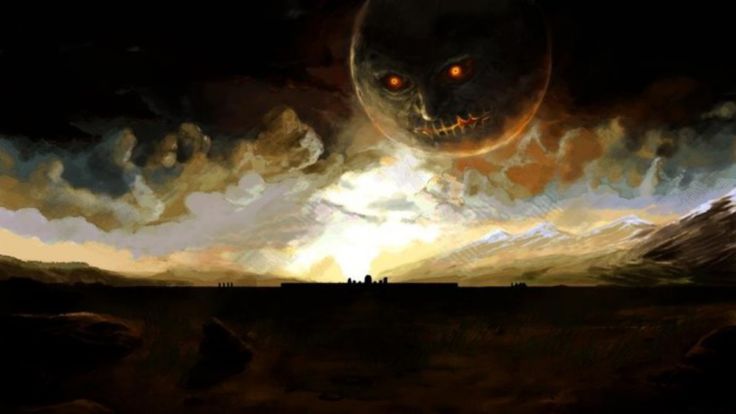
The final hours is the moment where denial is replaced by full awareness, Clock Town’s swan song as represented by the fireworks released at midnight against an atmosphere that makes it clear there is no need to speculate anymore. Tragedy is about to befall. There is not even need for alarming desperation since the deal has been sealed. The moon will collide directly with the town.
This is the Carnival of Time that receives the Hero of Time. The music is exactly what sounds when you are looking at the floor, slowly closing and opening your eyes while you wonder what could have been different, what went wrong. The sound of life and color draining from the world accompanied by a cursed requiem mourning the inevitable; Koji Kondo’s most hopeless and darkest hour. Not an ounce of heroism is left as Link realizes he doesn’t have the means to avert the situation unlike in Hyrule where a strength of mind and body was enough to overcome the impossible odds. In Termina you can only abandon the world and its people and start all over again. All for a small chance that it could be different, the natural conclusion to the best known video game mechanic of trying again.
The music set within a red sky, accompanied by the sounds of the tower bells and the exponentially more fierce movements of the earth is an apocalyptic tune that captures this unnatural moment with unnatural instruments and a sense of sadness that does not encourage any further action. It is as desolate as the town itself. Isolation in musical form.
Musical Analysis
Structure: Section 0 / Section 1 / Section 2 / Section 3 / Section 4
Time Signature: 4/4
Tempo: 69
Melodic and Harmonic Profiles: G Aeolian/Minor; G Harmonic Minor; F Harmonic Minor
Once again Koji Kondo manages to capture very difficult emotions in musical form with just a few instruments and notes, employing effective sound design and well placed harmony movements to emphasize the sadness. Unlike the sadness present in the Song of Healing, this is sadness with pain; the sad minor chords are not allowed to soothe and heal for long before a dissonance enters to sting and open the wounds again. Spacetime is being ripped.
The first element is the sound design component. The sample Koji Kondo bases the piece around, appropriately called “Iceland”, is designed to send chills down the spine, an incomprehensible mix that could be in itself the sound of a paralyzed soul. It is as if an arc is being dragged harshly across the heart strings combined with a choir of inner voices. The sound of a broken word; surrealism captured in aural form. Each single “note” of the glassy sample is in reality formed by a cluster of notes; in simple terms, the sampler is playing chords for each keyboard note. Kondo goes back and fort pressing G and F. You can hear the cluster of notes forming in the attack of every sample: for the “G note” it goes: F – E – G plus a low D, basically the sound of putting the palm of your hand across various keys on the piano; the more technically inclined would call this a Dm 9/11 chord.
So the result is that two chords are condensed to two piano keys:
G= Dm 9/11= Low D – E – F – G
F= Cm 9/11= Low C – D – Eb – F
You can hear how the chords form here, played by the string pad:
Volume is automated to go up and down in order to create a pulsating effect.
After the song’s aural bed has been prepared the music then starts with the ‘Twin Peaks‘ synth sounding more Twin Peaks than ever with the slow changing harmony mixing sad chords with haunting ones. The long drawn out notes help to build a feeling of somberness not found in short abrupt notes more appropriate for pure terror. Remembering that voice leading is key, Koji Kondo sets up an organically moving harmony that balances sadness with hopelessness, moving independently of the glassy sound.
Section 1:
Gm – F – Eb – Csus2-D
Gm – F – Ebmaj7-Cm -Dsus4-D
Hearing for the first time the Andalusian cadence as it is meant to be. The one where the first chord is minor instead of the Zelda series triumphant major—the world of Link is ending after all—It’s similar to the ‘Sunrise’ cue progression—even the same ending—sounding like a corrupted version of it. A sunrise that will never come.
If there was only Section 1, the song would be sad and contemplative. However section 2 comes to disrupt us and tell us that there is really no hope at all. Don’t even dare to lift your spirits.
Section 2:
Cm – Dbm – Gsus4 – D7 – Eb no 3 maj7(b5)-Ebmaj7-Eb no 3 maj7(b5)- Dsus4 – D
Then it goes back to the progression from Section 1.
The ending of this baroque world is also marked by the last cries of the harpsichord, sending S.O.S signals to outer space; you can watch them fly as the volume goes down, slowly debilitating, a series of rapid notes transposed one tone. We also have for Termina the industrial metallic noises straight from a Terminator film, that from then on went to become always identified with imminent danger; it gives the piece a rather 80s synthesized film score vibe like those of Vangelis. This noise is the sound of paralyzing fear stopping you on your tracks (or when someone receives bad news or realizes something is not right). The sounds are automated to start coming from the center and then manically panned from side to side—you could picture the camera freezing the image and going black and white each time this sound plays, even focusing on a Clock Townian’s panicked face for dramatic effect— By the last sections of the piece the ethereal string pad is mostly absent and the danger and S.O.S sounds become more pronounced, all combined with the cacophony of the church bells that also become more prominent when there are few seconds left and nobody is left.
Another outstanding work of sound design and harmony that shows that Kondo doesn’t always need to resort to melody to convey the emotions of a scene. The Legend of Zelda: Majora’s Mask presented a more modern narrative sensibility and complex emotions that, surprisingly, weren’t beyond the scope of the composer; from the Super Mario Brothers to Final Hours, Nintendo can rest assured that they can go to any frontier and the music will naturally escalate to match it.
Samples used on this track:
Partition A – ICELAND – ICELAND 1 [426] from the library Spectrasonics Distorted Reality
The sample was also used as a sound effect for the portals Link enters after a boss battle in The Wind Waker:
CD 1 – Instruments – Strings – Synth Strings – JX Lo Strings Right from the library Digidesign SampleCell Factory Library
Help to keep the rites going around here by supporting the shrine:

Media Files, requests and support for more interactive content

Thou shall donate since this is a cult and you are now a sheep

Help staying awake analyzing game tracks and writing posts or else everything will end up being written by A.I
- Inside The Score – The Legend of Zeda: A Link to the Past – End Credits / Staff Roll
 The land rests As the last few minutes of this extensive journey that has now come to an end fly by, the nostalgia and reflective mood kicks in. Because such a massive enterprise as a Zelda game or a Lord of the Rings movie require multiple endings to convey everything… Read More »Inside The Score – The Legend of Zeda: A Link to the Past – End Credits / Staff Roll
 - Inside The Score – The Legend of Zelda: A Link to the Past – Ending / Epilogue ~ Beautiful HyruleFinal of the fantasy The Triforce has been touched. A wish has been granted. For the occasion, the newly undeceased king of Hyrule has commissioned a march in honor of the legendary hero to the Hylian Sousa, who might as well be composer Nobuo Uematsu since this piece is very… Read More »Inside The Score – The Legend of Zelda: A Link to the Past – Ending / Epilogue ~ Beautiful Hyrule
- Inside The Score – The Legend of Zelda: A Link to the Past – Triforce Chamber / Power of the GodsTake your boots off your feet And thus the Triforce spoke to men. And it became present in history. And you better treasure and contemplate this moment seldom witnessed in the course of the series. The elusive opportunity to interact and touch the most important artifact. You are now in… Read More »Inside The Score – The Legend of Zelda: A Link to the Past – Triforce Chamber / Power of the Gods
- Inside The Score – The Legend of Zelda: A Link to the Past – Ganon Battle / Prince of DarknessProgressive evil En Garde! And you better be prepared since you are about to duel the iconic enemy of the series at perhaps his canonically most powerful incarnation. Right after having touched the sacred Triforce which allowed him to conquer all of the Golden Land and whose evil and darkness… Read More »Inside The Score – The Legend of Zelda: A Link to the Past – Ganon Battle / Prince of Darkness
- Inside The Score – The Legend of Zelda: A Link to the Past – Boss Battle / Anger of the GuardiansQuick mayhem Ah, the simpler times when boss battles where not a multi epic orchestral suite but just an ostinato more basic that even what became the music for standard battle encounters out there. We are a long way from each boss having his own personalized track. And this early… Read More »Inside The Score – The Legend of Zelda: A Link to the Past – Boss Battle / Anger of the Guardians
- Inside The Score – The Legend of Zelda: A Link to the Past – Dark World Dungeon / Dungeon of ShadowsMemento mori We are getting closer to Ganondorf (or at least the wizard Agahnim who ultimately fulfills the same human side of evil role in this game) and that means getting closer to the profiles and motifs of his own theme song (which naturally was the theme of Agahnim at… Read More »Inside The Score – The Legend of Zelda: A Link to the Past – Dark World Dungeon / Dungeon of Shadows