Directing a croaking choir
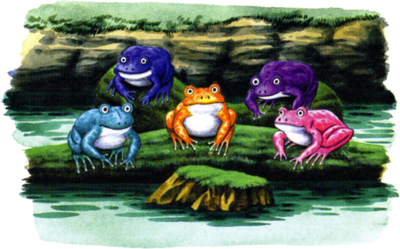
Time to say goodbye to the professional jazz band and welcome the Fabulous Five Froggish Tenors. Well, that was how they referred to themselves back in Ocarina of Time. But who wants to deal with band drama anyway when you can just connect with nature and creatures that will follow your instructions in a precise manner without any complains or inconvenience (drummers take note).
In Ocarina of Time they were a croaking choir that enjoyed and looked forward to being shown new tunes that the Hero of Time had collected throughout his adventures—they specially enjoyed ‘Singing in the Rain’, how they referred to the Song of Storms— On that game, it was another opportunity for the gameplay to make players interact even more with their MIDI instrument inside their controller, adding more gamification elements to an already musical game. Majora’s Mask continues that musical tradition. However, this time, the hero has to find a way to reunite the members of the choir and then conduct them in a performance where they have to be synchronized in order to complete a full melody line, composed, of course, of five melodic phrases; one for each frog. In order to do so, Link has to dress as one of their peers. Their leader. A conductor called Don Gero, which funnily enough is a very realistic frog compared to the cartoony frogs from the game world. As usual, the mask is acquired by performing a good deed, in this case for a hungry goron who, for some strange reason, was dreaming about Dodongo’s Cavern back in Hyrule. The frog trope goes back to Links Awakening, where a frog choir taught a song to the hero.
Musical Analysis
Structure: Section 1
Time Signature: 2/4
Tempo: 160
Melodic and Harmonic Profiles: C Ionian/Major
The melody is as simple as it gets, five frogs, five melodic phrase. On top of that, they all have the same rhythmic and almost the same melodic profile, except for the last frog who is in charge of the coda, exiting and finishing the song with a downwards cadence. With his melodic sensibilities, it probably didn’t take Kondo more than five minutes to compose this ditty, a simple children music tune; repetitive, in major tonalities and short. There is barely any attempt at creating tension or differentiation, there are just minor modifications to each question-answer block. This shows that even a simple unassuming tune has to at least make an effort to create the balance between expected and unexpected. The fifth frog is indispensable for making the piece end in an unambiguous cadence, avoiding an infinite loop that just four frogs could end up trapped in.
The five phrases are: [ (E F G -C) (B C D – G) ] the exact same phrase repeated, the second time a perfect fourth lower. Then it continues with [ (E F G -E) ( F G A – F) ] a little game of finding the differences. As you can see the big answer [ ] has small differences that creates the albeit limited balance between expected and unexpected; the expected here is of course the symmetry of 2 phrases vs 2 phrases, that every phrase plays ascending notes and the fact that everything uses the same rhythm; the unexpected is the notes chosen. Koji could just have made frog number 3 play exactly the same question-answer block of frog number 1, most people probably would not care or even notice. But changing just one note makes the piece feel more evolved, less symmetric. The other aspect is that frog number 4 decides to go higher up, contrasting with frog number 2 who went down in relation to the first phrase; a rule of thumb is that going up means more tension, going down means less tension; frog number four also makes minuscule changes to the melodic profile, omitting the opening minor second interval in favor of a major second. So frog 4 is at the point of most tension when frog number 5 comes to the rescue to form a contingent ending to the piece, deflating the balloon with a descending in diegetic fashion to the tonic (G F E D – C). that’s it, the song has ended. Frog number 5 is the one that makes the piece become a song, otherwise, the frogs would be trapped playing an ostinato forever. By virtue of the odd number 5, the last frog also creates unnatural asymmetry. For once, it contains five notes and it is the only phrase with a fully descending contour, then it can be dubbed a macro answer to the piece:
{ [ (E F G -C) (B C D – G) ] – [ (E F G -E) ( F G A – F) ] } ———————{ G F E D – C }
Because even within asymmetry we can find the fundamental duality of music.
The sample is just a stock frog croak sound pitched up and down. It is called:
FROG, BULLFROG – CROAKING, ANIMAL, AMPHIBIAN 02 from the library Sound Ideas Series 1000
So apparently, we know the actual species the sample was taken from. it’s the American bullfrog from the United States and Canada, a very large frog. You can hear the original voice actor of this piece in action here:
https://www.audiomicro.com/croaking-animal-frog-bullfrog-royalty-free-stock-music-891134
It’s good the spring full of life of the mountains, and the positive croaking of some amusing animals are the last images we will take with us before departing to the literal land of the dead, a place that will take the denial present in the Legend of Zelda: Majora’s Mask to its natural conclusion, the denial of having lost one’s own life.

Help to keep the rites going around here by supporting the shrine:

Media Files, requests and support for more interactive content

Thou shall donate since this is a cult and you are now a sheep

Help staying awake analyzing game tracks and writing posts or else everything will end up being written by A.I
- Inside The Score – The Legend of Zeda: A Link to the Past – End Credits / Staff Roll
 The land rests As the last few minutes of this extensive journey that has now come to an end fly by, the nostalgia and reflective mood kicks in. Because such a massive enterprise as a Zelda game or a Lord of the Rings movie require multiple endings to convey everything… Read More »Inside The Score – The Legend of Zeda: A Link to the Past – End Credits / Staff Roll
 - Inside The Score – The Legend of Zelda: A Link to the Past – Ending / Epilogue ~ Beautiful HyruleFinal of the fantasy The Triforce has been touched. A wish has been granted. For the occasion, the newly undeceased king of Hyrule has commissioned a march in honor of the legendary hero to the Hylian Sousa, who might as well be composer Nobuo Uematsu since this piece is very… Read More »Inside The Score – The Legend of Zelda: A Link to the Past – Ending / Epilogue ~ Beautiful Hyrule
- Inside The Score – The Legend of Zelda: A Link to the Past – Triforce Chamber / Power of the GodsTake your boots off your feet And thus the Triforce spoke to men. And it became present in history. And you better treasure and contemplate this moment seldom witnessed in the course of the series. The elusive opportunity to interact and touch the most important artifact. You are now in… Read More »Inside The Score – The Legend of Zelda: A Link to the Past – Triforce Chamber / Power of the Gods
- Inside The Score – The Legend of Zelda: A Link to the Past – Ganon Battle / Prince of DarknessProgressive evil En Garde! And you better be prepared since you are about to duel the iconic enemy of the series at perhaps his canonically most powerful incarnation. Right after having touched the sacred Triforce which allowed him to conquer all of the Golden Land and whose evil and darkness… Read More »Inside The Score – The Legend of Zelda: A Link to the Past – Ganon Battle / Prince of Darkness
- Inside The Score – The Legend of Zelda: A Link to the Past – Boss Battle / Anger of the GuardiansQuick mayhem Ah, the simpler times when boss battles where not a multi epic orchestral suite but just an ostinato more basic that even what became the music for standard battle encounters out there. We are a long way from each boss having his own personalized track. And this early… Read More »Inside The Score – The Legend of Zelda: A Link to the Past – Boss Battle / Anger of the Guardians
- Inside The Score – The Legend of Zelda: A Link to the Past – Dark World Dungeon / Dungeon of ShadowsMemento mori We are getting closer to Ganondorf (or at least the wizard Agahnim who ultimately fulfills the same human side of evil role in this game) and that means getting closer to the profiles and motifs of his own theme song (which naturally was the theme of Agahnim at… Read More »Inside The Score – The Legend of Zelda: A Link to the Past – Dark World Dungeon / Dungeon of Shadows