A soul shining in the land of the dead
“Even now it is a place where troubled, regretful spirits gather”
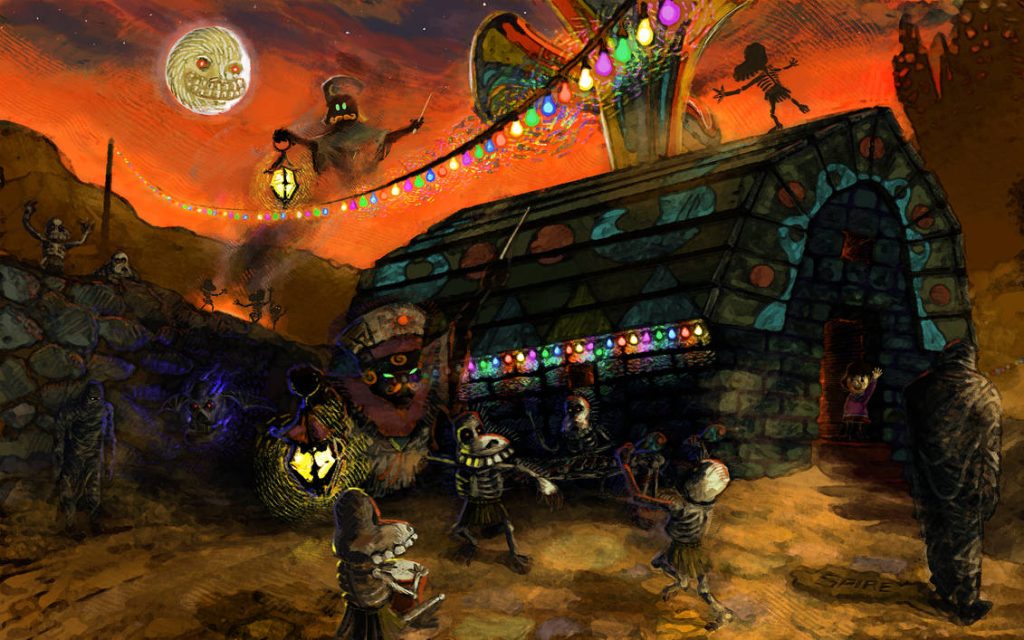
Fight as if your life depended on it, but what about when yours is already gone? What are you fighting for then? Those dilemmas are the ones that accompany the cursed people inhabiting Ikana Canyon, the very last stage of awakening for the Hero of Time, where he will descend unto the heavens to reach the light, earn his place as the fifth guardian deity of Termina and fight alongside the spirits of a deku, a goron and a zora. And why not? Free and heal more haunted souls full of hatred while he is at it.
The land of the dead is only accessed after the quest party is completed, fitting since Link’s entire party has already left the world of the living. They are all prepared together to open the gates to heaven. Good thing we just spent some time listening to good ol’ lounge jazz before coming to this dread and gloominess; we certainly needed to calm our spirits.
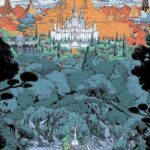
The Ikana region is a masterclass of atmosphere and lore, the rightful, appropriate coda to The Legend of Zelda: Majora’s Mask; it is the most ancient, cohesive and culturally rich area alongside Clock Town, to which it is intimately related. A whole narrative for a different game could be extracted just from the situations occurring on this impure land, and even so, the game still manages to leave all kinds of mysteries open. Who were these people? What were they fighting for? And why do they refuse to leave the battlefield even in death? In Termina, souls are permitted to roam until they can be put to rest or they promises are fulfilled, however, in Ikana there is something more akin to a curse than genuine attachment. We will have front row seats to watch the cursing process first hand by curing one such a curse behest on a man and, furthermore, Link will even end up with the honor of becoming the captain of the Stal Army, ordering his undead troops to finally take leave. War is over. Unlike the three other regions of Termina, there are no bustling settlements or amenities to be found nor is there the anticipation of festivity and happiness; it is a place that exists in stagnation and ruin, a place whose true time was a long time ago.
It is aptly the most difficult and extensive region in the game, with multiple quests to complete before reaching the dungeon, multiple bosses to defeat, and it has several items and gemeploy elements that one must be acquainted with; there is also no transformation mask as we know them. Link will have to visit most of the landmarks in order to finally bring peace and calm the lingering spirits that fill Ikana Canyon, the kingdom with a history of greed and hatred—hmm sound just like the Shadow Temple.
This is a desert level unlike your typical camel-pyramid-egyptian filled themed scenarios from the Middle-East and Egypt. This is different. Unlike the other three lands from Termina, the land of Ikana has the strongest ties to real world culture and history—analog to the Gerudo Valley region in Ocarina of Time—It’s fitting and not surprising that the land of the east, Ikana, has influence from the real world lands of the East. And it’s the Far East we are talking about. We are referring to the often unexplored in media and underrated deserts alongside the Silk Road, shared among different nations and reaching the massive country of China, the real world basis for the kingdom of Ikana. More specific, the lands and histories we would find in the Gobi Desert, an expanse of land with plenty to discover. The Ikana region, being the last stage of awakening, makes sense from the central point of the game too, which was based from the beginning on Eastern concepts in order to differentiate itself from the medieval European Hyrule.
Of course the knack of Majora’s Mask for inserting out there modern media tropes is still intact in the figure of a paranormal researcher living with his daughter; yet, it manages to still be one of the most disturbing stories found within the game.
If Clock Town is your rural, modern village, then Ikana plays around with the most ancient past, which in our own reality is also shrouded in mystery, specially in China. There are many mysterious ancient cultures in Chinese history, namely among them are the Yelang Kingdom, Loulan Kingdom and Dali Kingdom; but the most famous might be the one from the desert known as the Kucha kingdom. Just like the kindom of Ikana, these mysterious civilizations banished without anyone knowing exactly why; history doesn’t give much detailed account of it. The masked Nuo rituals and culture, being one of the most ancient shamanic rituals, also played a part in these civilizations. To this day there are still excavations that unearth ethnic tombs and uncover a little more of the mystery of these kingdoms. Buddhism came to China from India, originally by way of the desert lands, and the religious developments are reflected in murals across grottoes in the desert, which have survived thanks to the durability of stone. They are a pictorial history of China and its past kingdoms. The desert was the birthplace of Buddhism in the Far East. Ikana kingdom may similarly be the birthplace of many of the customs from Clock Town.
We can infer that a lot of the practices from the inhabitants of Clock Town, like the masks, the carnival of time and their passion for astronomy—in Ikana it would have been closer to astrology, which in the past was basically the same thing as astronomy—as seen in the adoration of the moon and the sun; even the iconic clock tower right at the center of Clock Town seems to be a remnant of the might and expanse of the Ikana kingdom (the clock tower, minus the clock, is made of ancient stone and is full of symbols from Ikana, including its symbol crest) So naturally, the Nuo culture and ancient Chinese influence from Majora’s Mask are at its strongest on this land of the east. It is perhaps an amalgam of who knows how many stories and cultures from the rich ancient past of China, its relationships with neighbor countries like Mongolia, fights against Turkish invaders, and everything else that entailed on the desert regions across the Silk Road, specifically the Taklamakan Desert, which has a reputation as a place where people will die if not by nature or by other men, then by demonic spirits. In fact, according to the Italian adventurer Marco Polo, it is said that on the desert “they hear spirits malignant in the air, talking in a way that they seem to be their companions, sometimes they hear many instruments of music sounding in the air. Just like with the Kucha kingdom, we will see that Ikana has a musical motif and tradition in addition to the undead motif.
Musical Analysis
Structure: Section 0 / Section 1 / Section 2
Time Signature: 4/4
Tempo: 60
Melodic and Harmonic Profiles: D Whole Tone; D Diminished (Section 1) A Phrygian Major; A Harmonic Minor; A Chromatic (Section 2)
With a tempo of 60, just like the rate of time itself, the music has once again horror elements, apt for the kingdom of hungry ghosts arising from people whose deaths have been violent or unhappy. We are in a land of the undead after all. The string pad is back in place of our standard orchestral strings; they are truly the definition of uncanny, sounding like strings but not quite like the ones we are accustomed to. By this point in the game their sonority is already cemented as one of the go-to standards featured in the score of Majora’s Mask. The last land corrupted by Majora has the final arrangement of the corrupted mask theme at its most dangerous, unsettling version; perhaps the definitive one. The already eerie harmony and melodic intervals finally encountering their match in orchestration and sound design. You can feel immediately that this place has a long history lost by time just by the music, the sound of a cursed people all around.
For the horror elements, we will revisit old friends from back in the ‘Cavern’ theme first heard when falling down the rabbit hole after chasing the skull kid. The standard ambient track is the same cavern atmosphere that muddies the ear and clouds the spirit in a subliminal manner (only Snowhead Mountain and Ikana have an ambience track on their region cue). You already know the drill: maxed out reverb and pitches moving up and down in semi random fashion. The main difference with other uses of ambience is that Koji doesn’t use volume automatization, it stays at full loudness all the way. An asphyxiating, nasty atmosphere engulfs this land.
Then we got the deep, low, piercing piano replacing the original phrase played by the low strings. As seen on the ‘Inside Ganon’s Castle’ cue, the piano is used in its raspy low register meant to sound more aggressive. It is a staple of danger and horror in media that Kondo appropriates once again for his Ikana cue; just let it ring and it gets the job done to make anyone turn around and never come back. The horror combo is completed with the classic dissonant high strings that signal a dangerous situation. There are assassins literally waiting for Link who remain unseen. Unlike in the cavern cue, the string noise remains in the same register, appearing at disjointed times throughout the piece. This time around, Kondo leaves out the countermelody characteristic of Section 1 (the one first played by the bassoon on the first arrangement).
The Twin Peaks’ string pad, sounding close to the main theme of the TV series, is playing what used to be the oboe part in the first swamp version. The calming but slightly eerie oasis where the track lifts and stays suspended.
You also would think that the track has a brand new sample not heard before, playing sustained minor second intervals, perhaps a cool synth sound from the wizards who created the Distorted Reality library CD? Nope, it just the good old Hammond organ from the Milk Bar and the Aliens’ theme enhanced with the power of dynamic pitch shifting giving it a hand to sound totally unrecognizable, as if a vortex full of darkness has been opened and is emanating cursed energy. Unlike the other corrupted lands’ themes, the intro of this piece is completely without any notes, just avant garde sounds.
If in each theme there is an instrument that gets distorted by an insane amount of vibrato, then here in Ikana, that fate falls onto the piccolo, who enters to double the melody and complement the choirs, which also have a considerable amount of vibrato added.
Turns out not everyone in here is dead. Over the valley there is word going around that a single soul is still struggling for life, afraid but sill resilient; traces of a pure, innocent mind are still found within Ikana, like for example a paper plane used to play and a cute music box house. They are the traces of a lonely girl living in the valley, which are also echoed on the music, as her voice takes over the last portion. Crying for help. Hoping her whispers are carried by the wind onto someone who can make her situation stop. Besides her, the other voices we hear are the voices of the undead as a choir, telling us their history and making their presence felt in aural form too. The lower part of the octave is the one that indicates to us that these voices are not human but demonic in nature.
It’s now time to meet some of the ghosts roaming this land and see who has (or wants) redemption. As it starts to become apparent, in The Legend of Zelda: Majora’s Mask not everyone can be saved.

Help to keep the rites going around here by supporting the shrine:

Media Files, requests and support for more interactive content

Thou shall donate since this is a cult and you are now a sheep

Help staying awake analyzing game tracks and writing posts or else everything will end up being written by A.I
- Inside The Score – The Legend of Zeda: A Link to the Past – End Credits / Staff Roll
 The land rests As the last few minutes of this extensive journey that has now come to an end fly by, the nostalgia and reflective mood kicks in. Because such a massive enterprise as a Zelda game or a Lord of the Rings movie require multiple endings to convey everything… Read More »Inside The Score – The Legend of Zeda: A Link to the Past – End Credits / Staff Roll
 - Inside The Score – The Legend of Zelda: A Link to the Past – Ending / Epilogue ~ Beautiful HyruleFinal of the fantasy The Triforce has been touched. A wish has been granted. For the occasion, the newly undeceased king of Hyrule has commissioned a march in honor of the legendary hero to the Hylian Sousa, who might as well be composer Nobuo Uematsu since this piece is very… Read More »Inside The Score – The Legend of Zelda: A Link to the Past – Ending / Epilogue ~ Beautiful Hyrule
- Inside The Score – The Legend of Zelda: A Link to the Past – Triforce Chamber / Power of the GodsTake your boots off your feet And thus the Triforce spoke to men. And it became present in history. And you better treasure and contemplate this moment seldom witnessed in the course of the series. The elusive opportunity to interact and touch the most important artifact. You are now in… Read More »Inside The Score – The Legend of Zelda: A Link to the Past – Triforce Chamber / Power of the Gods
- Inside The Score – The Legend of Zelda: A Link to the Past – Ganon Battle / Prince of DarknessProgressive evil En Garde! And you better be prepared since you are about to duel the iconic enemy of the series at perhaps his canonically most powerful incarnation. Right after having touched the sacred Triforce which allowed him to conquer all of the Golden Land and whose evil and darkness… Read More »Inside The Score – The Legend of Zelda: A Link to the Past – Ganon Battle / Prince of Darkness
- Inside The Score – The Legend of Zelda: A Link to the Past – Boss Battle / Anger of the GuardiansQuick mayhem Ah, the simpler times when boss battles where not a multi epic orchestral suite but just an ostinato more basic that even what became the music for standard battle encounters out there. We are a long way from each boss having his own personalized track. And this early… Read More »Inside The Score – The Legend of Zelda: A Link to the Past – Boss Battle / Anger of the Guardians
- Inside The Score – The Legend of Zelda: A Link to the Past – Dark World Dungeon / Dungeon of ShadowsMemento mori We are getting closer to Ganondorf (or at least the wizard Agahnim who ultimately fulfills the same human side of evil role in this game) and that means getting closer to the profiles and motifs of his own theme song (which naturally was the theme of Agahnim at… Read More »Inside The Score – The Legend of Zelda: A Link to the Past – Dark World Dungeon / Dungeon of Shadows