Because rock people can also be soft
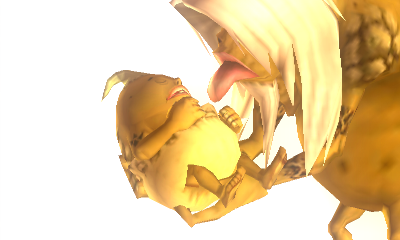
The second “warp song”—or at least its equivalent—from Majora’s Mask. It also shares a bizarre pedagogic method with all the other dungeon ocarina tunes from the game; first one taught by the monkey, now it is a Goron baby and this is only after Link has learned the intro from the Goron elder that seems to have memory issues—the remaining two songs are even more bizarre— the ocarina tunes may imply some lessons the hero is learning on his path towards enlightenment; the first one representing his awakening, this one about one’s parent relationship.
The songs are mostly taught via singing. Now that Link has access to the spirit of Darmani, the Goron hero, the ocarina has the spirit of the Goron instrument as well; a drum with a skin frame.
The Goron Lullaby is the counterpart to the Sonata of Awakening. It has the opposite effect, that being, making people sleep. It will be specially useful to finally soothe the son of the Goron elder; fitting, since a lullaby is a simple, soft melody played to children in order to help them sleep at night.
Musical Analysis
Structure: Section 1 / Section 2
Time Signature: 3/4
Tempo: Dynamic: (from 81 to 93)
Melodic and Harmonic Profiles: D Dorion; D Aeolian/Minor
Gorons, being based around a tribalistic motif, are the perfect candidates to play all kinds of rawhide drums, perhaps the simplest, most basic instruments one can make—not counting the voice itself— They are some of the most ancient instruments around; drums are the world’s oldest and most ubiquitous musical instruments found all over the world, and the basic design has remained virtually unchanged for thousands of years. You only need some kind of shell and stretch an animal skin or organic membrane over it; a drumhead and a resonator. That’s it. The playing technique is equally simple, after all, how many brain cells can it really take to bang on stuff with sticks? (drummers beware of the joke). In any case, it is expected that a tribe like the Goron will have music that tends to be more ritualistic, primal, repetitive and straightforward.
This time around we don’ t have a duet but a core ensemble composed of Link; darmani, the Goron hero; and the voice of the baby Goron— curiously, the Zora guitar is also used here as accompaniment— Link plays his ocarina on the “happy”mode (notes A, B, D) using a motif of only three notes, where the question is an ascending pattern and the answer the one that descends to the tonic; it is as simple as it gets, perhaps only competing with Epona’s Song as the easiest song to perform. Another difference with the other duets is that here it does not happen that an instrument plays and then the other responds; the ocarina and the frame drums are played throughout the entire piece.
Similar to the Sonata of Awakening (and many more ocarina tunes), Koji selects two chords to go back and forth in the beginning of the piece and then on to a coda. The acoustic guitar is arpeggiating between D minor and D minor sixth, giving the piece an slightly dissonance by using the tritone interval from F to B as opposed to the safer, consonant option (G major) However, the presence of the B natural retains the Dorian flavor of the piece—it even feels as if the acoustic guitar is playing the song of soaring— The high strings help to soften the diminished fifth played by the guitar by sticking to the G chord.
The triumphant Mario cadence had a good run (it will only return at the very end of the score); here we see it vanish as Kondo finally opts to let a minor tonality ocarina song end in melancholy, the outro being composed of Bb – Am – Dm, with the Bb major a small tease of a Mario cadence that never will come—although it manages to thrive a little in the figure played by the strings at the end, implying an Am7 (which contains a C major chord).
Like many of the orchestrated ocarina tunes, they end up being more sophisticated than they would need because Kondo always make sure to mix at least two harmonic profiles or modes in each of the tunes; in this case the Dorian and the minor.
The Goron drums are special in the sense that throughout the game they fulfill a melodic role, something unusual for these kinds of drums. Their design and sound are based around the ones played by the Native Americans (USA), where drums are very influential, demonstrating that the Goron are not based on any specific culture but an amalgam of anything that feels tribal and indigenous to the developers—to make them a melodic instrument Kondo uses a sample spread across his keyboard in order to play the different pitches.
The cute voice of the Goron child is likely a recording of a girl no older than 10, girls are typically used to voice babies even if in-game they are meant to be boys, similar to how women tend to voice young boys; it’s definitively easier than giving recording instructions to an actual baby—or perhaps the sample was taken from a random recording of a baby—The vocals play after the ocarina does a melody round and, similar to Malon, the singing ranch girl, Koji uses pitch manipulation to reach the intended notes in order to make the voice sound as natural as possible with the limited technology of the time. Just like a baby with limited musical training, Kondo makes the last pitches not being completely in tune with the ocarina and the Goron drums, making it realistically amateur or as if the baby Goron had started crying mid song or getting sleepy.
Now Link and Darmani have everything they need to have another go, a second opportunity at trying to tame the blizzard preventing the entrance to Snowhead Temple, coming from a giant Goron that unintentionally caused the demise of the legendary Goron hero, a hero whose destiny is about to be fulfilled. Promise from one hero to another.

Help to keep the rites going around here by supporting the shrine:

Media Files, requests and support for more interactive content

Thou shall donate since this is a cult and you are now a sheep

Help staying awake analyzing game tracks and writing posts or else everything will end up being written by A.I
- Inside The Score – The Legend of Zeda: A Link to the Past – End Credits / Staff Roll
 The land rests As the last few minutes of this extensive journey that has now come to an end fly by, the nostalgia and reflective mood kicks in. Because such a massive enterprise as a Zelda game or a Lord of the Rings movie require multiple endings to convey everything… Read More »Inside The Score – The Legend of Zeda: A Link to the Past – End Credits / Staff Roll
 - Inside The Score – The Legend of Zelda: A Link to the Past – Ending / Epilogue ~ Beautiful HyruleFinal of the fantasy The Triforce has been touched. A wish has been granted. For the occasion, the newly undeceased king of Hyrule has commissioned a march in honor of the legendary hero to the Hylian Sousa, who might as well be composer Nobuo Uematsu since this piece is very… Read More »Inside The Score – The Legend of Zelda: A Link to the Past – Ending / Epilogue ~ Beautiful Hyrule
- Inside The Score – The Legend of Zelda: A Link to the Past – Triforce Chamber / Power of the GodsTake your boots off your feet And thus the Triforce spoke to men. And it became present in history. And you better treasure and contemplate this moment seldom witnessed in the course of the series. The elusive opportunity to interact and touch the most important artifact. You are now in… Read More »Inside The Score – The Legend of Zelda: A Link to the Past – Triforce Chamber / Power of the Gods
- Inside The Score – The Legend of Zelda: A Link to the Past – Ganon Battle / Prince of DarknessProgressive evil En Garde! And you better be prepared since you are about to duel the iconic enemy of the series at perhaps his canonically most powerful incarnation. Right after having touched the sacred Triforce which allowed him to conquer all of the Golden Land and whose evil and darkness… Read More »Inside The Score – The Legend of Zelda: A Link to the Past – Ganon Battle / Prince of Darkness
- Inside The Score – The Legend of Zelda: A Link to the Past – Boss Battle / Anger of the GuardiansQuick mayhem Ah, the simpler times when boss battles where not a multi epic orchestral suite but just an ostinato more basic that even what became the music for standard battle encounters out there. We are a long way from each boss having his own personalized track. And this early… Read More »Inside The Score – The Legend of Zelda: A Link to the Past – Boss Battle / Anger of the Guardians
- Inside The Score – The Legend of Zelda: A Link to the Past – Dark World Dungeon / Dungeon of ShadowsMemento mori We are getting closer to Ganondorf (or at least the wizard Agahnim who ultimately fulfills the same human side of evil role in this game) and that means getting closer to the profiles and motifs of his own theme song (which naturally was the theme of Agahnim at… Read More »Inside The Score – The Legend of Zelda: A Link to the Past – Dark World Dungeon / Dungeon of Shadows