Pure adventure awaits
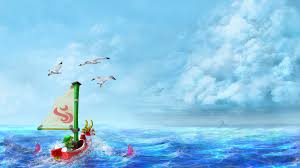
Just like the wind blowing at your back, the call to adventure is strong on this one. You close your eyes, feel the breeze, a mixture of air and water, and then move forward completely uplifted and full of determination toward the horizon into the expansive unknown hopeful that your adventure will pay off; it sounds just like you are on top of the world (and you literally are!). That is OK, what happened is that the swashbuckling influences have reached their natural conclusion in this pirate themed quest that will find our young hero traversing the single seas in his pursuit to find his missing sister and uncover the ancient history of what used to be this land.
The sense of freedom is in full display as you can travel wherever the wind takes you, and later the wind will go wherever you take it; you will always have the wind in your sail which is the reason why the game has the name that it has.
This is all captured by the Ocean Theme a.k.a the Wind Waker Overworld theme which does heavy lifting in making the traversing of the sea feel like the biggest adventure of a lifetime, like this is a true ocean of the same expanse as the ones in real life and even if you are just going in a straight line to your destination without any other action you feel like you are on an epic voyage, the wind accompanying you alongside flocks of birds and dolphins jumping beside your speeding boat—where where the dolphins and whales here Nintendo, where? What was the point of naming the console the dolphin if there weren’t going to be dolphins jumping to the rhythms of the music from time to time? The worst part is that nobody complained—Anyway, back to the music, the Wind Waker Overworld theme was composed by the music director of the project, Kenta Nagata, who previously worked in Mario Kart 64. It is a track based around the movement of ocean waves, the openness of the sea with various melodic phrases following one after the other, and the adventure feel is brought courtesy of the main theme of the series, whose motifs are present throughout the piece. And not only the cello swells are mimicking the ocean waves but if you could see the actual waveform you would notice that the entire piece has a wavelike shape thanks to the pizzicato strings adding volume to the low end; the amplitude of the arrangement itself is all wavelike, capturing the rhythms of the movement similarly to the Spirit Tracks overworld.
Musical Analysis
The composition is actually shorter than the Ocarina of Time field theme, omitting all the convoluted dynamic sections in favor of a straightforward single piece made with intro, two long melody sections and interludes akin to the intro separating its main sections. Unlike other Zelda overworlds this one does not make any pretense of mixing a little bit of danger in, opting instead for pure adventure and excitement, sounding like a coming of age story about a hero that is leaving home behind looking back at it with nostalgia but completely determined to what lies ahead. Musically, it is also more conventional than other Zelda pieces which are more modal. Here we also include the classic morning cue, the ‘Sun’s Song’ originally from Ocarina of Time that wakes you up with the sound of flute mimicking the birds—although they are now seagulls— that are just waking up; the piece is now in a D profile to connect with the Great Sea theme and the main curiosity is the harp sound played in a freestyle fashion as if someone is just plucking the arpeggios without too much thought, like the random movement of water in a calm morning or bubbles underwater. From the ‘Sun’s Song’ the echoes of the main theme of the series start to permeate to create the Zelda sound, with the final run of the opening phrase from the flute playing a motif from the main theme of the series (the scale from G to D). Just like in its original incarnation, the morning cue ends with the IV to V sustaining the dominant to prepare for leashing into the tonic when the Ocean Theme triumphantly starts.
You set you sail and the boat starts jumping with the movement of the waves. This movement is captured in the main accompaniment of the bass which plays the wavelike figure composed of a pedal Dsus2 chord over which the string chords will change, giving it different colors. The harmony that the bowed strings are playing is:
D – A – Am – Gadd9
D – A – Gdim7 – Am7
Naturally, all these chords have a D5 as a pedal chord in the bass creating different sonorities, but at its core it is is the most pop/rock progression that the Zelda series has employed, a chord progression that you could find in, say, one of those uplifting Foo Fighters songs. The horns would function as one of those pirate calls sounding in the distance. Instrumentally we are pretty much back to the standard Orchestra used in Zelda except for the lack of woodwinds, we just have a bunch of brass sounding like boat horns fanfares responding each other across distances; just like in Ocarina of Time, the trombone sound plays double duty as a second trumpet harmonizing and responding to the melody. Timpani and Pizzicato strings are correlated to reinforce the low end. The voice leading in the strings is smooth, meaning as few movements as possible between notes, some remaining while other gently moving in chromatic steps.
The main section is played by the brass instruments playing melodies with a lot of space, get it? Because you are in the open sea. The melody takes clues from the main Zelda series theme playing a tweaked version of that melody opening statement. The Zelda main theme nostalgia version. The second phrase also plays with the motif of the equivalent phrase in the main theme of the series. The chords for this first section would be:
D – [F#m7 – D/F#] – G – [Asus4 – A]
G – Dadd9/F# – Em7 – Gadd9/A – A7
It is the least modal progression for the Zelda series, remaining anchored to the D Ionian/Major key and using typical nostalgia movements like the I to iii; nevertheless the extended harmony still makes it sound interesting. The entire phrase repeats a second time with only a small twist at the end and some more boat honks added in.
D – [F#m7 – D/F#] – G – [Asus4 – A]
G – [Dadd9/F# – Bm7/11] – Bb – [Bbadd9/C – C]
The piece throws a surprise for the last batch of chords moving away from nostalgia and into a more determined and heroic space courtesy of the Mario cadence [ bVI – bVII – I] which is pretty much a Zelda cadence since it is practically more used on The Legend of Zelda series. It is the modal quota that borrows the two last chords from the parallel minor profile.
The intro comes back but not really, it is an interlude since even though the bass arpeggio is the same, the string chords are different so you get a different sensation.
D – E – D – Aadd11
The E coming from the Lydian version of D. Again, all of these chords are on top of the Dsus2 ostinato.
The second main section has an identical substructure to the first one, it repeats twice an spacious melody inspired by the motifs of the Main theme of the series, sometimes implying it in even stronger fashion. The harmony would be something like:
D – A/C# – [Am/C – Amadd11] – G/B
G – [D/F# – Bm7] – Em7 – Gadd9/A – A7
The voice leading on the bass line in the first part is meant to descend chromatically from D to B, same progression as the intro. It also ends in the same way as the first section. The second time also ends with the same chords as the equivalent first section:
D – A/C# – [Am/C – Amadd11] – G/B
G – [D/F# – Bm7] – Bb – [Bbadd9/C – C]
So Overall a more cohesive piece than the fragmented style from Ocarina of Time that returned in Twilight Princess in a more measured fashion. Another way this section is differentiated from the other is that the lead instrument here are the strings.
After this, the interlude returns and the piece loops, the original intro never to be heard again.
Even though the ocean from Wind Waker is way bigger than Hyrule Field from Ocarina of Time, that previous cue was used in many other parts while this is meant to exclusively carry you through the seas. It is the sailing theme. No danger is heard, for that we will have to wait for the cursed version of this theme which incorporates the ‘Ganondorf’s Theme’. As pointed, even though the interplay between the bass line and chords create all kinds of interesting colors, the piece has more conventional harmony progressions than other overworlds in the series and it is almost always in an uplifting mood appropriate for the brand new and colorful art style that managed to propel The Legend of Zelda into the modern era; because even though the series is portrayed as more serious than Mario it still has the bizarre, quirky Japanese fantasy quality plus a lot of video game-like movements and moments that would be harder to convey with realistic graphics even if they tried it on Twilight Princess.
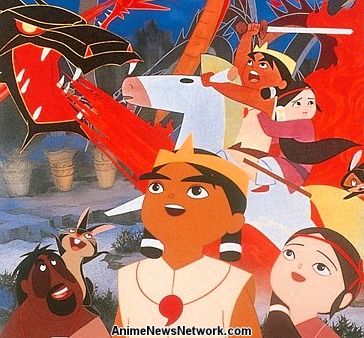
Down to the latest entries, the animesque influence from The Wind Waker is still present on the series which managed to get right the proper balance between cartoony and realistic allowing for gameplay ideas and moments that would look plain weird with photorealism; so the influence of The Wind Waker lives on. This style was heavily inspired by the anime film The Little Prince and the Eight-Headed Dragon from 1963—other notable works inspired by the film style is Samurai Jack—Interestingly, Yoichi Kotabe, one of this film’s animators, would work at Nintendo later in his career, and was still working at the company during Wind Waker’s development. While he himself was not involved with the game, his protégé Yoshiki Haruhana is credited as one of the design managers and for creating the original design of Toon Link.
Some story beats also seem to be inspired by the anime series Future Boy Conan. As for your transport across the single seas, the King of the Red Lions, his concept was inspired by the Dragon boats originally from China and rooted in competitions between villagers who made boats with designs similar to the one that Link uses here:

This was the promised open world Zelda, you can go anywhere where your heart desires and get treasure, both rupees and memories await. And even though it is uplifting, its theme manages to capture the fact that you are over the remnants of Hyrule by playing fragmented motifs of the main overworld of the land.

Help to keep the rites going around here by supporting the shrine:

Media Files, requests and support for more interactive content

Thou shall donate since this is a cult and you are now a sheep

Help staying awake analyzing game tracks and writing posts or else everything will end up being written by A.I
- Inside The Score – The Legend of Zeda: A Link to the Past – End Credits / Staff Roll
 The land rests As the last few minutes of this extensive journey that has now come to an end fly by, the nostalgia and reflective mood kicks in. Because such a massive enterprise as a Zelda game or a Lord of the Rings movie require multiple endings to convey everything… Read More »Inside The Score – The Legend of Zeda: A Link to the Past – End Credits / Staff Roll
 - Inside The Score – The Legend of Zelda: A Link to the Past – Ending / Epilogue ~ Beautiful HyruleFinal of the fantasy The Triforce has been touched. A wish has been granted. For the occasion, the newly undeceased king of Hyrule has commissioned a march in honor of the legendary hero to the Hylian Sousa, who might as well be composer Nobuo Uematsu since this piece is very… Read More »Inside The Score – The Legend of Zelda: A Link to the Past – Ending / Epilogue ~ Beautiful Hyrule
- Inside The Score – The Legend of Zelda: A Link to the Past – Triforce Chamber / Power of the GodsTake your boots off your feet And thus the Triforce spoke to men. And it became present in history. And you better treasure and contemplate this moment seldom witnessed in the course of the series. The elusive opportunity to interact and touch the most important artifact. You are now in… Read More »Inside The Score – The Legend of Zelda: A Link to the Past – Triforce Chamber / Power of the Gods
- Inside The Score – The Legend of Zelda: A Link to the Past – Ganon Battle / Prince of DarknessProgressive evil En Garde! And you better be prepared since you are about to duel the iconic enemy of the series at perhaps his canonically most powerful incarnation. Right after having touched the sacred Triforce which allowed him to conquer all of the Golden Land and whose evil and darkness… Read More »Inside The Score – The Legend of Zelda: A Link to the Past – Ganon Battle / Prince of Darkness
- Inside The Score – The Legend of Zelda: A Link to the Past – Boss Battle / Anger of the GuardiansQuick mayhem Ah, the simpler times when boss battles where not a multi epic orchestral suite but just an ostinato more basic that even what became the music for standard battle encounters out there. We are a long way from each boss having his own personalized track. And this early… Read More »Inside The Score – The Legend of Zelda: A Link to the Past – Boss Battle / Anger of the Guardians
- Inside The Score – The Legend of Zelda: A Link to the Past – Dark World Dungeon / Dungeon of ShadowsMemento mori We are getting closer to Ganondorf (or at least the wizard Agahnim who ultimately fulfills the same human side of evil role in this game) and that means getting closer to the profiles and motifs of his own theme song (which naturally was the theme of Agahnim at… Read More »Inside The Score – The Legend of Zelda: A Link to the Past – Dark World Dungeon / Dungeon of Shadows