Bluesy ambient
The piece that kickstarted David Wise’s journey through the Donkey Kong franchise and ended up giving the identity to the DKC series since in only one piece it features the range that would characterize the score for the games. Wise is known for his atmospheric style of music, mixing natural environmental sounds with prominent melodic and percussive accompaniment. The music goes against the typical mascot platformer, opting for atmosphere and buildup as opposed to immediate catchiness and bounciness. Before Wise the philosophy was that the music should match the action and jumps of the character; for him it is all about the environments and atmosphere.
Notwithstanding, if you need to have a main theme for your series, it better have a memorable melody and the ape from Nintendo is not left behind thanks to the use of a swing jazz section (you know, cause the game is all about swinging in vines), creating the theme of the character which would go on to compete with the Donkey Kong NES title theme as for which is the theme of the series as a whole. The jury is still out.
Kongo Jungle
The composition was born out of David Wise, at the time a freelance composer used by the company Rareware, who were trusted with reviving and rebranding the famous Nintendo character Donkey Kong thanks to their mastery of very sophisticated equipment to create realistic graphics. David was introduced into the video game world when the founders of Rare found him at a music equipment store, where he showcased some demos he composed just for the sake of demonstrating equipment capabilities. He worked on various NES games for the company but when it came to the Donkey Kong property he was sure that a composer at Nintendo would be the one in charge of the music. Rare was preparing to show the project at Nintendo and only required music to accompany this demonstration, basically asking David to provide a tempt track for the showcase, just for it to not to be pure silence. the instruction was just to make “jungle music” so David composed three different pieces in three different styles for them to choose. The developers liked them so much that just directed him to piece together all three and the DK Island Swing was born. So the main theme of the series was the very first composition. People were so satisfied with his work that the company proceeded to hire him full time to focus on scoring most of the game.
And anyone can easily hear how the three pieces were stitched together. We have the typical African jungle drums, a sister trope of ‘the natives are restless’, based around the common conception of tribes from the continent using large drums—specially if they are about to eat you in one of their rituals; the name Kongo is actually a pun with the African country named Congo. It lend the percussive element to the series and in the context of the track it became a perfect intro; another peculiar characteristic of the soundtrack of the Donkey Kong Country series are very long intros full of build up where layer upon layer is introduced slowly and carefully into the soundscape. The second song is the main jazz melody, a catchy minor tune that uses the chromatic ornaments characteristic of the genre. The song practically ends there and the atmospheric part is added as if a totally different song just started. Thus the three moods of the soundtrack are born.
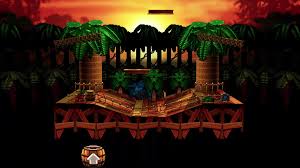
This stage is loosely based on the various jungle themed levels of the game, its gradient sunset based background and plastic palm trees found in the level called Orang-utan Gang. The upmost soft platforms of the stage don’t resemble anything from the Donkey Kong Country series, which avoided abstract floating platforms in favor of natural environment pieces.
The Super Smash Bros arrangement captures most of the instruments and feel of the original track. The bass line is made potent by layering an electric bass with the spiky attack of the acoustic bass. A similar treatment is used with the strings, layering the more natural sounding ones with synthetic strings (the string pad plays chords for each note preset on the keyboard); a particularity of the Smash 64 score is this mix of natural samples with synthesized ones. There are notes so high and so low that they get outside the range of the keyboard in the visualization. In subsequent reuses of the track in the Smash series the intro is shortened sacrificing buildup for the sake of immediacy in battles.
In Super Smash Bros. 4, this stage’s song’s intro was slightly edited, possibly because it was originally too long, and it fit with the original on-screen appearance that was in the original Smash 64. This change was carried over into Ultimate.
Donkey Kong Victory Theme
Originally written by David Wise for the game Donkey Kong Country. This flourish is a cover of the short track that plays whenever a playable Kong defeats a boss or completes a bonus game. So unlike with the Mario victory theme, the standard course complete tune was not used; the bonus and boss defeated theme just sounded more victorious or perhaps had a more appropriate length for the animation.
The track gets that bittersweet, nostalgic kind of feeling thanks to its use of the now common Pachelbel’s Canon chord progression in F major. A well known harmonic progression and used schema in the Western canon during the 17th and 18th centuries. The progression is usually in a major key, and runs the: I-V-vi-iii-IV-I-IV-V chords on repeat alongside a falling bass line. After a 1968 arrangement and recording of it by the Jean-François Paillard chamber orchestra gained popularity over the next decade, the piece began to be recorded by many ensembles; by the early 1980s its presence as background music was deemed inescapable. From the 1970s onward elements of the piece, especially its chord progression, were used in a variety of popular music. Since the 1980s, it has also found increasingly common use in weddings and funeral ceremonies in the Western world.
For the specific case of Donkey Kong in Smash it used the chords F – C – Dm – Am – Bb – C7 – F ending with a pretty Fmaj7. This score loves ending on extended harmony chords.

Help to keep the rites going around here by supporting the shrine:

Media Files, requests and support for more interactive content

Thou shall donate since this is a cult and you are now a sheep

Help staying awake analyzing game tracks and writing posts or else everything will end up being written by A.I
- Inside The Score – The Legend of Zeda: A Link to the Past – End Credits / Staff Roll
 The land rests As the last few minutes of this extensive journey that has now come to an end fly by, the nostalgia and reflective mood kicks in. Because such a massive enterprise as a Zelda game or a Lord of the Rings movie require multiple endings to convey everything… Read More »Inside The Score – The Legend of Zeda: A Link to the Past – End Credits / Staff Roll
 - Inside The Score – The Legend of Zelda: A Link to the Past – Ending / Epilogue ~ Beautiful HyruleFinal of the fantasy The Triforce has been touched. A wish has been granted. For the occasion, the newly undeceased king of Hyrule has commissioned a march in honor of the legendary hero to the Hylian Sousa, who might as well be composer Nobuo Uematsu since this piece is very… Read More »Inside The Score – The Legend of Zelda: A Link to the Past – Ending / Epilogue ~ Beautiful Hyrule
- Inside The Score – The Legend of Zelda: A Link to the Past – Triforce Chamber / Power of the GodsTake your boots off your feet And thus the Triforce spoke to men. And it became present in history. And you better treasure and contemplate this moment seldom witnessed in the course of the series. The elusive opportunity to interact and touch the most important artifact. You are now in… Read More »Inside The Score – The Legend of Zelda: A Link to the Past – Triforce Chamber / Power of the Gods
- Inside The Score – The Legend of Zelda: A Link to the Past – Ganon Battle / Prince of DarknessProgressive evil En Garde! And you better be prepared since you are about to duel the iconic enemy of the series at perhaps his canonically most powerful incarnation. Right after having touched the sacred Triforce which allowed him to conquer all of the Golden Land and whose evil and darkness… Read More »Inside The Score – The Legend of Zelda: A Link to the Past – Ganon Battle / Prince of Darkness
- Inside The Score – The Legend of Zelda: A Link to the Past – Boss Battle / Anger of the GuardiansQuick mayhem Ah, the simpler times when boss battles where not a multi epic orchestral suite but just an ostinato more basic that even what became the music for standard battle encounters out there. We are a long way from each boss having his own personalized track. And this early… Read More »Inside The Score – The Legend of Zelda: A Link to the Past – Boss Battle / Anger of the Guardians
- Inside The Score – The Legend of Zelda: A Link to the Past – Dark World Dungeon / Dungeon of ShadowsMemento mori We are getting closer to Ganondorf (or at least the wizard Agahnim who ultimately fulfills the same human side of evil role in this game) and that means getting closer to the profiles and motifs of his own theme song (which naturally was the theme of Agahnim at… Read More »Inside The Score – The Legend of Zelda: A Link to the Past – Dark World Dungeon / Dungeon of Shadows