The Mushroom Kingdom
Of course we could not let go of somehow making a score visualizer for arguably the most iconic piece of video game music ever written. It is not a stretch to even say that it might be one of the most famous pieces of music from the 20th century, known across multiple demographics even outside video games and whose infecting melody has been arranged in many ways throughout the eras since its inception in 1985. Officially known as the ‘Ground Theme’ the main theme of the Super Mario series was composed by Nintendo in-house sound designer Koji Kondo for the 8-bit NES game Super Mario Bros, becoming an instant classic and pretty much the anthem of video game music, to the point that In 2023 the theme was chosen by the U.S. Library of Congress as the first ever video game recording selected for inclusion in the National Recording Registry. A Complete analysis alongside other tracks can be found here.
Peach’s Castle
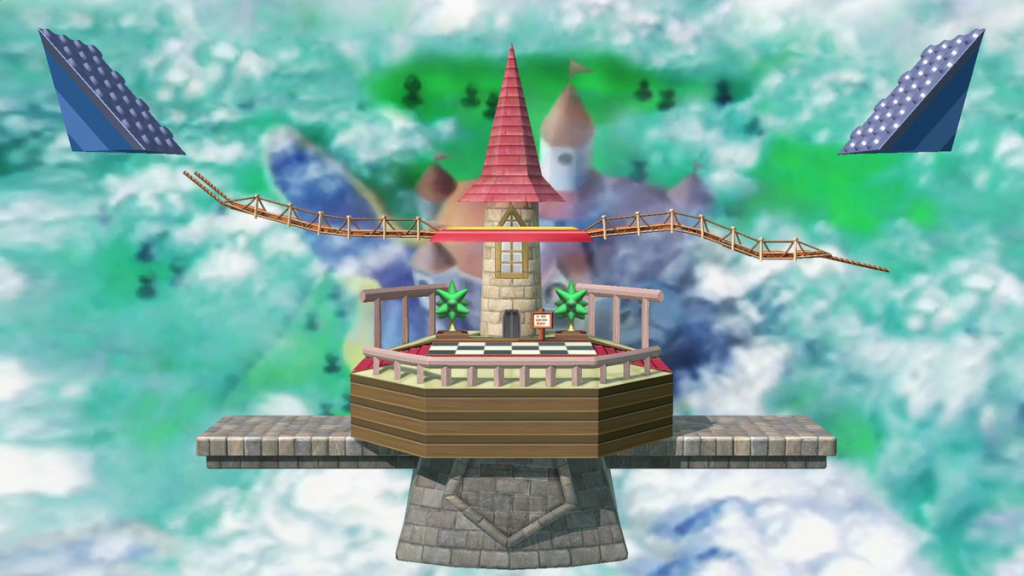
The design of the stage, and the definitive princess Peach castle for that matter, is based around motifs from the one that appeared on Super Mario 64. It features multiple elements taken from that game. The stage mainly takes place around a tower spire resembling the center tower spire on the roof of Peach’s Castle. The red carpet staircases on each side of the main platform and the black-and-white checker pattern floor in the middle is similar to the carpeted staircases and the floor patterns found inside of the castle. The bridges are similar to those found in the Cool, Cool, Mountain course and the design of the triangular platforms in the upper corners are the same as the starting platform in the Bowser in the Dark World boss course. Curiously you also get the actual castle as a background. Overall, it is one of the smaller stages. a Lakitu Bro, who was the cameraman. will occasionally appear as a background character.
For the N64 era the most standard version of this theme is found as the background music for the Mario level in the crossover fighting game Super Smash Bros, which serves also as a little interactive museum of video game characters and assets; the main themes of various series are heard here so it serves well as a starting point of reference to various well known series. The rearrangements for the N64 game were made by the musician Hirokazu Ando, bringing to fruition the Calypso seeds planted on the original.
So much has already been said and dissected about the theme that it would be impossible to add new insights. Suffice to say that the track is all about the synergy between Mario movements, a character all about jumping and running, and the heavily syncopated rhythms of the melodies found. The theme is set in the key of C major and features a swing feel with prominent use of Latin rhythms. It is often scored as a calypso song led by steel drums, just like the ones heard on this arrangement. It was one of six themes composed for the original NES game by Kondo, who found it to be the most difficult track to compose for it. In fact, there were a couple of discarded early version were the composer made the mistake of letting the background environment speak as opposed to the action of the character and rhythm of the gameplay. After seeing that the laidback, pastoral direction would not cut it, Kondo then zeroed on the jumping action to create a fast paced tune heavily syncopated; however, from the early theme he retained the cha-cha swing of the “drum kit” (just the noise channel of the Famicon), making a Frankenstein where melody and harmony are not played with swing but the percussion is. This adds to the bounciness of the melody.
It has been noticed, even by Koji Kondo himself, that the piece has influences from the 1984 song “Sister Marian” by T-Square, a Japanese fusion band that is a favorite of the composer.
This is probably how the original, early version of the piece sounded, just accompanying the background blue sky and green mountains, which inspired the composer to make a laidback tune. The theme we ended up with borrows the first part of the A phrase from a figure heard in the T-Square tune by the 1 minute mark, just to kickstart the melody and then take it to other places. The harmony uses the limited 3 channels of the NES to create interesting chord voices which are by necessity incomplete and mostly employed by the spaced out melody lines. The bass is a melody in itself, creating interesting counter punctual parts that help to make the music richer considering the limited sounds that were available. What makes the piece more than just a pleasant major tonality song is the bVI – I progression during the C section and the debut of the Mario cadence (bVI -bVII – C) that ends the B section.
The arrangement in Super Smash Bros stays faithful to the original intention and tempo of the 8-bit track, reinforcing the calypso connection with the steelpans giving the melody to different instruments to create a more robust orchestration. The ear candy is provided by the pan flute playing the coin sound effects from the series and a nod to the 8-bit origins by employing a square wave to add color. Here you can hear the track consisting of just the accompaniment rhythm section and then with the melody added.
All in all, a good way to explore some more iconic themes and keep the blog active while the next deep dive project is decided. You can request other songs and games you have in mind and of course feel free to discuss further the music.
Mario Victory Theme
Happy Mario Day!
This is the Mario cadence at its most Mario cadence. It was a no brainer to choose the flagpole fanfare from the original Super Mario Bros game to score the victories of characters from the series in the fighting game Super Smash Bros. Originally composed by Koji Kondo, this 8-bit fanfare shows and establishes his preference for the bVI – bVII – I chord progression to signify a triumph for the player and epic moments. Initially teased in the main theme of the series to cap off its B section, this harmonic movement is embedded in other works by the composer like the rest of the Mario series, The Legend of Zelda series and Star Fox. Curiously, it also appears subliminally in the iconic sound effect for getting the mushroom in the Mario series, since this “sound effect”is none other than a sped-up version of this cadence:
In reality this piece includes the tonic to establish the tonality, making it I – bVI – bVII. It can be thought of as a progression that borrows two chords from the parallel minor scale of C (C minor). In the Super Smash Bros version the last C chord adds a D note in the real trumpets, making this last chord a Cadd9 that inflects a different color; the synthesized brass which carries the main tune ends on an E note, additionally giving the chord an inverted nature.
It is the Mario cadence, it is uplifting, over the top but unquestionably majestic, so it will continue to be over used whenever composers want that added drama to a victory that is hard to achieve.
Starman Theme
Time to party. The Latin roots have come to the surface with a vengeance
The classic invincibility music from the Mario series makes an appearance as part of the corresponding item in Super Smash Bros. Its Latin influences are turned up to eleven, with a swag that has nothing to envy from Afrocuban music classics such as “Conga” by Miami Sound Machine. You can feel your body moving just with the sparkly glockenspiel who is as far removed from a Latin instrument as you could expect; it just goes to show how rhythm is at the core of these Latin styles; It is here just to represent the sparkly star item. That particular swing you cannot get out of notation, you must feel it in your bones.
The piece known to all mankind is just a little vamp between two chords, Dm7 and Cmaj, the jazzy quota in the harmony. The bass has many ghost notes and you can see that the muted trumpet has a subliminal melody on top of the standard DuDuDUdududu tune. That is usually the main melody although it can also fulfill the role of accompaniment as it did on the WIng Cap music from Super Mario 64, where there is a string melody on top. The arranger from Super Smash Bros decided to use three glockenspiels panned center, L and R in order to wrap the listener in magic. So dance away while you are untouchable.
Naturally, the piece was written by Nintendo maestro Koji Kondo for the Super Mario Bros game on the NES. It has been used on practically every Mario related thing except bizarrely for Super Mario Land which ditched many standards.

Help to keep the rites going around here by supporting the shrine:

Media Files, requests and support for more interactive content

Thou shall donate since this is a cult and you are now a sheep

Help staying awake analyzing game tracks and writing posts or else everything will end up being written by A.I
- Inside The Score – The Legend of Zeda: A Link to the Past – End Credits / Staff Roll
 The land rests As the last few minutes of this extensive journey that has now come to an end fly by, the nostalgia and reflective mood kicks in. Because such a massive enterprise as a Zelda game or a Lord of the Rings movie require multiple endings to convey everything… Read More »Inside The Score – The Legend of Zeda: A Link to the Past – End Credits / Staff Roll
 - Inside The Score – The Legend of Zelda: A Link to the Past – Ending / Epilogue ~ Beautiful HyruleFinal of the fantasy The Triforce has been touched. A wish has been granted. For the occasion, the newly undeceased king of Hyrule has commissioned a march in honor of the legendary hero to the Hylian Sousa, who might as well be composer Nobuo Uematsu since this piece is very… Read More »Inside The Score – The Legend of Zelda: A Link to the Past – Ending / Epilogue ~ Beautiful Hyrule
- Inside The Score – The Legend of Zelda: A Link to the Past – Triforce Chamber / Power of the GodsTake your boots off your feet And thus the Triforce spoke to men. And it became present in history. And you better treasure and contemplate this moment seldom witnessed in the course of the series. The elusive opportunity to interact and touch the most important artifact. You are now in… Read More »Inside The Score – The Legend of Zelda: A Link to the Past – Triforce Chamber / Power of the Gods
- Inside The Score – The Legend of Zelda: A Link to the Past – Ganon Battle / Prince of DarknessProgressive evil En Garde! And you better be prepared since you are about to duel the iconic enemy of the series at perhaps his canonically most powerful incarnation. Right after having touched the sacred Triforce which allowed him to conquer all of the Golden Land and whose evil and darkness… Read More »Inside The Score – The Legend of Zelda: A Link to the Past – Ganon Battle / Prince of Darkness
- Inside The Score – The Legend of Zelda: A Link to the Past – Boss Battle / Anger of the GuardiansQuick mayhem Ah, the simpler times when boss battles where not a multi epic orchestral suite but just an ostinato more basic that even what became the music for standard battle encounters out there. We are a long way from each boss having his own personalized track. And this early… Read More »Inside The Score – The Legend of Zelda: A Link to the Past – Boss Battle / Anger of the Guardians
- Inside The Score – The Legend of Zelda: A Link to the Past – Dark World Dungeon / Dungeon of ShadowsMemento mori We are getting closer to Ganondorf (or at least the wizard Agahnim who ultimately fulfills the same human side of evil role in this game) and that means getting closer to the profiles and motifs of his own theme song (which naturally was the theme of Agahnim at… Read More »Inside The Score – The Legend of Zelda: A Link to the Past – Dark World Dungeon / Dungeon of Shadows