The weather cycle
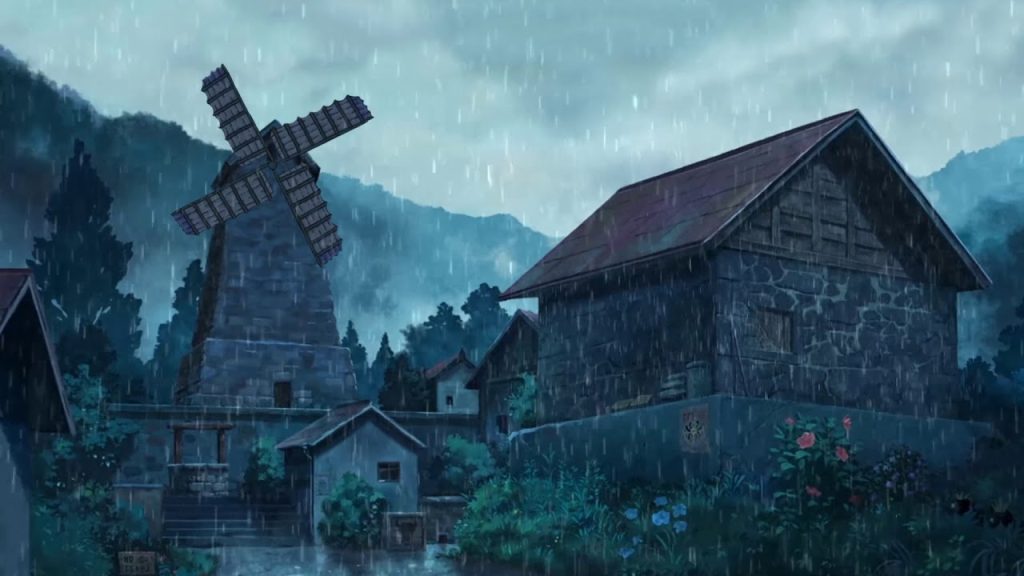
One of the most mysterious locations in all of Zelda. The combo of a windmill connected to a series of underground tunnels, a suspicious lone man playing music nonstop, its enigmatic tune and the events of the whole Song of Storms Saga make this part of the game one of the most remembered. The whole scenario manages to capture the surreal ‘Twin Peaks‘ vibe that the developers were aiming for. The windmill is also the most characteristic landmark of all Kakariko Villages across the series (although in the original there was just a weather vane).
In-game, the Song of Storms seems to have existed forever, without a composer; making the windmill of Kakariko Village go around and around. So, it’s no surprise the piece adheres to that narrative concept of circularity, since it forms the basis of one of the best uses of the time travel mechanic of the game. It is also the only one of the simple ocarina melodies that we learn as an adult.
As for the choice of music, it probably went like this:
—What can we add to make the town more picturesque and replace the weather vane?
—Hmm a windmill perhaps?
—Alright
—Hey windmills make me think of the Netherlands, why don’t we put an organ grinder player inside
—Kondo-san, go writhe some Dutch music please
Kondo proceeds to write one of the most memorable tracks on the soundtrack, one of those haunty melodies that only needs a few seconds to remain forever around..and around.
Musical Analysis
Structure: Section 0 / Section 1 / Section 2
Time Signature: 3/4 (6/8)
Tempo: 100
Melodic and Harmonic Profiles: D Dorian; D Aeolian/Minor; D Melodic Minor
Windmills, wooden shoes and barrel organs playing oom-pah rhythms are ingrained on the culture of the Dutch people. Thus it’s not a stretch to suggest that the piece was born after the connection between windmills and the Netherlands was made. Just listen to what their traditional folk music sounds like:
The accordion and the barrel organ are even still being used today in Dutch pop music, in a genre called Levenslied, which would be like the equivalent to country music in the United States.
The street barrel organ culture is unique to the Netherlands; there are even famous barrel organ museums over there. The organs are giant, with elaborate ornamentation and one of the tourist attractions from the country. A barrel organ man can always be seen standing on a corner of the street with his grinded instrument and a monkey, box in hand while shaking the coins in his money box.
Koji Kondo takes this music tradition and infuses it with a darkness and mystery, courtesy of his note choices; creating in the process one of the quintessential songs from Ocarina of Time. Another Kondo’s specialty, in less than 15 seconds he creates a piece that sounds catchy, happy, sad, and enigmatic at the same time.
He emulates what this mystic barrel organ would sound like (Is it diegetic or non-diegetic, is Guru-Guru playing this tune all along?) by combining the accordion with a very high pitched ocarina (it is an ocarina cue after all).
This short piece is just composed of two sets of question-answer blocks, where the question is always the Song of Storms and the answer phrases only differ in the way they end.
Koji is able to pull those different emotions in such a short time because the harmony selects notes from three different minor profiles: The Dorian profile (Em chord), the Aeolian/Minor profile (Bb chord) and the Melodic Minor profile (A chord). Like our windmill the harmony goes around and around going from Dm to Em and F and then circling back (Dm – Em – F – Em).
The composer himself had already used this Dorian progression combined with an oom-pah rhythm on a previous track from the Mario series:
The cadences of the phrases are with the VI – V – i. So Bb – A – Dm. The full progression that also goes in circles: Bb – F – Bb – A. The song is all about musical loops.
This song and the Lost Woods theme belong to a category of Kondo tunes we could call “whimsically sad”, that’s because the two themes share some DNA; both have rhythms with the tambourine we perceive as jolly—like bunnies jumping around on a meadow—as accompaniment and both use the same trick on their melodies: a descending minor chord with a minor sixth added; a trick that guarantees a burst of melancholy or mystique on whoever hears it. There is a reason why these two melodies often get singled out as fan favorites from the soundtrack. Listen to the piano figure on this song to hear the effect this chord has played as a melody:
The same figure appears on both the Song of Storms and Saria’s Song as the answer to the ocarina question motif that the player inputs.
The panning of the accompaniment accordion is dynamic, changing from right to left and vice versa, creating the effect of going in circles around and around, either mimicking how the instrument from the organ grinder rotates or that of the platform inside the windmill, just like the main accompaniment continues the circularity motif by going i-ii-III-ii-i
It’s an standout composition from both a musical and thematic point of view.

Help to keep the rites going around here by supporting the shrine:

Media Files, requests and support for more interactive content

Thou shall donate since this is a cult and you are now a sheep

Help staying awake analyzing game tracks and writing posts or else everything will end up being written by A.I
- Inside The Score – The Legend of Zeda: A Link to the Past – End Credits / Staff Roll
 The land rests As the last few minutes of this extensive journey that has now come to an end fly by, the nostalgia and reflective mood kicks in. Because such a massive enterprise as a Zelda game or a Lord of the Rings movie require multiple endings to convey everything… Read More »Inside The Score – The Legend of Zeda: A Link to the Past – End Credits / Staff Roll
 - Inside The Score – The Legend of Zelda: A Link to the Past – Ending / Epilogue ~ Beautiful HyruleFinal of the fantasy The Triforce has been touched. A wish has been granted. For the occasion, the newly undeceased king of Hyrule has commissioned a march in honor of the legendary hero to the Hylian Sousa, who might as well be composer Nobuo Uematsu since this piece is very… Read More »Inside The Score – The Legend of Zelda: A Link to the Past – Ending / Epilogue ~ Beautiful Hyrule
- Inside The Score – The Legend of Zelda: A Link to the Past – Triforce Chamber / Power of the GodsTake your boots off your feet And thus the Triforce spoke to men. And it became present in history. And you better treasure and contemplate this moment seldom witnessed in the course of the series. The elusive opportunity to interact and touch the most important artifact. You are now in… Read More »Inside The Score – The Legend of Zelda: A Link to the Past – Triforce Chamber / Power of the Gods
- Inside The Score – The Legend of Zelda: A Link to the Past – Ganon Battle / Prince of DarknessProgressive evil En Garde! And you better be prepared since you are about to duel the iconic enemy of the series at perhaps his canonically most powerful incarnation. Right after having touched the sacred Triforce which allowed him to conquer all of the Golden Land and whose evil and darkness… Read More »Inside The Score – The Legend of Zelda: A Link to the Past – Ganon Battle / Prince of Darkness
- Inside The Score – The Legend of Zelda: A Link to the Past – Boss Battle / Anger of the GuardiansQuick mayhem Ah, the simpler times when boss battles where not a multi epic orchestral suite but just an ostinato more basic that even what became the music for standard battle encounters out there. We are a long way from each boss having his own personalized track. And this early… Read More »Inside The Score – The Legend of Zelda: A Link to the Past – Boss Battle / Anger of the Guardians
- Inside The Score – The Legend of Zelda: A Link to the Past – Dark World Dungeon / Dungeon of ShadowsMemento mori We are getting closer to Ganondorf (or at least the wizard Agahnim who ultimately fulfills the same human side of evil role in this game) and that means getting closer to the profiles and motifs of his own theme song (which naturally was the theme of Agahnim at… Read More »Inside The Score – The Legend of Zelda: A Link to the Past – Dark World Dungeon / Dungeon of Shadows