Yearning for the semi-simple life
Ah! the peaceful, pastoral town of Kakariko Village. By now a staple in the Zelda series alongside its yearning music sensibilities. Everyone knows we can take a seat here and relax, preparing for the next travel (except that in Ocarina of Time, Kakariko Village actually hides a dark, dark secret underneath its tranquil facade)
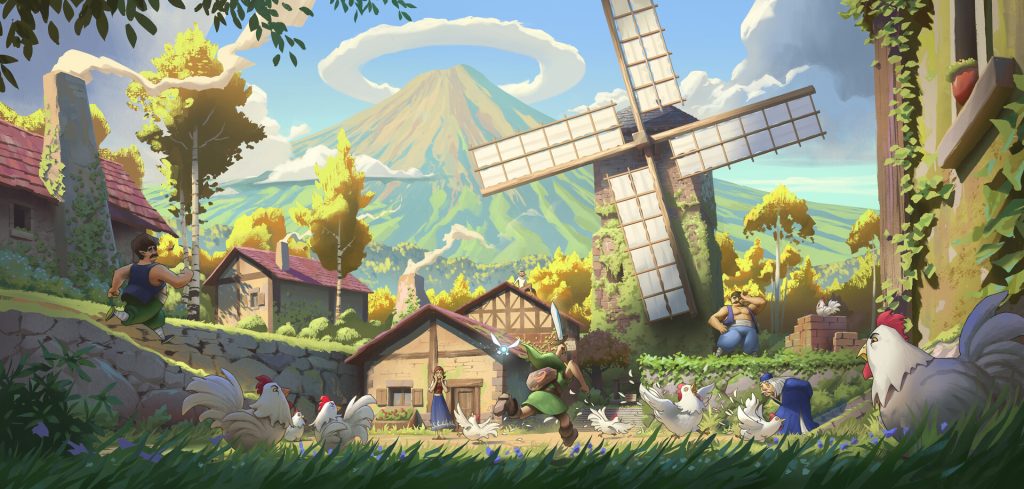
On the same boat as Princess Zelda’s Theme, the tune to the deceptively peaceful side town for the Hylians known as Kakariko Village due to the sound its most famous inhabitants make, the cuccos, also originated as a more romantic version played with strings in the previous game; not only that, like Zelda’s Theme it also has two different versions that convey the passage of time and how it generates changes, maturing the town. Only thing it does not have going on for it is that it was neglected as an ocarina melody—in any case the ocarina scale did not fit so it was impossible for it to be an ocarina tune. Well, at least here you learn three tunes and find the composer brothers who let the Sun’s song and these blog posts as their legacy after years of researching the music of Hyrule; they are probably the ones who composed the magical songs of the royal family.
Kakariko Village is the kind of horror movie town that looks like just a pastoral village but it is actually here where the sins of the royal family of Hyrule, perpetrated by the Sheikah monks are buried; it hides the dark side of the supposedly good guys making the Ocarina of Time world one more complex and real than the typical black and white fantasy. Even on the surface you can see something not quite right with this village such as the mad man at the windmill, the creepy Skulltula House, the potion shop and the graveyard—don’t forget the pinnacle of terror that are the chickens themselves. The horror elements will only get progressively more overt as you grow up. The developers of the game, ever since the Game Boy title Link’s Awakening have been trying to capture what they deem the Twin Peaks vibe, a famous series at the time that similarly had an apparent normal town in which its inhabitants slowly revealed that they had secrets and peculiarities of their own; suspicious characters is the term the developers use, in order to make them more ambiguous and quirky. Kakariko Village exemplifies this philosophy.
Like the town’s facade, the music hides this side of town by being just the sister cue to the Lon Lon Ranch one, the slice of Americana with the campfire instrumentation chosen is the most responsible for this. It i the kind of melody that is automatically nostalgic even if you are just hearing it for the first time. It brings to mind an old cowboy sitting with a guitar and another with an harmonica at the fence of some house (and of course Link joins them with his ocarina). Motifs of this this tune for such a recurrent location recur throughout the different versions of the town even if the actual tracks are very different—even the overtly Japanese cue from Breath of the Wild incorporates little motifs of this.
The piece is so relaxing that Koji Kondo did not even bother to make something else for the fishing pond.
Musical Analysis: Child Version
Structure: Section 0 / Section 1 / Section 2
Time Signature: 3/4 (6/8)
Tempo: Dynamic tempo (104 to 80)
Melodic and Harmonic Profiles: Bb Ionian/Major; Bb Aeolian Dominant (Part of Section 2)
Just like Princess Zelda’s Theme the new revamped Kakariko Village has the same chords but slightly more sophisticated. Yet, unlike the Princess Zelda’s Theme, this arrangement from Ocarina of Time does not deviate too much from the original in A Link to the Past— it substitutes a Gm7 chord for a G Major chord in Section 1 for example. We arrive at another music composition that has more modern sensibilities even though the setting is medieval—a traditional pop chord progression, for instance— But, as is common with Koji Kondo, chords get weirder with extensions by virtue of his melodic voice leading. In simplifying the main melody, the composer is free to create a more involved arpeggio below it. The accompaniment of the guitar is in 6/8 but the melody suggest a 3/4 meter.
When mimicking a guitar playing via sequencing you need to make sure the chord notes are sufficiently open in order to sound faithful to the instrument. Kondo manages to create a convincing guitar performance by knowing that this instrument usually plays the types of chords where the notes are at longer distances than on the piano, forming inversions and non-clustered chords—nevertheless, the exact progression would actually be technically impossible on a standard tuned guitar (or at least you would not be able to let all the notes ring on that F chord). The first part of the guitar arpeggio has a 6/8 feel, giving the piece that hammock feel, rocking back and forth. The main chord progression would be I – vi – ii – V heard on countless songs from modern popular music.The tempo of the piece is ultra dynamic ranging from 104 to 80, giving the impression that this is an actual guitar player playing the instrument on the garden outside his home while watching the cuccos. The actual harmony would be
Bb – Gm – C7sus4 – F7
B Sections usually go to the fourth and the coda of the main melody here goes to Eb. The harmony being
Eb – F – Bb – G – C7 – F – Bb
Section 2 also goes to the IV. The guitar accompaniment changes a little, picking now two note chords at the end of the arpeggio. It also makes chord changes each 2 bars at the beginning. Full Harmony would be:
Eb – Bb – Cm7 – F7 – Bb – Bb7
Eb – Bb – G – Cm – F – Bb
Same chords that end Section 1 but with the twist that the C is now minor. So some borrowed chords here that make the piece more sophisticated.The Bb7 also adds spice to the progression.
Both this piece and Lon Lon Ranch feel like the two American exchange students coming into this medieval kingdom with knowledge of instrumentation and jazzy harmony.
In-game the lead instruments have very expressive vibrato applied to make it even more emotional.
As has been noted previously, one of the strengths of Koji Kondo as a composer is having the capacity of creating bittersweet melodies; catchiness is only the tip of the iceberg. The sentiments of nostalgia Nintendo melodies conjures are not only due to memories of the games played, there is a quality to the melodies that manage to find that balance between happy and sad, infusing the music with a sense of melancholy—Other composers like Paul McCartney and the Swedish school of modern pop music have exploited these qualities that always seem to capture the hearts (and pockets) of people around the world, not even needing to speak the same language.
Is there a magic formula to these types of melodies? At the end of the day it is better to leave the question open and just hear and internalize these melodies, but that does not mean somebody out there has not tried to crack the code to the bittersweet factory machine.
There are some patterns that seem to infuse melodies with nostalgia. Beethoven for example has a tune that cadences in a similar fashion to that of Kakariko Village:
That ii – V – I with a descending melody on top seems to be very effective in pulling nostalgia strings.
And there is a reason why ‘Hey Jude’ is perhaps the most famous song of the most famous musical act, its bittersweet melody. As the lyrics of the song reveal: ‘take a sad song and make it better’, or for this purpose, take a sad song make it happier. If there is something close to a formula for “good music” or at least universality is that evasive quality of making it sound happy and sad at the same time.
So, what could be the secret behind these melodies like the one for Kakariko village? here are some ingredients:
- The Ionian/Major scale is a must, but how to make this happy mode sadder and not fall into children rhymes? Japanese composers have had the cheat code all along: major pentatonic melodies, especially when descending at the end of phrases. For example, here is a song that is bittersweet exactly because of this:
Japanese melodies often use pentatonic scales for the melodies which helps in not sounding too major and with some childish nostalgia
- Ending descending phrases with a perfect cadence. We find this in both Kakariko Village and Hey Jude. As said, that ii – V – I does heavy lifting.
Try playing a descending major pentatonic scale with the [V] chord underneath until the very last note, where you play the [I] and that’s it, you just gave nostalgia to yourself for absolutely no reason (you can also start a country group and spam this technique) sustain the penultimate note for maximum effect. Both Kakariko Village and Sukiyaki end phrases in this way.
- You obviously have to use those minor chords, a simple I – IV – V won’t cut it—okay maybe a vamp between the I and IV can be enough. Also, don’t pick all the minor chords of the scale or it will go the sad route; two of them will do the job. You can also borrow some chords sporadically from the parallel minor—pop music discovered this a long time ago and has exploited it ever since. The subdominant chord (IV) also always comes accompanied by the highest notes on the melody; the subdominant is the origin of the tension. As heard on The Beatles track, the Super Mario 64 End credits, the Shire theme from LOTR; all nostalgic themes.
Mixing some of these techniques guarantees a bittersweet effect. Are there other elements that infuse a piece with melancholy? Comment if you have additional ideas.
Music Analysis: Adult Version
For all of the desolation that welcomes the player once they arrive to this new Hyrule, Kakariko Village managed to stay strong all these years and it even evolved. Many of the people that lived in Hyrule Castle Town managed to flee and settle for a new life inside this apparently peaceful town.
Like Link himself, the town also has grown up since the times in which the hero used to visit it as a kid; houses have been built, shops have been opened and alongside the town, its music has also grown up.
No longer using instruments commonly associated with more juvenile, casual or amateur sensibilities, the new Kakariko Village cue has abandoned the ocarina, the harmonica and the guitar in favor of the strings and woodwinds of a professional orchestra, now closely resembling its original incarnation that appeared on ‘A Link to the Past’. Link simply does not have the time to relax here and play the ocarina with other happy-go-lucky townsfolk. In fact, he is about to start exploring the ghastly undergrounds of this Sheikah town, where he is about to learn that even the royal family of Hyrule has a darker side which is best left a secret.
The music will always be identified with Kakariko Village in future main Zelda games, even in very subtle ways; its main motifs are featured one way or another in The Wind Waker, Twilight Princess, Four Swords Adventures and as recent as Breath of the Wild.

Help to keep the rites going around here by supporting the shrine:

Media Files, requests and support for more interactive content

Thou shall donate since this is a cult and you are now a sheep

Help staying awake analyzing game tracks and writing posts or else everything will end up being written by A.I
- Inside The Score – The Legend of Zeda: A Link to the Past – End Credits / Staff Roll
 The land rests As the last few minutes of this extensive journey that has now come to an end fly by, the nostalgia and reflective mood kicks in. Because such a massive enterprise as a Zelda game or a Lord of the Rings movie require multiple endings to convey everything… Read More »Inside The Score – The Legend of Zeda: A Link to the Past – End Credits / Staff Roll
 - Inside The Score – The Legend of Zelda: A Link to the Past – Ending / Epilogue ~ Beautiful HyruleFinal of the fantasy The Triforce has been touched. A wish has been granted. For the occasion, the newly undeceased king of Hyrule has commissioned a march in honor of the legendary hero to the Hylian Sousa, who might as well be composer Nobuo Uematsu since this piece is very… Read More »Inside The Score – The Legend of Zelda: A Link to the Past – Ending / Epilogue ~ Beautiful Hyrule
- Inside The Score – The Legend of Zelda: A Link to the Past – Triforce Chamber / Power of the GodsTake your boots off your feet And thus the Triforce spoke to men. And it became present in history. And you better treasure and contemplate this moment seldom witnessed in the course of the series. The elusive opportunity to interact and touch the most important artifact. You are now in… Read More »Inside The Score – The Legend of Zelda: A Link to the Past – Triforce Chamber / Power of the Gods
- Inside The Score – The Legend of Zelda: A Link to the Past – Ganon Battle / Prince of DarknessProgressive evil En Garde! And you better be prepared since you are about to duel the iconic enemy of the series at perhaps his canonically most powerful incarnation. Right after having touched the sacred Triforce which allowed him to conquer all of the Golden Land and whose evil and darkness… Read More »Inside The Score – The Legend of Zelda: A Link to the Past – Ganon Battle / Prince of Darkness
- Inside The Score – The Legend of Zelda: A Link to the Past – Boss Battle / Anger of the GuardiansQuick mayhem Ah, the simpler times when boss battles where not a multi epic orchestral suite but just an ostinato more basic that even what became the music for standard battle encounters out there. We are a long way from each boss having his own personalized track. And this early… Read More »Inside The Score – The Legend of Zelda: A Link to the Past – Boss Battle / Anger of the Guardians
- Inside The Score – The Legend of Zelda: A Link to the Past – Dark World Dungeon / Dungeon of ShadowsMemento mori We are getting closer to Ganondorf (or at least the wizard Agahnim who ultimately fulfills the same human side of evil role in this game) and that means getting closer to the profiles and motifs of his own theme song (which naturally was the theme of Agahnim at… Read More »Inside The Score – The Legend of Zelda: A Link to the Past – Dark World Dungeon / Dungeon of Shadows