Primitive matter, Rock’n’Roll
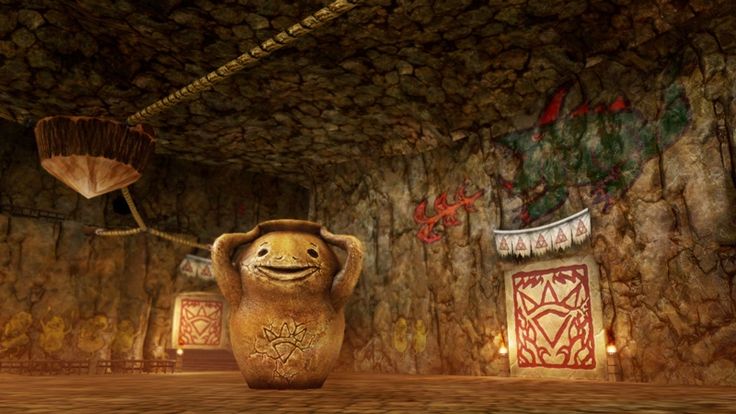
The rock people, coming directly from the earth and named after the Japanese onomatopoeia for boulders rolling down, the Goron tribe is the first of the nonhuman cultures Link encounters. He has to prove his worth before the patriarch and become a brother. They are literally one with nature and worship fire.
Ocarina of Time introduced important innovations to the Zelda series that went beyond the mere technical. On a conceptual level it introduced the notion of ‘culture’ to the franchise; bringing it closer to a true high fantasy work of fiction. Before Ocarina of Time, the series had certainly developed an important mythology (and we did have sort of the river Zora race), but it still had strong ties to standard fantasy fare and fairy-tale elements—knights, princesses, sorcerers and monsters populated Hyrule, and their roles were no different than in the folk tales that have been told countless times.
Yet, now we have races, with their own history, traditions and identity; closing the gap on seminal fantasy works like Tolkien’s Middle Earth and opening more complex narrative possibilities. Now there were true analogous to the races of, say, The Lord of the Rings, and their dynamics could be explored; the Kokiri are not far from the Hobbits, same with the Hylians and the humans, the Goron tribe thrives in the mountains and are expert blacksmiths in the same way as the Dwarfs, and the Elves find their counterparts in the form of the Zoras who live many years and thus are more sophisticated.
At the end of the day, since the Goron seem to be creatures in tune with their environment—they literally eat it—their main influences are all kinds of primeval tribes before the advent of kingdoms and civilizations. Like their music they seem to be like a mix of a bunch of tribal and indigenous people from various continents. This is even amplified in their more realistic depiction in Twilight Princess. They reliance on almost no clothing except for undergarments, their elder and patriarch based leadership, their body tattoo culture, pottery, pictorial drawings and their primitive and simple home carved directly into a volcano paints the Goron in the same light as other human tribes we might find in the wild such as Polynesians and various Native Americans. This is even more explicit also in the Twilight Princess region where actual Native Americans live on the town right at the side of Dead Mountain and we get various elders. On the other hand Polynesian cultures, particularly Native Hawaiians, have a deep and complex relationship with volcanoes, viewing them as living entities with distinct rights and responsibilities. Volcanoes are not just geological features for them, but are intertwined with their mythology, spirituality, and daily life.
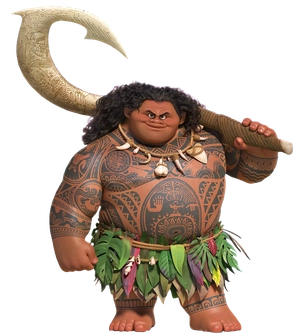
So Kondo was, naturally, entrusted with the task of giving a musical identity to the different races, an identity that is still maintained to the present day. He took it a little too literally, seeing these boulder creatures that roll down the mountain…he decided he should throw around some Rock ‘n’ Roll licks, obviously with characteristic tribal instrumentation from anywhere. In that sense the music ends up on the same boat as the Crash Bandicoot series soundtrack, whose Australian marsupial also inspired the tribal elements of that setting; this means lots of wood marimbas and percussion but both ended rocking too. The Rock ‘n’ Roll influences can also connect with Native Americans as just a music genre that came from that territory.
Musical Analysis
Structure: Section 0 / Section 1 / Section 2 / Section 3 / Section 4
Time Signature: 4/4
Tempo: 115
Melodic and Harmonic Profiles: C Mixolydian; C Blues
As a tribalistic race, the natural choice for the Gorons was ethnic music. Unlike on the West, where authenticity is more of a requirement—they would research a specific culture and base a concept around it— the developers on the Zelda team sometimes mix and match a patchwork of real cultures from around the world to infuse their own with exotic elements, Therefore it’s difficult to identify a single source of inspiration. Since the same goes for the music, the Goron theme ends with influences from African and South American traditions for the orchestration and some American blues based rock ‘n’ roll for the pun —although, to be fair, the same phenomenon happens in the real world too, where is difficult to track how cultures influence each other.
Thus, Goron City gets the generic direction of sounding “ethnic” and Koji Kondo does exactly that, focusing mostly on percussion. He buys a sample pack that contains a collage of world music instruments and, most likely, was inspired by the demo song that was included on the card. just listen to the demo from the ethnic pack from this Korg sample library:
As a tribal, dance loving race the music is also based around a marimba ostinato that serves for ritualistic and communal purposes, it is varied subtly throughout the piece to add interest. The blues based licks are repetitive and simple as if they are recurrent riffs that Goron play as mantras. The bass marimba provides a ritualistic semi-improvised accompaniment using mostly the pitches of a C7 chord, fitting for a tribe (Inside the Deku Tree and the grottoes in the earth also connect with nature via a single dominant seventh chord).
The emphasis on the [Bb] note and the omission, for the most part, of the [A] note gives the piece a more bluesier feel than the more pure Mixolydian mode we find in sections of the Kokiri Forest.
The sound that ended being the most identifying feature of the Goron tribe is the Brazilian cuica (some people to this day believe that Gorons produce this sound themselves); also called monkey drum, the cuica is a friction drum where the movement of a rope against a frame produces its characteristic sound. With the marimbas it creates a call and response dynamic. The marimbas are the kind of unrefined ones a tribe would produce made with larger wood blocks and any support unlike the slick design of the orchestral one. Just like their home, the music is constructed with easy to construct resources.
The conga glissando is a technique that is also better shown than explained.
In any case the Goron are musical people, and they are specially in tune with a song that comes from one strange passage on their lair. It is an infectious melody that somehow ended up magically traveling not only from the forest to Goron City but also to our real world, bringing joy to both virtual and tangible people.

Help to keep the rites going around here by supporting the shrine:

Media Files, requests and support for more interactive content

Thou shall donate since this is a cult and you are now a sheep

Help staying awake analyzing game tracks and writing posts or else everything will end up being written by A.I
- Inside The Score – The Legend of Zeda: A Link to the Past – End Credits / Staff Roll
 The land rests As the last few minutes of this extensive journey that has now come to an end fly by, the nostalgia and reflective mood kicks in. Because such a massive enterprise as a Zelda game or a Lord of the Rings movie require multiple endings to convey everything… Read More »Inside The Score – The Legend of Zeda: A Link to the Past – End Credits / Staff Roll
 - Inside The Score – The Legend of Zelda: A Link to the Past – Ending / Epilogue ~ Beautiful HyruleFinal of the fantasy The Triforce has been touched. A wish has been granted. For the occasion, the newly undeceased king of Hyrule has commissioned a march in honor of the legendary hero to the Hylian Sousa, who might as well be composer Nobuo Uematsu since this piece is very… Read More »Inside The Score – The Legend of Zelda: A Link to the Past – Ending / Epilogue ~ Beautiful Hyrule
- Inside The Score – The Legend of Zelda: A Link to the Past – Triforce Chamber / Power of the GodsTake your boots off your feet And thus the Triforce spoke to men. And it became present in history. And you better treasure and contemplate this moment seldom witnessed in the course of the series. The elusive opportunity to interact and touch the most important artifact. You are now in… Read More »Inside The Score – The Legend of Zelda: A Link to the Past – Triforce Chamber / Power of the Gods
- Inside The Score – The Legend of Zelda: A Link to the Past – Ganon Battle / Prince of DarknessProgressive evil En Garde! And you better be prepared since you are about to duel the iconic enemy of the series at perhaps his canonically most powerful incarnation. Right after having touched the sacred Triforce which allowed him to conquer all of the Golden Land and whose evil and darkness… Read More »Inside The Score – The Legend of Zelda: A Link to the Past – Ganon Battle / Prince of Darkness
- Inside The Score – The Legend of Zelda: A Link to the Past – Boss Battle / Anger of the GuardiansQuick mayhem Ah, the simpler times when boss battles where not a multi epic orchestral suite but just an ostinato more basic that even what became the music for standard battle encounters out there. We are a long way from each boss having his own personalized track. And this early… Read More »Inside The Score – The Legend of Zelda: A Link to the Past – Boss Battle / Anger of the Guardians
- Inside The Score – The Legend of Zelda: A Link to the Past – Dark World Dungeon / Dungeon of ShadowsMemento mori We are getting closer to Ganondorf (or at least the wizard Agahnim who ultimately fulfills the same human side of evil role in this game) and that means getting closer to the profiles and motifs of his own theme song (which naturally was the theme of Agahnim at… Read More »Inside The Score – The Legend of Zelda: A Link to the Past – Dark World Dungeon / Dungeon of Shadows