Imperial march
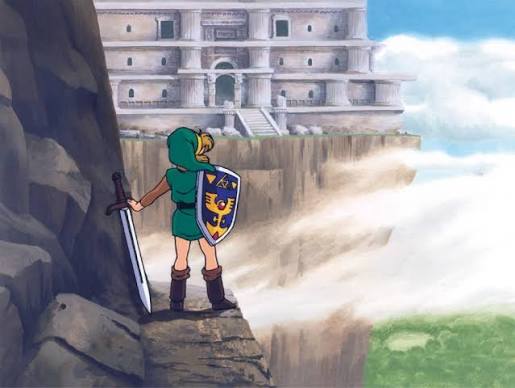
Subtlety and ambiguity are no more. We are now fully immersed into the Dark World and, literally, we are now in the end game here, fully committed to war; Ganon ought to be slashed and his army destroyed.
This is all back in the day, when the base of operations of Ganon was located at the appropriately named Death Mountain as established in the original Legend of Zelda; this terrain used to be Ganon’s own Mordor. Friendly Gorons that do not resonate with this unsubtle name were not yet in the picture and the Death Mountain name went on to be associated more for its environmental hazards than for being the location of Ganon and his troops.
As we are in Ganon’s territory we get his own version of the Imperial March from the Star Wars series, associated with Darth Vader and his minions. If it weren’t for the fact that Ganon gained a more restrained, sinister theme no doubt this would have become his signature tune just like it happened for the main bad guy of the space opera. Maybe we could say that this theme represents his army, codename: the Black Mist due to the darkness that wraps wherever they are located (not recommended for stealth soldiers). Except for the fact that its Section 2 represents the honor of the other side of the war, the opposing faction of the hero and Hyrule who still need to partake in the ugly business of war that sometimes is a necessary evil if done for the right reasons. Section 1 is the dark side, Section 2 the honorably side of the conflict; but a conflict nonetheless.
Musical Analysis
The doom of the Imperial March from Star Wars naturally come from its minor profiles and the fact that its main motif, that is also appropriately reproduced here for a place called Death Mountain, quotes Chopin’s Marche Funebre, a funeral march which for a time became shorthand snippet for dying in all kinds of early video games (with lack of proper composers and just a bunch of programmers doing the music the path of least resistance was to arrange public domain tunes); the intervals of the Death Mountain cue are not exactly the same as the Imperial March though because here the motif follows a C minor chord. Other references that the music of Star Wars uses are the Planets suite, specially Mars the bringer of war. The use of a march for armies is self explanatory. Same for huge drums and brass. The composer of Death Mountain might have also relied on the Symphony From the New World of Antonin Dvorak, specially for the cadences of phrases.
Just like the Dark World dungeons which are also more standardly evil, this tune is fully committed to minor profiles. And, due to its influences, is one of the most Hollywood inspired tunes in Zelda; or more Western Classical than the jazzy chords that are often brought in. It is a classic epic cue based on C minor. No more of that major/minor ambiguity (well, except for one chord that represents the hero). Still, we get some borrowed notes that make proceedings more spicy, wicked and interesting such as the tritone note Gb which lends its dissonance to the vamp between Cm and Ebm that serves as the main ostinato and opens the piece and is also featured as an ornamental note in the melody bordering the G natural alongside the Ab.
The melody is harmonized in sixths and fifths by a second trumpet. The second trumpet changes from right to left in the stereo spectrum after playing a phrase. Harmony wise we get only two notes to work with in the low end, giving us a Phrygian ptogression Cm to Db. Like other minor based composition we get an interplay between the natural minor profile and the harmonic minor one, with the cadences of the melody using the B natural note and its accompanying Bdim chord. The full progression would be:
Cm – Db – Cm – Cm – Ab – Bdim – Cm
The melodic phrase then responds in a completely symmetrical way, reusing its exact same question-answer blocks.
The honor based section is played with the more mellow strings. One with the main melody and the second with a countermelody. This epic section has a more classic epic harmony that moves in fourths. The heroism is conveyed by the C now in its major form kickstarting the progression C – Fm – Bb – Eb – Ab – Bdim – G7 – Cm. The G7 from the harmonic minor profile bringing us back to the C minor that opens the loop. It is a progression that fits nicely with a descending melody line such as this one that repeats the same phrase lower and lower. If this progression sounds familiar is because it is reminiscent of a common four chord progression such as the popular song I Will Survive by the convenient named Gloria Gaynor—which is totally the mindset our pink haired weirdo should have in this place—and the Zelda series ‘own Milk Bar tune in Majora’s Mask during its second section. A very emotionally charged progression indeed for an emotional final stretch for the game. You can do It.
Any other tracks from the soundtrack missing? Please share any other insight or memory from this score.

Help to keep the rites going around here by supporting the shrine:

Media Files, requests and support for more interactive content

Thou shall donate since this is a cult and you are now a sheep

Help staying awake analyzing game tracks and writing posts or else everything will end up being written by A.I
- Inside The Score – The Legend of Zeda: A Link to the Past – End Credits / Staff Roll
 The land rests As the last few minutes of this extensive journey that has now come to an end fly by, the nostalgia and reflective mood kicks in. Because such a massive enterprise as a Zelda game or a Lord of the Rings movie require multiple endings to convey everything… Read More »Inside The Score – The Legend of Zeda: A Link to the Past – End Credits / Staff Roll
 - Inside The Score – The Legend of Zelda: A Link to the Past – Ending / Epilogue ~ Beautiful HyruleFinal of the fantasy The Triforce has been touched. A wish has been granted. For the occasion, the newly undeceased king of Hyrule has commissioned a march in honor of the legendary hero to the Hylian Sousa, who might as well be composer Nobuo Uematsu since this piece is very… Read More »Inside The Score – The Legend of Zelda: A Link to the Past – Ending / Epilogue ~ Beautiful Hyrule
- Inside The Score – The Legend of Zelda: A Link to the Past – Triforce Chamber / Power of the GodsTake your boots off your feet And thus the Triforce spoke to men. And it became present in history. And you better treasure and contemplate this moment seldom witnessed in the course of the series. The elusive opportunity to interact and touch the most important artifact. You are now in… Read More »Inside The Score – The Legend of Zelda: A Link to the Past – Triforce Chamber / Power of the Gods
- Inside The Score – The Legend of Zelda: A Link to the Past – Ganon Battle / Prince of DarknessProgressive evil En Garde! And you better be prepared since you are about to duel the iconic enemy of the series at perhaps his canonically most powerful incarnation. Right after having touched the sacred Triforce which allowed him to conquer all of the Golden Land and whose evil and darkness… Read More »Inside The Score – The Legend of Zelda: A Link to the Past – Ganon Battle / Prince of Darkness
- Inside The Score – The Legend of Zelda: A Link to the Past – Boss Battle / Anger of the GuardiansQuick mayhem Ah, the simpler times when boss battles where not a multi epic orchestral suite but just an ostinato more basic that even what became the music for standard battle encounters out there. We are a long way from each boss having his own personalized track. And this early… Read More »Inside The Score – The Legend of Zelda: A Link to the Past – Boss Battle / Anger of the Guardians
- Inside The Score – The Legend of Zelda: A Link to the Past – Dark World Dungeon / Dungeon of ShadowsMemento mori We are getting closer to Ganondorf (or at least the wizard Agahnim who ultimately fulfills the same human side of evil role in this game) and that means getting closer to the profiles and motifs of his own theme song (which naturally was the theme of Agahnim at… Read More »Inside The Score – The Legend of Zelda: A Link to the Past – Dark World Dungeon / Dungeon of Shadows