“Bah-Dum-Dum Bah-Dum DUM-Dum” Everyone’s head right now
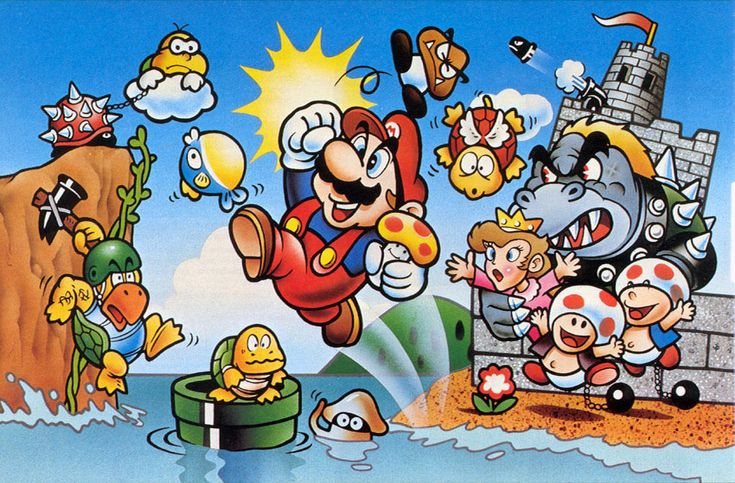
“If somewhere in your mind you have an image that Mario is cute, please get rid of it. Mario is cool!”
Koji Kondo
Now we can finally tackle some music. Of course we could not let go of somehow making space for arguably the most iconic piece of video game music ever written, even if so much has been said and written about it that it’s difficult to contribute more without restating trite exclamations. For starters, it is not a stretch to even say that it might be one of the most famous pieces of music from the 20th century and beyond, heard countless of times just going by its functional role as a gameplay cue; just reflect on how many hours people have spent listening to this piece and you can begin to formulate an argument for it being one of the most heard compositions overall. Known across multiple demographics even outside video games and whose infecting melody has been arranged in many ways throughout the eras since its inception in 1985, the Mario theme is a staple across both the western and eastern hemispheres; few tunes can claim that. Officially known as the ‘Ground Theme’, the main theme of the Super Mario series was composed by Nintendo in-house sound designer Koji Kondo for the 8-bit NES game Super Mario Bros, becoming an instant classic and pretty much the anthem of video game music, to the point that In 2023, the theme was chosen by the U.S. Library of Congress as the first ever video game recording selected for inclusion in the National Recording Registry. It could not be any other choice.
So what new insights can we add? Suffice to say that the track is all about the synergy between Mario movements, a character all about jumping and running, and the heavily syncopated rhythms of the melodies found. The music also has to be somewhat sophisticated which is what the quote above, what Kondo tells to anyone who is about to do Mario music, means; when composers see the world of Mario they see a bunch of cute creatures, but Koji Kondo wants them to treat the music seriously, not like a children’s cartoon. It should be music that you actually want to listen to.
The theme is set in the key of C major, as is all the rest of the soundtrack for the original game, and curiously features a swing feel only in the percussion with prominent use of Latin rhythms. It is often scored as a calypso song led by steel drums, just like the ones heard on this arrangement:
It was one of six themes composed for the original NES game by Kondo, who found it to be the most difficult track to create. In fact, there were a couple of discarded early versions where the composer made the mistake of letting the background environment speak as opposed to the action of the character and rhythm of the gameplay. After seeing that the laidback, pastoral direction would not cut it, Kondo then zeroed on the jumping action to create a fast paced tune heavily syncopated; however, from that early theme he retained the cha-cha swing of the “drum kit” (just the noise channel of the Famicon), making a Frankenstein where melody and harmony are not played with swing but the percussion is. This adds to the bounciness of the melody. Rhythmically, this creates enormous variation within the piece, with swing rhythms on the drums while the melodies are in straight notes.
This amplifies the bouncy sensation because that is what this cue is all about after all: the Mario brothers’ movements which are based around the concept of jump; there is a reason why this plumber carried himself under the name of Jumpman in his early working days. This rhythmic disjoint alongside the heavy emphasis on syncopation follows closely the typical movements of Mario during a playthrough, like avoiding enemies or strolling through mushrooms. Finally, the piece employs modal mixture in order to take Mario into other musical territories.
As was said, the thought process behind the piece was to mimic the action, not the environment. It was the very last level track put together for the original game after various iterations—the water level came first since a waltz for floating was a no brainer— the earlier version was discarded precisely because it mimicked the relaxed, blue sky Mushroom Kingdom instead of the frenetic movements of the plumbers through it. Kondo described this early theme as a bit lazier, slower tempo, and more laid back. As the game underwent changes, he realized that his theme no longer fit, so he increased the pace and changed it around to fit better. From this version we only know that it was slower and that he took the swinging drum pattern and repurposed it for the new melody as an experiment that paid off.
It seems that from the beginning Kondo had in mind the sounds of Caribbean music like reggae, soca and calypso, which technically make the Super Mario Bros main theme the most popular Reggaeton track almost 10 years before the genre appeared on the map.
This is what the Ground Theme might have originally sounded like:
Even the clave pattern characteristic of Latin music and all about that bounce colors the first few bars of the melody (two dotted quarter notes plus a quarter will do). Although tt has been noticed, even by Koji Kondo himself, that the piece has influences from the 1984 song “Sister Marian” by T-Square, a Japanese fusion band that is a favorite of Kondo
This is also probably reminiscent of how the original, early version of the piece sounded, just accompanying the background blue sky and green mountains that inspired the composer to make a laidback tune. The theme we ended up with borrows the first part of the A phrase from a figure heard in that T-Square tune by the one minute mark, just to kickstart the melody and then take it to other places.
The harmony uses the limited 3 channels of the NES to create interesting chord voicings which are by necessity incomplete and mostly employed as the spaced out melody lines. The bass is a melody in itself, creating interesting counterpoint parts that help to make the music richer considering the limited sounds that were available. Counterpoint and fast arpeggios were the law of the land for chiptunes since they give the illusion of—ok, they actually are—more complexity.
What makes the piece more than just a pleasant major tonality song is the bVI – I progression during the C section and the debut of the Mario cadence (bVI -bVII – C) that ends the B section. Let’s go into proper detail
Musical Analysis
- Composer: Koji Kondo
- Structure: Intro – {ABC – ADCD}
- Harmonic and Melodic Profiles: C Ionian/Major; C Aeolian/MInor
Please stand up for the anthem of video game music, here recreated at its most primordial form, the 8 bit orchestra that embedded its bleeps and blows into the minds of people around the world and kickstarted the Mario craze.
The piece may be the most complex one of the Mario main tunes; for some reason Koji Kondo dialed down on the amount of structure in future pieces, this one being one of the few that reaches the D section. Not only that but the way the 4 sections are organized make use of repetition strategically in order to leverage the limited amount of memory at the time in a way that listeners would not notice; almost subliminally. Sections often appear in new contexts, one moment the C Section follows the B section but in other instance it follows the D section, which itself was originally heard following the A Section but now is put after the C Section and so on. It is like seeing the same object from different angles and getting more mileage out of the short amount of original material that is really there. It is also one of the only Mario pieces that does not abandon its Intro after kickstarting the piece, deploying it inside the tune as the cadence of the C Section; future Mario titles keep the idea of the immediate, ear grabbing Intro but then never use it again within the piece.
Of course while the original theme is composed within the sound limitations of the NES’s 8-bit hardware, in later installments with more powerful sound hardware it is scored as the intended calypso song led by steel drums it was all along. In the NES era you were stuck with five channels at the same time, which made composers aware that they better come up with a good melody since there is no way to hide behind epic orchestration or production tricks; musicality is all you got to work with. Here is a brief explanation of how the channels of this 8-bit machine worked:
Other composers pushed the NES capabilities to the limit and found neat production tricks to vary its sound palette even more, Kondo was happy to just stick with his melodic intuition, playing around with rhythm and balance between repetition and variety. He did not use the fifth sampler channel for musical purposes until Super Mario Bros 3 where the cartridge had more memory. He also did not vary the duty cycle of the wave, leaving it at 50%. Even sound effects needed to be done with these sounds so whenever you hear an effect, the music changes accordingly to accommodate it, creating a musical vacuum. Suffice to say that 8-bit music is a window into music at its more barebones form, distilling it to its essential components: Melody, Accompaniment, Bass and Percussion. No matter how many instruments a piece has or how overwhelming it may seem, every single sound can be classified under one of those parameters, just make sure to play around with those roles.
Each section also presents different performance options for the rhythmic section composed of the drums and bass. During the Intro and A section the bass is not a bass but rather the third voice of a three part harmony; it then changes to proper bass role with a counterpoint melody of its own during the remaining sections. Meanwhile the drum beat made with noise that simulates a kick drum, a snare drum and a closed hi-hat varies its patterns. During the A and B section you can see its skipping movement mimicking a happy, bouncy walk, then it becomes more aggressive with straight sixteenth notes on the C section, with the final reggaeton beat summoned for the last section.
The harmony of the full piece is based mainly around the I-IV-V (there is not a single minor chord there, just pure bounciness), although there is a lot of chromaticism in the piece. It could be thought of as something like this:
[Intro]
D7 – G The D here functions as the dominant of G, so a secondary dominant of C
[A]
C – F – C – F – C – G
[B]
C – F – C – F
C – F – Ab – Bb – C
[C]
Ab – C – Ab – C
Ab – C – D7 – G
[D]
C – F – G – C
Pretty much all the songs of the original Super Mario Bros are in the key of C; perhaps it was easier to compose code for the NES with this scale.
So yeah, Koji Kondo would still pretty much be famous if he had not composed anything more after Super Mario Bros. It is the biggest legacy of the composer and where he got the feeling for what makes not only good music but good game music specifically.

Help to keep the rites going around here by supporting the shrine:

Media Files, requests and support for more interactive content

Thou shall donate since this is a cult and you are now a sheep

Help staying awake analyzing game tracks and writing posts or else everything will end up being written by A.I
- Inside The Score – The Legend of Zeda: A Link to the Past – End Credits / Staff Roll
 The land rests As the last few minutes of this extensive journey that has now come to an end fly by, the nostalgia and reflective mood kicks in. Because such a massive enterprise as a Zelda game or a Lord of the Rings movie require multiple endings to convey everything… Read More »Inside The Score – The Legend of Zeda: A Link to the Past – End Credits / Staff Roll
 - Inside The Score – The Legend of Zelda: A Link to the Past – Ending / Epilogue ~ Beautiful HyruleFinal of the fantasy The Triforce has been touched. A wish has been granted. For the occasion, the newly undeceased king of Hyrule has commissioned a march in honor of the legendary hero to the Hylian Sousa, who might as well be composer Nobuo Uematsu since this piece is very… Read More »Inside The Score – The Legend of Zelda: A Link to the Past – Ending / Epilogue ~ Beautiful Hyrule
- Inside The Score – The Legend of Zelda: A Link to the Past – Triforce Chamber / Power of the GodsTake your boots off your feet And thus the Triforce spoke to men. And it became present in history. And you better treasure and contemplate this moment seldom witnessed in the course of the series. The elusive opportunity to interact and touch the most important artifact. You are now in… Read More »Inside The Score – The Legend of Zelda: A Link to the Past – Triforce Chamber / Power of the Gods
- Inside The Score – The Legend of Zelda: A Link to the Past – Ganon Battle / Prince of DarknessProgressive evil En Garde! And you better be prepared since you are about to duel the iconic enemy of the series at perhaps his canonically most powerful incarnation. Right after having touched the sacred Triforce which allowed him to conquer all of the Golden Land and whose evil and darkness… Read More »Inside The Score – The Legend of Zelda: A Link to the Past – Ganon Battle / Prince of Darkness
- Inside The Score – The Legend of Zelda: A Link to the Past – Boss Battle / Anger of the GuardiansQuick mayhem Ah, the simpler times when boss battles where not a multi epic orchestral suite but just an ostinato more basic that even what became the music for standard battle encounters out there. We are a long way from each boss having his own personalized track. And this early… Read More »Inside The Score – The Legend of Zelda: A Link to the Past – Boss Battle / Anger of the Guardians
- Inside The Score – The Legend of Zelda: A Link to the Past – Dark World Dungeon / Dungeon of ShadowsMemento mori We are getting closer to Ganondorf (or at least the wizard Agahnim who ultimately fulfills the same human side of evil role in this game) and that means getting closer to the profiles and motifs of his own theme song (which naturally was the theme of Agahnim at… Read More »Inside The Score – The Legend of Zelda: A Link to the Past – Dark World Dungeon / Dungeon of Shadows


Oh my goodness! Incredible article dude! Many thanks, However I am experiencing problems with your RSS. I don’t understand the reason why I cannot join it. Is there anybody having the same RSS issues? Anyone that knows the solution will you kindly respond? Thanx!!
What do you mean? Like problems in subscribing? I will need to check that out to see what seems to be the problem. Tell if you manage to sove it from your end